
🪄 AI Summary
Heading 1
Heading 2
Heading 3
Heading 4
Heading 5
Heading 6
Lorem ipsum dolor sit amet, consectetur adipiscing elit, sed do eiusmod tempor incididunt ut labore et dolore magna aliqua. Ut enim ad minim veniam, quis nostrud exercitation ullamco laboris nisi ut aliquip ex ea commodo consequat. Duis aute irure dolor in reprehenderit in voluptate velit esse cillum dolore eu fugiat nulla pariatur.
Block quote
Ordered list
- Item 1
- Item 2
- Item 3
Unordered list
- Item A
- Item B
- Item C
Bold text
Emphasis
Superscript
Subscript
Every funded startup has a podcast episode sitting in a folder doing nothing. That's a pipeline problem. Podcast repurposing transforms a single 40-minute recording into LinkedIn clips, audiograms, blog posts, sales enablement assets, and YouTube Shorts that educate buyers week after week. This guide is my step-by-step playbook for turning your startup's podcast library into a full-stack demand generation engine, built specifically for founders, marketing heads, and growth teams who need ROI, not just reach.
TL;DR
- Podcast repurposing multiplies one episode into 15–20 buyer-facing assets across every channel where your ICP lives.
- A systematic workflow beats ad-hoc clipping every time: record → transcribe → atomize → distribute → measure.
- The right tool stack (Riverside.fm, Descript, Transistor.fm) removes 70% of the manual production burden.
- Startups that build repurposing into their content marketing strategy use podcasts as a pipeline asset, not just a brand play.
What Is Podcast Repurposing and Why Does It Matter for Funded Startups?
Podcast repurposing is the systematic process of taking a long-form audio or video episode and breaking it into targeted short-form assets: video clips, audiograms, quote cards, blog posts, show notes, email sequences, and sales enablement snippets. For venture-backed startups, it's not a nice-to-have, it's a force multiplier on content you've already paid to produce.
Here's why it matters right now. B2B podcasts are no longer side projects or brand experiments. They are a core part of communication, marketing, and authority building. But most startup teams record an episode, publish it on Buzzsprout or Anchor by Spotify, share it once on LinkedIn, and move on. That's leaving a real pipeline on the table.
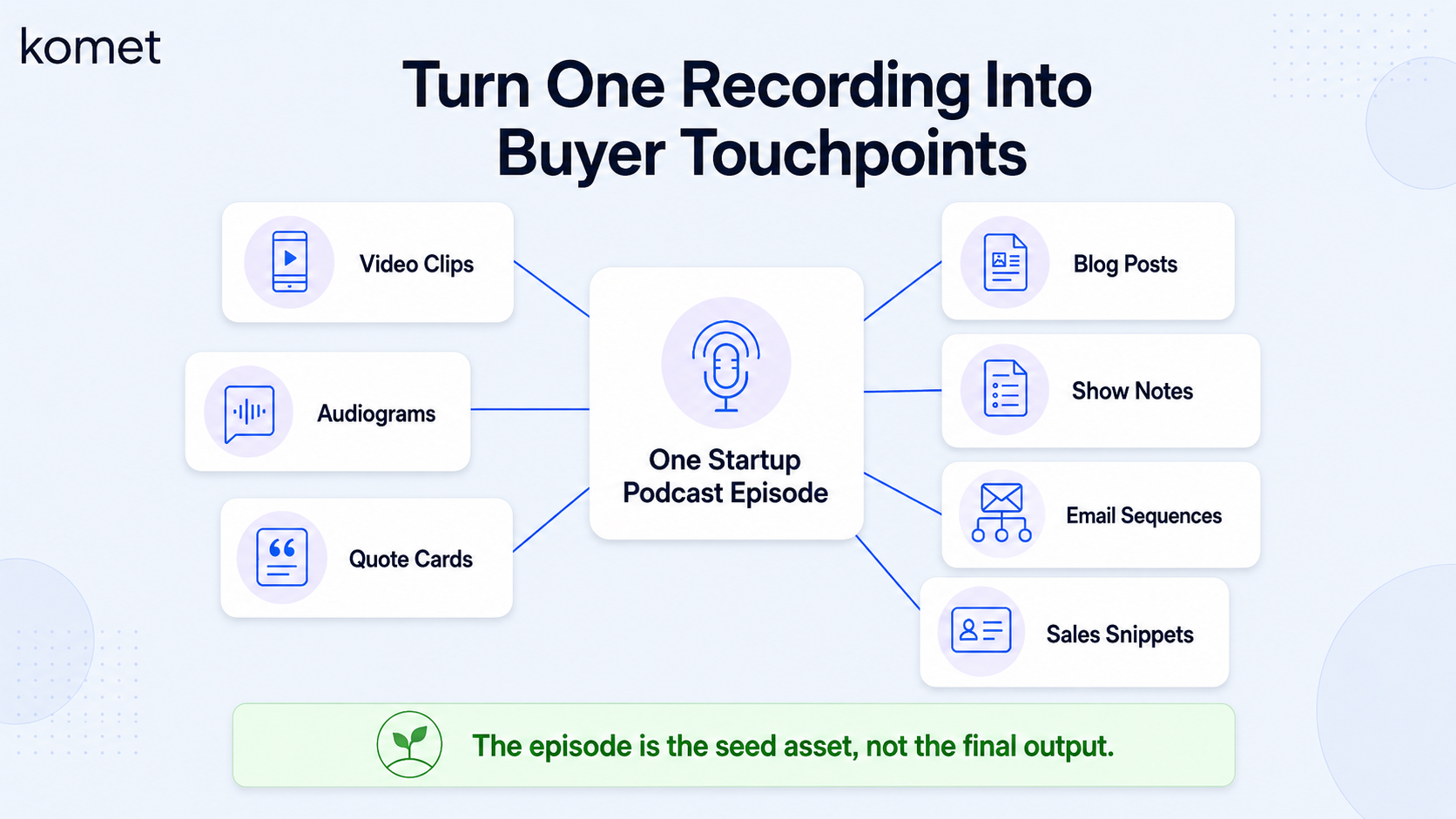
One 2025 CoHost study notes that 85% of companies capture video when producing podcasts, and 65% of showrunners post short clips weekly. The teams distributing clips consistently are the ones winning algorithmically and in front of buyers. The compounding case is even stronger. After hearing podcast episodes, 61% of podcast listeners feel more favorable toward a brand, and companies with branded podcasts achieve 89% higher brand awareness and 57% higher brand consideration.
That's the trust dynamic funded B2B SaaS teams are desperately trying to build with cold outbound and paid ads, and podcast content delivers it organically. This multi-purpose use is what makes podcasts so effective. They aren't just content; they are brand assets that can be repurposed across marketing channels.
Podcast repurposing is how you activate that asset. For early-stage startups especially, when potential customers research the space, they keep encountering helpful content by the founder or team, building trust, and for early-stage startups, this strategy is cost-effective marketing, trading time and expertise for reach rather than pure ad spend. That's the core value proposition: one recording session, dozens of buyer touchpoints, zero incremental production budget.
The Podcast Repurposing Strategy for Startups: How to Think About It
Before you clip anything, you need a framework. Random repurposing produces random results. A proper podcast repurposing strategy starts with understanding which episodes serve which funnel stages, then mapping derivative assets to buyer intent.
The Content Atomization Model is the mental model I use with every client at Komet Media:
- Identify your seed episode: Not every episode is equally repurposable. Prioritize episodes that address a specific buyer pain, product outcome, or founder point of view.
- Map assets to funnel stages: Top-of-funnel gets thought leadership clips and audiograms. Middle gets educational short videos and blog explainers. Bottom gets product demo moments and customer story clips.
- Assign channel homes: LinkedIn Video Strategy for B2B decision-makers, YouTube Shorts Optimization for search and discovery, TikTok for Business for brand-building among younger SaaS buyers.
- Set a distribution cadence: Batch-process one episode into 15 assets, then distribute over 3–4 weeks. This creates consistency without requiring constant recording.
- Track pipeline attribution: Use UTM parameters on every asset. Link repurposed content to demo requests, not just impressions.
From a single 30-minute recording, you can extract 3 LinkedIn articles, 10 social posts, 5 email sequences, 2 blog posts, and 15 sales enablement assets. That's a 30x content multiplier from one session.
The strategic advantage for funded startups is reach without proportional spend. Companies with sophisticated B2B podcast marketing strategies generate 3x more qualified pipeline than those chasing audience size. Strategy beats volume every time.
Also consider the Thought Leadership Distribution angle: investor relations content, board update decks, and partner communications can all be seeded from podcast insights, making your content library work for multiple audiences simultaneously.
Best Podcast Repurposing Tools for Funded Startups
The right tool stack does most of the heavy lifting. Here's how the key platforms compare:
Descript automatically generates editable transcripts that can be turned into show notes, blog posts, or captions, while Riverside also provides automatic transcriptions and clip generation, making it easier to create short-form social media content.
The key difference between the two leading tools: both platforms leverage AI, but Riverside uses it for content repurposing, while Descript employs AI for enhancing and fixing content.
For funded startups that care about clip quality and downstream editing, Descript's text-based editing workflow is the stronger choice for post-production. One of Riverside's standout features is how it handles clip creation; after recording, Riverside automatically creates clips, shorts, and longer segments without any prompting.
For podcast production and podcast editing, my recommendation is to use Riverside.fm for recording and Descript for editing and asset creation. AI transcription tools handle the tedious middle layer so your team focuses on creative decisions, not mechanical tasks.
Step-by-Step Podcast Repurposing Workflow for Early-Stage Startups
This is the exact workflow I run for B2B SaaS clients:
- Record with Riverside.fm: Capture separate local tracks for each speaker in 4K video. This protects quality even on poor connections and gives you clean audio per speaker for editing.
- Export and transcribe in Descript: Import your recording. Descript's AI transcription generates a full, editable transcript in minutes. Clean filler words automatically.
- Identify your "golden moments": Scan the transcript for a punchy insight, a counterintuitive claim, or a buyer pain articulated clearly. These become your short-form clips.
- Create 3–5 video clips per episode: Cut 60–90 second vertical clips for LinkedIn Video and YouTube Shorts. Add captions, open-mouth silence kills retention.
- Generate an audiogram: Pull 30–60 seconds of high-signal audio. Pair it with a branded waveform graphic. Distribute via LinkedIn and embed in podcast show notes.
- Write the blog post from the transcript: Use the transcript as your draft. Restructure for SEO. Add headers, pull quotes, and internal links. This is evergreen content that ranks for months.
- Build the email sequence: Extract 3 key insights from the episode and write a 3-email nurture sequence. Gate a clip or insight behind a CTA pointing to your demo page.
- Publish and distribute: Push to Transistor.fm or Buzzsprout. Post clips natively on LinkedIn and as YouTube Shorts. Seed in relevant Slack communities.
- Track and attribute: Tag all assets with UTMs. In HubSpot Content Hub, link asset views to contact records and pipeline stages.
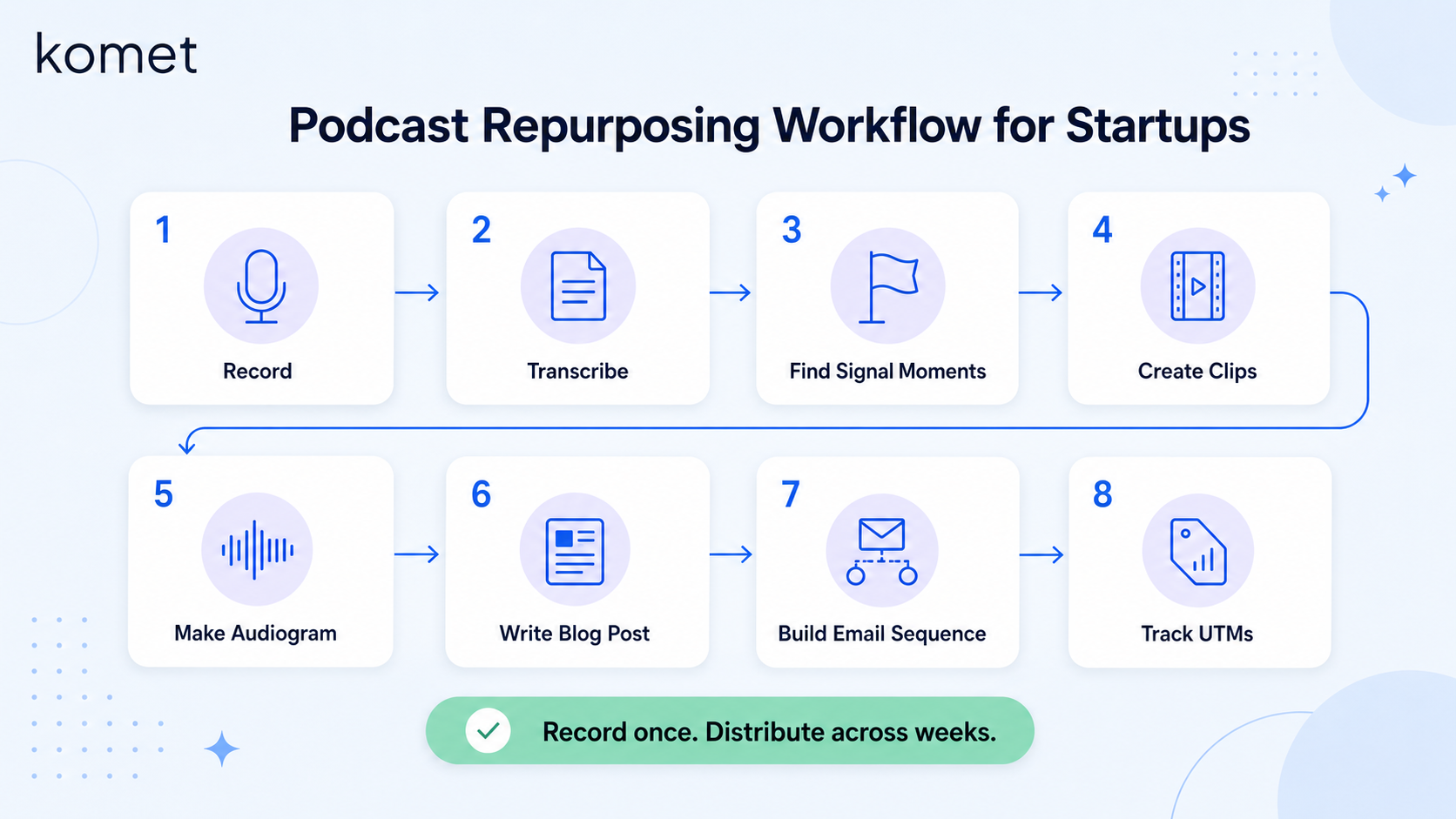
Repurposing podcast content visually is one of the most efficient ways to expand reach; once you've recorded an episode, extract 3–5 high-impact clips per week for promotion across platforms like LinkedIn, YouTube Shorts, and Twitter.
How Funded Startups Use Podcasts to Build Brand Awareness and Pipeline
Podcast content has a unique trust signal that other B2B content formats struggle to replicate. A founder explaining their product philosophy on a podcast is fundamentally different from a landing page claiming the same thing. 46% of brands view podcasts as more effective for establishing authority than other mediums, and 75% of podcast listeners stay attentive through entire branded podcast episodes. That sustained attention is what creates buyer readiness.
Funded startups have a specific advantage: their founders have earned stories, a funding round, a category insight, a contrarian product decision. These are podcast gold. When a Series A or Series B company's founder records even five episodes discussing category problems and product thinking, and then executes podcast repurposing into video clips, that content compounds.
A fintech firm generated 47 MQLs from repurposing a single episode about CFO challenges. That's the result of matching the right insight to the right buyer pain and distributing clips into the channels where that buyer lives. For founder personal branding, Komet Media's podcast marketing services are built specifically around this distribution system. We take the podcast as the seed asset, then build a short-form video system on top of it.
The dark social opportunity is also significant for startups targeting enterprise buyers. When executives share podcast content, 84% happens in private channels, WhatsApp groups, internal Teams channels, email forwards, and by creating "dark social friendly" assets such as executive summaries, quotable insights, and shareable frameworks, you multiply reach without increasing spend.
Sales teams should also receive a weekly "content kit" built from each episode: one clip, one quote image, one short insight paragraph they can drop directly into outbound sequences or follow-up emails. That's podcast repurposing working as sales enablement.
Podcast Repurposing Mistakes to Avoid
Most B2B SaaS teams make the same five mistakes when they first build a podcast repurposing workflow.
- Clipping the wrong moments: Repurposing the intro or the housekeeping section instead of the high-signal 90 seconds buried at minute 22. Watch retention data to find where listeners actually lean in.
- Ignoring captions: More than 80% of social video is watched without sound. An uncaptioned clip loses its entire message. Every clip needs burnt-in captions, not just auto-generated subtitles hidden behind a toggle.
- One-and-done distribution: Posting once and moving on. A single clip should be posted, reposted after 30 days if it performed, and iterated (different hook, same insight).
- No funnel alignment: Creating top-of-funnel awareness clips but linking them to a contact page instead of a demo signup, gated asset, or relevant landing page. Every clip needs a conversion destination.
- Skipping podcast transcription: The transcript is the foundation of every downstream asset, the blog post, show notes, email copy, LinkedIn carousel. Teams that skip transcription are doubling their content production work.
- Platform-agnostic formatting: Posting a landscape YouTube clip natively on LinkedIn. Every platform has native format preferences. Vertical (9:16) for LinkedIn and YouTube Shorts, square (1:1) for feed posts, horizontal (16:9) for YouTube full-length.
Most B2B teams treat podcast episodes like one-and-done social posts, but the data says that's leaving search demand on the table. The compounding effect only kicks in when distribution is systematic and sustained.
How to Get More ROI from Your Startup's Podcast Content
ROI from podcast repurposing doesn't come from reach alone. It comes from connecting content touchpoints to pipeline outcomes. Here's how to optimize for it:
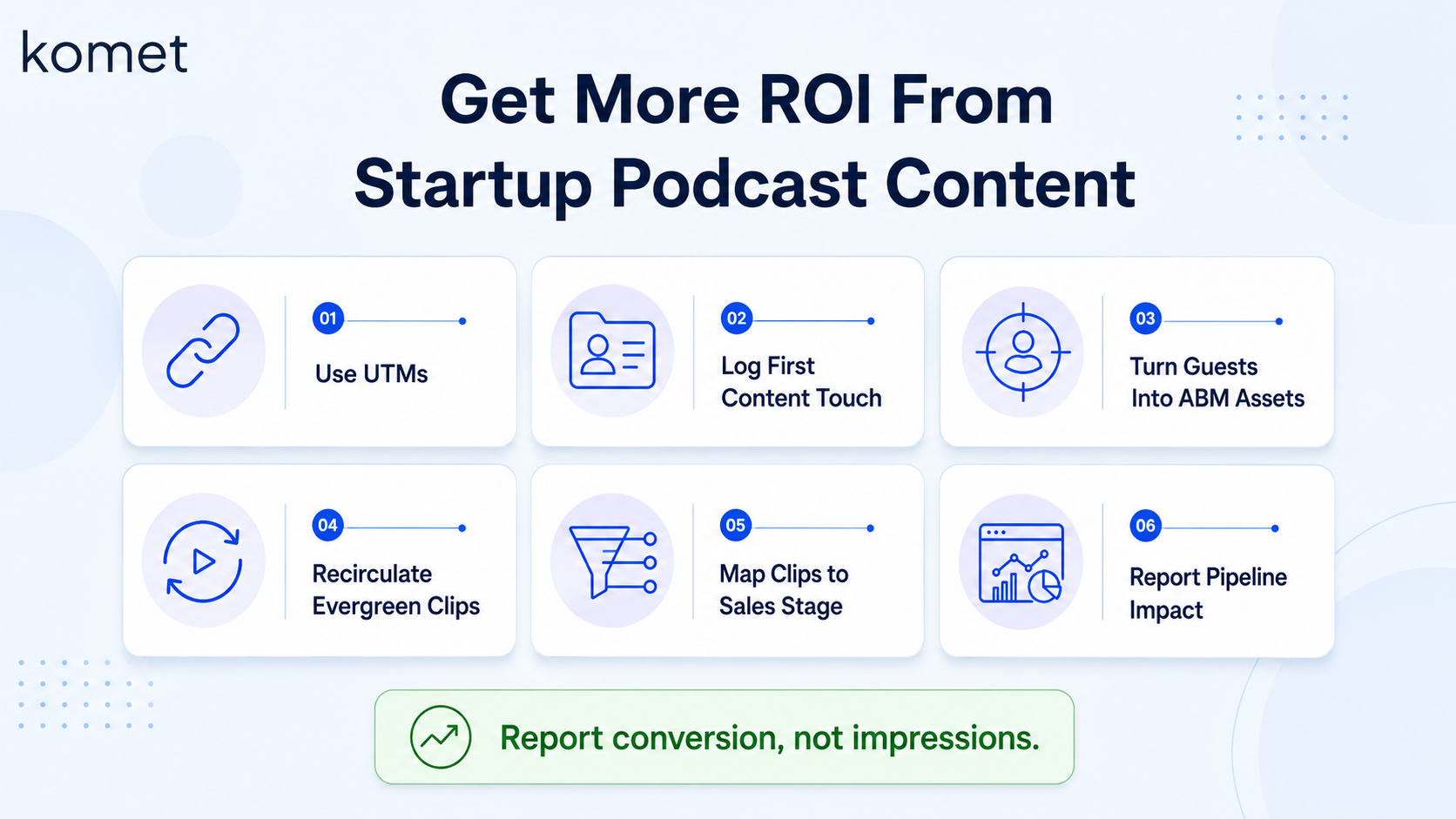
- Attribute content to the pipeline explicitly. Use UTM parameters on every derivative asset. In HubSpot Content Hub, build a contact property that logs the first podcast content touchpoint. When a deal closes, you'll know which episode or clip influenced that buyer.
- Turn guest episodes into ABM assets. Guest-to-opportunity conversion rates on B2B podcasts run at 30–40% within 6 months, and one SaaS startup booked 8 enterprise demos from their first 12 guest conversations. Invite target accounts as guests, then use the episode's clips in your post-interview follow-up sequence.
- Build an evergreen content system. The best podcast clips don't expire. A founder explaining why a specific buyer pain matters in 2026 is still relevant in 2027 if the insight is structural. Tag evergreen clips separately and recirculate them quarterly.
- Align clips to your sales cycle stages. Awareness clips educate on the problem. Consideration clips introduce your category perspective. Decision clips are product demos, customer outcomes, and proof-of-concept walkthroughs. Our short-form video editing service at Komet Media is built around this framework.
- Report on content-influenced pipeline, not just impressions. When you present content performance to a board or growth lead, impressions are noise. Leads touched by a podcast clip before booking a demo, conversion rates on landing pages seeded by an audiogram, email open rates on sequences built from episode insights, those are the numbers that matter.
One SaaS company attributed 47% of enterprise deals to podcast listeners, and podcasts lead to 25x more conversions than blogs. That conversion advantage is why video marketing built on podcast content compounds so effectively for B2B SaaS teams.
Conclusion
Podcast repurposing is the highest-leverage content system available to funded B2B SaaS startups in 2026. One recording session, executed with the right workflow, produces weeks of pipeline-supporting assets.
Key takeaways:
- Treat every episode as a seed asset, not a one-time publish event.
- Use Riverside.fm to record and Descript to edit, transcribe, and atomize.
- Distribute across LinkedIn Video, YouTube Shorts, email sequences, and sales enablement kits.
- Attribute every clip to pipeline, not just reach, and report on conversion, not impressions.
- Build the system once and let it compound, that's the Komet Media approach to B2B growth.
Frequently Asked Questions
Q1: What exactly is podcast repurposing?
Podcast repurposing is the process of taking a long-form podcast episode and converting it into multiple shorter assets: video clips, audiograms, blog posts, show notes, email snippets, and quote graphics. The goal is to maximize the reach and pipeline impact of one recording session across multiple channels.
Q2: How many assets can one podcast episode realistically produce?
A 30–45 minute episode can generate 15–20 derivative assets: 3–5 video clips, 1–2 audiograms, 1 blog post, 1 email sequence (3 parts), branded quote cards, show notes, and a sales enablement summary. The exact number depends on the episode's depth and how rigorously you apply an atomization workflow.
Q3: Which is better for a funded startup, Riverside.fm or Descript?
Use both together. Riverside.fm excels at remote recording quality, capturing separate local tracks even when internet connections are unstable. Descript handles post-production: text-based editing, AI clip creation, transcript generation, and short-form video formatting. They cover different parts of the production chain.
Q4: How long does a podcast repurposing workflow take per episode?
With the right tools and a trained team, a full repurposing workflow takes 4–6 hours per episode: roughly 1 hour for editing and transcription, 2 hours for clip creation and captioning, and 1–2 hours for blog post, show notes, and email copy. A dedicated team or agency can cut this significantly.
Q5: Do I need a large podcast audience for repurposing to drive the pipeline?
No. Audience size is a vanity metric for pipeline-focused teams. A 200-listener B2B podcast composed of ICP decision-makers outperforms a 20,000-listener general show for demo demand and inbound leads. Repurposing amplifies targeted reach, the quality of your distribution matters more than raw download numbers.
Q6: How do I connect podcast content to actual sales pipeline?
Tag all derivative assets with UTMs and feed them into your CRM (HubSpot Content Hub works well for this). Build a "first content touch" property on contact records. Track whether prospects who engaged with a podcast clip before a demo convert at higher rates. Present content-influenced pipeline, deals that touch a podcast asset, to your growth team monthly.