
🪄 AI Summary
Heading 1
Heading 2
Heading 3
Heading 4
Heading 5
Heading 6
Lorem ipsum dolor sit amet, consectetur adipiscing elit, sed do eiusmod tempor incididunt ut labore et dolore magna aliqua. Ut enim ad minim veniam, quis nostrud exercitation ullamco laboris nisi ut aliquip ex ea commodo consequat. Duis aute irure dolor in reprehenderit in voluptate velit esse cillum dolore eu fugiat nulla pariatur.
Block quote
Ordered list
- Item 1
- Item 2
- Item 3
Unordered list
- Item A
- Item B
- Item C
Bold text
Emphasis
Superscript
Subscript
Most founders know they should be on LinkedIn. Few have a system that actually turns their presence into a pipeline. This LinkedIn video playbook for founders & CEOs gives you that system, from algorithm mechanics to weekly cadence to the exact video formats that convert cold audiences into warm buyers. If you want to stop being invisible to the people who should already trust you, this is where you start.
TL;DR
- Videos on LinkedIn are shared at 20x the rate of any other post type, native video is the single highest-leverage asset a founder can publish.
- The playbook covers format selection, hook writing, posting cadence, content creation and repurposing, and engagement metrics.
- Authenticity and consistency outperform production value every time.
- Founders who build a system ship more, compound faster, and close more trust-based deals.
Why LinkedIn Video Is the Highest-ROI Channel for Founders Right Now
The data is unambiguous. Video posts from CEOs have increased by 68% on LinkedIn over the last two years. That is not noise, it is a market signal. Decision-makers are moving from text scrolling to video watching, and the founders who show up on camera first are capturing the attention their competitors are still ignoring.
LinkedIn users are 3x more likely to engage with content that features a CEO or founder. That multiplier exists because the platform is a B2B buying environment at its core. Your buyers, investors, and future hires are already there, already scrolling, and already forming opinions about founders they have never met.
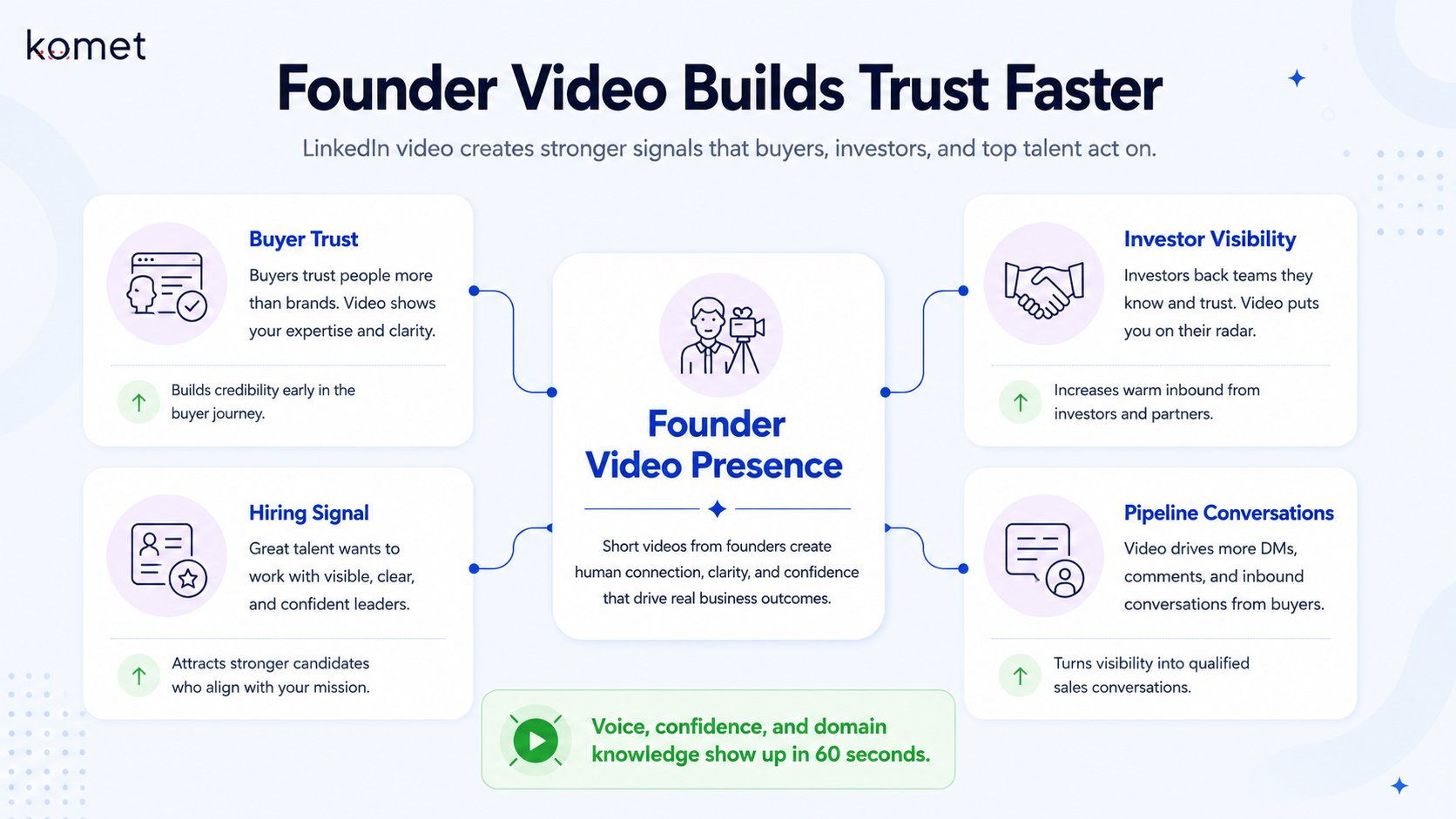
LinkedIn research with Edelman found that 64% of buyers favour thought leadership content over promo and product sheets when it comes to assessing capabilities. Video is the most efficient delivery mechanism for that thought leadership. It signals voice, confidence, domain knowledge, and humanity in 60 seconds, things a text post cannot do.
LinkedIn reports that total video views increased 36% year-over-year, and video views rose 6x quarter-over-quarter in early 2025. The platform is actively rewarding the format with algorithmic lift. Native video receives a +69% performance boost, especially when your logo or brand appears in the first four seconds.
The strategic framing is simple: every conversation you have, every podcast episode, keynote, sales call debrief, or team standup, contains content your buyers need to hear. The LinkedIn video playbook for founders & CEOs is a system for extracting that value and deploying it where your buyers are already paying attention. At Komet Media, this is exactly what we build for serious B2B teams.
The founders winning on LinkedIn right now are not posting harder. They are posting smarter, with clear content formats, sharp hooks, and a repurposing engine that multiplies output without multiplying effort.
How the LinkedIn Algorithm Actually Works for Video in 2026
Understanding the algorithm is non-negotiable. Post into it blind and you will consistently underperform.
LinkedIn's algorithm operates as a real-time semantic ranking system. It evaluates professional content through three core signals: initial engagement quality within the first 60 minutes, sustained dwell time measuring how long users actually read content, and creator authenticity signals that validate genuine expertise. For video specifically, dwell time is the dominant lever.
In the LinkedIn algorithm, dwell time takes into consideration how long someone sits on your post, so when you post a video, you give people more chances to stay on the post and therefore push it out to more people. Early engagement during the first 60 to 90 minutes, your "golden hour", influences whether LinkedIn expands your post's reach. This means the moment you publish matters. Publish during decision-maker planning windows: 8 AM EST on Tuesday through Thursday. Native upload is mandatory.
LinkedIn heavily favors videos uploaded directly to the platform over posts that link to external sites like YouTube or Vimeo. Native videos autoplay in the feed, are more mobile-friendly, and receive significantly more algorithmic preference. External links appear as a small preview, require an extra click, and take users off-platform, resulting in suppressed reach.
Uploading directly to LinkedIn rather than linking from outside boosts post visibility by 42%.
Two additional mechanics to lock in:
- Profiles with Creator Mode enjoy up to 35% more reach. Turn it on immediately.
- Posts with external links experience 60% reach reduction as LinkedIn prioritizes keeping users on the platform. Put links in the first comment, not the post body.
LinkedIn scans for spam signals, AI-generated patterns, and engagement pod manipulation before any distribution occurs. Posts flagged for artificial engagement receive immediate suppression. The platform prioritizes "obviously human" signals over polished AI output. Authenticity is not just a brand value here, it is an algorithmic requirement.
What Types of Videos Should Founders Post on LinkedIn?
Not all video formats serve the same purpose. Map your content to the buyer stage and use each format deliberately.
According to LinkedIn, thought leadership posts generate 6x more engagement than job-related content. That category includes framework breakdowns, honest opinion pieces, and lessons from your direct experience, the formats only you can own. LinkedIn reports that total video views increased 36% year-over-year, and short-form clips under 15 seconds tend to perform best, especially when paired with captions.
For founders who speak at events or host webinars, a single session can produce 8–12 repurposed clips across all six formats above. One format founders consistently underuse: the client result story. Framed as a narrative, "We had a client doing X, they hit this problem, here is what shifted", it functions as social proof without reading like a testimonial. It earns trust from buyers who are not yet in your pipeline.
LinkedIn's own Creative Labs analysis links vertical formats and face-to-camera norms with higher engagement and longer dwell times, indicating that "talking head plus captions" is not only acceptable on LinkedIn but often aligned with what the platform's audience and algorithm reward. The goal is not variety for variety's sake. The goal is a content mix that covers every stage of the buyer journey so that your audience is always encountering you at exactly the right moment.
LinkedIn Video vs. Text Posts: Which Performs Better for Founders?
The honest answer: both belong in your mix, but for different jobs. The average engagement rate on LinkedIn posts is 2.8%. LinkedIn video content gets 5x more engagement than text-only posts. That gap is significant. Video reaches cold audiences faster because of its combination of dwell time and autoplay mechanics. But the text has a counter-argument.
Document posts are hitting 6.60% engagement rates, the highest of any LinkedIn format. Meanwhile, standard text posts struggle to break 2%. Carousel-style documents outperform video on pure engagement rate by impression, and they require no camera time. Video under 30 seconds works for awareness-stage content targeting cold audiences, achieving 200% higher completion rates than longer formats. Text posts or multi-image carousels work better for engagement-stage content building substantive discussion with warm networks. The sequence matters: video seeds cohort distribution, text converts engagement into business relationships.
The practical framework for founders:
- Video: Use to break into new audiences, establish personality, and anchor thought leadership.
- Text/Carousel: Use to deepen existing relationships, share nuanced thinking, and drive comments from people who already follow you.
- Hybrid: Pair a video post with a follow-up text post 48 hours later expanding on the same idea. You get two bites of the same apple.
SaaS companies that share transparent metrics, failed experiments, and founder stories see 47% higher engagement than those posting generic industry insights. The format is less important than the authenticity of the signal. Founder-led content that is specific and honest outperforms polished corporate output in any format.
How Often Should a Founder or CEO Post Videos on LinkedIn?
Cadence is where most founders fail. They post in bursts, go quiet for three weeks, and wonder why growth has stalled. Posts published 3–5 times per week maintain a 46% higher average retention rate across videos.
That is the target window. For most founders balancing a company, three posts per week is realistic, one video, one text post, and one carousel or document. Companies that post 4 times per week see a 2x lift in engagement. The compounding effect of consistent output is not linear. Each post that earns engagement trains the algorithm on who your audience is, making the next post reach them more efficiently.
Creators who batch film and post on a regular content calendar see 31% more interaction per video. Batch filming is the operational unlock for time-constrained founders. One 90-minute filming session, ideally off the back of a podcast recording or keynote prep, yields four to six clips ready to publish over the next two weeks.
Practical posting framework for a founder:
- Block one filming session per week (or bi-weekly for smaller audiences).
- Record 3–5 short takes on different topics in one sitting.
- Send raw footage to your short-form video editing team for captioning, cuts, and branding.
- Schedule Tuesday, Wednesday, and Thursday at 8–10 AM in your buyer's time zone.
- Spend 15 minutes engaging with comments in the first hour after each post goes live.
LinkedIn engagement peaks on Tuesdays, Wednesdays, and Thursdays between 10 AM and noon, suggesting these as the best times for sharing content. For global founders, stagger posts to cover primary buyer time zones.
How to Write Hooks That Make Your LinkedIn Videos Actually Get Watched
Most founder videos fail in the first three seconds. Not because the content is bad, because the hook is weak. A strong hook in the first 3 seconds increases average retention by 23%. Viewers decide whether to keep watching within the first 8 seconds. Those eight seconds are the only metric that matters at the top of the funnel.
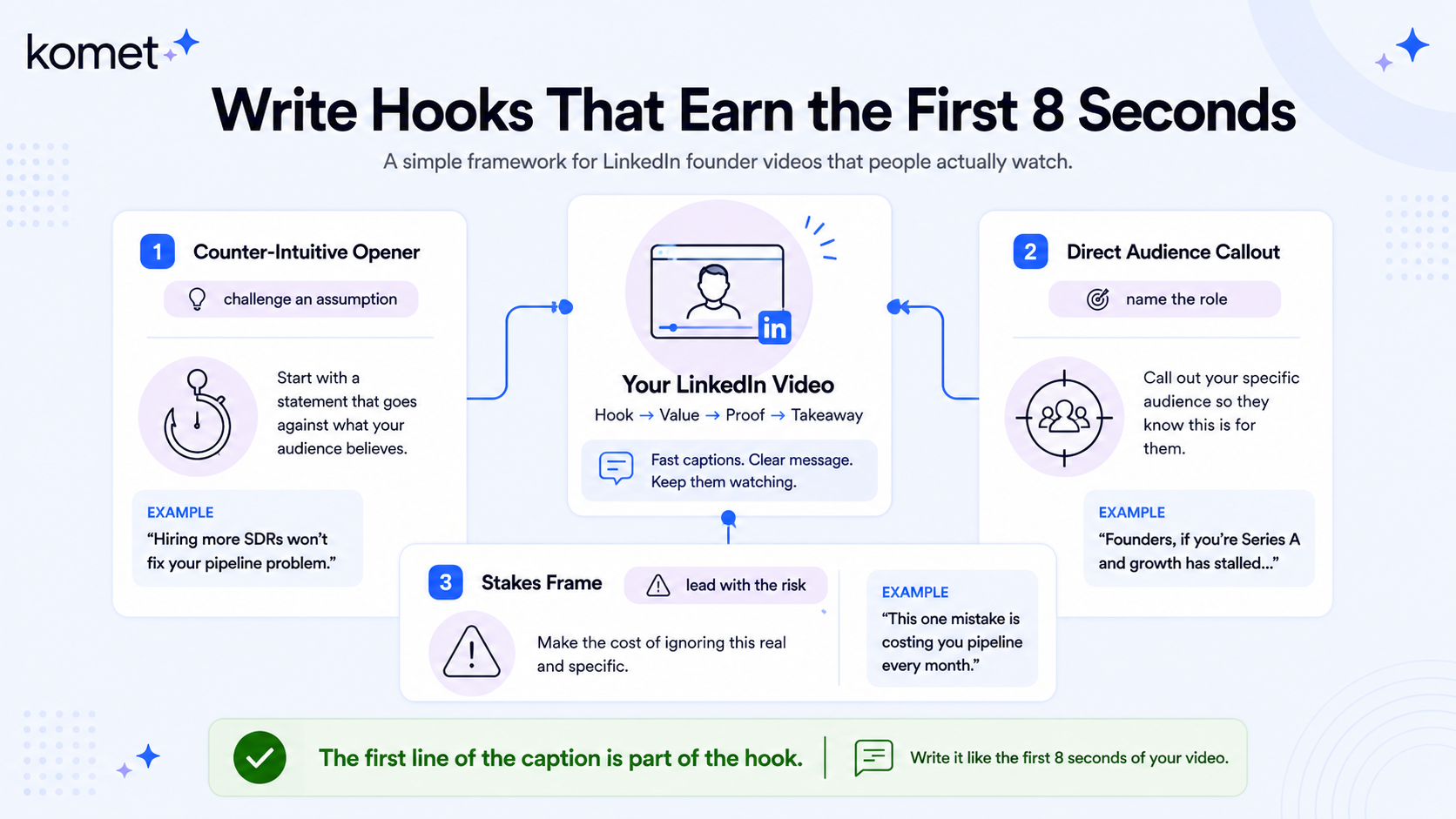
Three hook structures that consistently work for B2B founders:
- The counter-intuitive opener: "Every founder I talk to is doing X. It's costing them Y." Forces the viewer to lean in because it challenges an assumption they hold.
- The direct-address pattern: "If you're a [role] trying to [goal], this is the most important thing I've learned." Videos that mention the audience ("you," "your") in the first 15 seconds see a 22% lift in engagement.
- The stakes frame: "I almost lost a $400k client because of this one mistake." Outcome-first storytelling that makes the rest of the video essential.
Posts with a teaser or hook in the caption generate 2.7x more watch time. The caption is an extension of the hook, treating the first line of your post copy with the same weight as the first second of your video.
Additional technical hygiene:
- Videos with captions retain viewers 32% longer compared to non-captioned videos.
- Thumbnails that include a human face improve click-through rates by 28% on average.
- Including a clear call-to-action in the last 10 seconds increases profile visits by 27%.
Hook writing is a skill, not a talent. The more videos you publish, the faster you will identify which openings resonate with your specific audience. Track completion rate, not views, as the core diagnostic metric.
How to Build a Content Repurposing Framework That Scales
The most time-efficient founders are not creating more content. They are extracting more from the content they already create. The repurposing principle: one long-form asset generates a full week of LinkedIn content. A 45-minute podcast episode or keynote talk contains enough material for two video clips, one carousel, one text post, and one LinkedIn article, all from a single conversation you were going to have anyway.
The extraction workflow:
- Record your long-form asset (podcast, webinar, board presentation, sales call).
- Transcribe it automatically using your podcast transcription workflow.
- Identify 3–5 standalone moments: a strong opinion, a counter-intuitive stat, a client story, a framework, a question.
- Clip, caption, and brand each moment for LinkedIn native video upload.
- Write one text post that expands the single best idea from the long-form.
- Publish across Tuesday–Thursday with 24-hour spacing between posts.
Video creation on LinkedIn is reportedly growing at twice the rate of other post formats. Founders who build a repurposing engine are compounding that growth with zero additional idea generation overhead. The average founder has 6 months of LinkedIn content sitting in their podcast library, past keynotes, and sales calls. The only thing missing is the extraction system.
SaaS founders who post about their product development process get 3.4x more engagement than those sharing third-party industry reports. The raw material for your highest-performing content is already in your own conversations, you just need a system to pull it out. This is the core of what we do at Komet Media's video marketing services.
How to Measure Whether Your LinkedIn Video Strategy Is Working
Vanity metrics, views, likes, follower count, are informative but not diagnostic. The metrics that tell you whether your LinkedIn video playbook for founders & CEOs is generating real business outcomes are different.
Many marketers now believe LinkedIn places greater emphasis on deeper engagement signals such as comments, saves, shares, dwell time, and repeat audience interaction. Optimise for those, not raw view counts.
Videos that receive engagement in the first hour are 4.1x more likely to be promoted by the algorithm. Build an engagement ritual: immediately after publishing, reply to every comment within the first 60 minutes. Each reply is a signal the algorithm reads as conversation quality.
Asking a question in the caption increases comment volume by 33%. Pair that with a strong hook and you have a post designed to earn deep engagement signals from the first minute it is live.
Monthly review cadence:
- Identify the top three videos by completion rate.
- Identify the three with the highest inbound DM or profile visit conversions.
- Double down on the topic and format overlap between those two lists.
- Cut any recurring format that produces neither metric.
The LinkedIn video playbook for founders & CEOs is not a one-time setup. It is a feedback loop: publish, measure, double down on what works, and systematically cut what doesn't.
Conclusion
This LinkedIn video playbook for founders & CEOs works because it maps to how B2B buyers actually make decisions, through repeated exposure, authentic signals, and accumulated trust. Execute the playbook consistently and your LinkedIn presence becomes an always-on trust engine.
Core takeaways:
- Upload natively, use Creator Mode, and protect your golden hour engagement every post.
- Match your video format to buyer stage, awareness, consideration, or decision.
- Batch film weekly, publish three times per week minimum, and repurpose everything.
- Measure completion rate, inbound DMs, and profile visits, not just views.
Ready to build the system? Start with Komet Media.
Frequently Asked Questions
1) How long should a founder's LinkedIn video be?
Videos under 60 seconds retain 87% of viewers on average. For awareness and cold-audience content, stay under 60 seconds. For deeper framework breakdowns targeting warm followers, 90–120 seconds is acceptable. Never exceed 2 minutes for a talking-head format without a strong narrative arc.
2) Should a founder appear on camera themselves, or is animated/produced video fine?
On-camera talking head video consistently outperforms produced animation for trust-building. LinkedIn's own Creative Labs analysis links face-to-camera norms with higher engagement and longer dwell times. Buyers buy from people. Your face is a trust signal animation cannot replicate.
3) Does LinkedIn Creator Mode actually help founder visibility?
Yes, meaningfully. Profiles with Creator Mode turned on enjoy up to 35% more reach, and in 2025, over 16 million users activated it. Enable it, select 5 relevant topics, and make sure your featured section includes your best-performing video.
4) Is it worth repurposing YouTube or podcast content for LinkedIn video?
Absolutely, with one hard rule. Always upload your videos natively to LinkedIn for maximum visibility. Never embed a YouTube link. Download the clip, add LinkedIn-optimized captions, and upload directly. The algorithmic difference between native and linked video is not marginal.
5) How do you avoid sounding salesy on LinkedIn videos?
Lead with insight, not offers. 63% of buyers said thought leadership is "important in providing proof that an organisation genuinely understands or can solve your specific business challenges." Teach what you know, share what you have learned, and let the trust compound. Calls-to-action belong at the end, never the top.
6) What is the biggest mistake founders make with LinkedIn video?
Inconsistency. A burst of five videos followed by three weeks of silence resets your algorithmic momentum and signals to your audience that you are not reliable. Creators who batch film and post on a regular calendar see 31% more interaction per video. Consistency compounds. One video per week, every week, beats five videos per month posted irregularly.