
🪄 AI Summary
Heading 1
Heading 2
Heading 3
Heading 4
Heading 5
Heading 6
Lorem ipsum dolor sit amet, consectetur adipiscing elit, sed do eiusmod tempor incididunt ut labore et dolore magna aliqua. Ut enim ad minim veniam, quis nostrud exercitation ullamco laboris nisi ut aliquip ex ea commodo consequat. Duis aute irure dolor in reprehenderit in voluptate velit esse cillum dolore eu fugiat nulla pariatur.
Block quote
Ordered list
- Item 1
- Item 2
- Item 3
Unordered list
- Item A
- Item B
- Item C
Bold text
Emphasis
Superscript
Subscript
I have sat in enough editorial reviews to know the pattern. A founder records a strong episode, a good guest, a sharp conversation, then publishes the raw file and moves on to the next recording. Podcast editing for founders and CEOs is the step that decides whether that conversation becomes a business asset or disappears into a feed within a week. Most founders treat editing as cleanup. In practice, it is closer to the difference between having a podcast and having a system.
Quick Answer
Podcast editing for founders and CEOs means shaping a raw recording into a clean episode, short clips, and platform-ready assets that support authority, pipeline, and hiring, not just producing a polished audio file.
Why Podcast Editing Matters More Than Founders Expect
Most founders start a podcast to build a relationship channel. Guests, investors, prospects, and future hires all show up somewhere in the recording. Editing decides whether that channel actually reaches any of them, or whether it stays a single audio file that a handful of people hear once.
The medium itself has shifted in a way that raises the stakes on this decision. Edison Research's Podcast Consumer 2026 study found that weekly video-podcast viewing overtook audio-only listening for the first time in the third quarter of 2025, with monthly podcast reach across the US at an all-time high. A founder recording audio alone in 2026 is producing for a shrinking half of the audience. That single fact changes what editing needs to deliver: not just a clean mix, but a video-first cut that also works as short clips.
A few other patterns show up often in our work with founder-led shows:
- The best insight rarely opens the episode. Founders seldom lead with their sharpest point. It tends to surface after the warm-up, once the guest relaxes and the conversation turns specific and unscripted.
- Raw audio alone underperforms as a distribution asset. In HubSpot's 2026 State of Marketing Report, short-form video ranked as the top ROI-driving content format among marketers, while podcasts and audio content on their own ranked far behind. The podcast is the source material. The edited clips are what marketers report actually moving the needle.
- Buyers trust the person more than the brand. Edelman and LinkedIn's 2024 B2B Thought Leadership Impact Report found that a majority of B2B decision-makers see thought leadership content as a more trustworthy basis for judging a company than its marketing materials. A founder's unscripted answer on a podcast carries more of that trust than a scripted ad ever will, but only if someone edits it into something a buyer will actually watch.
Podcast editing for founders and CEOs is what turns a single conversation into several proof points a buyer, investor, or candidate can actually see, rather than one long file that asks a lot of a listener's attention.
Where Founder Podcasts Usually Break Down
I would rather name the common failure points than repeat generic advice. Four show up constantly across founder-led shows.
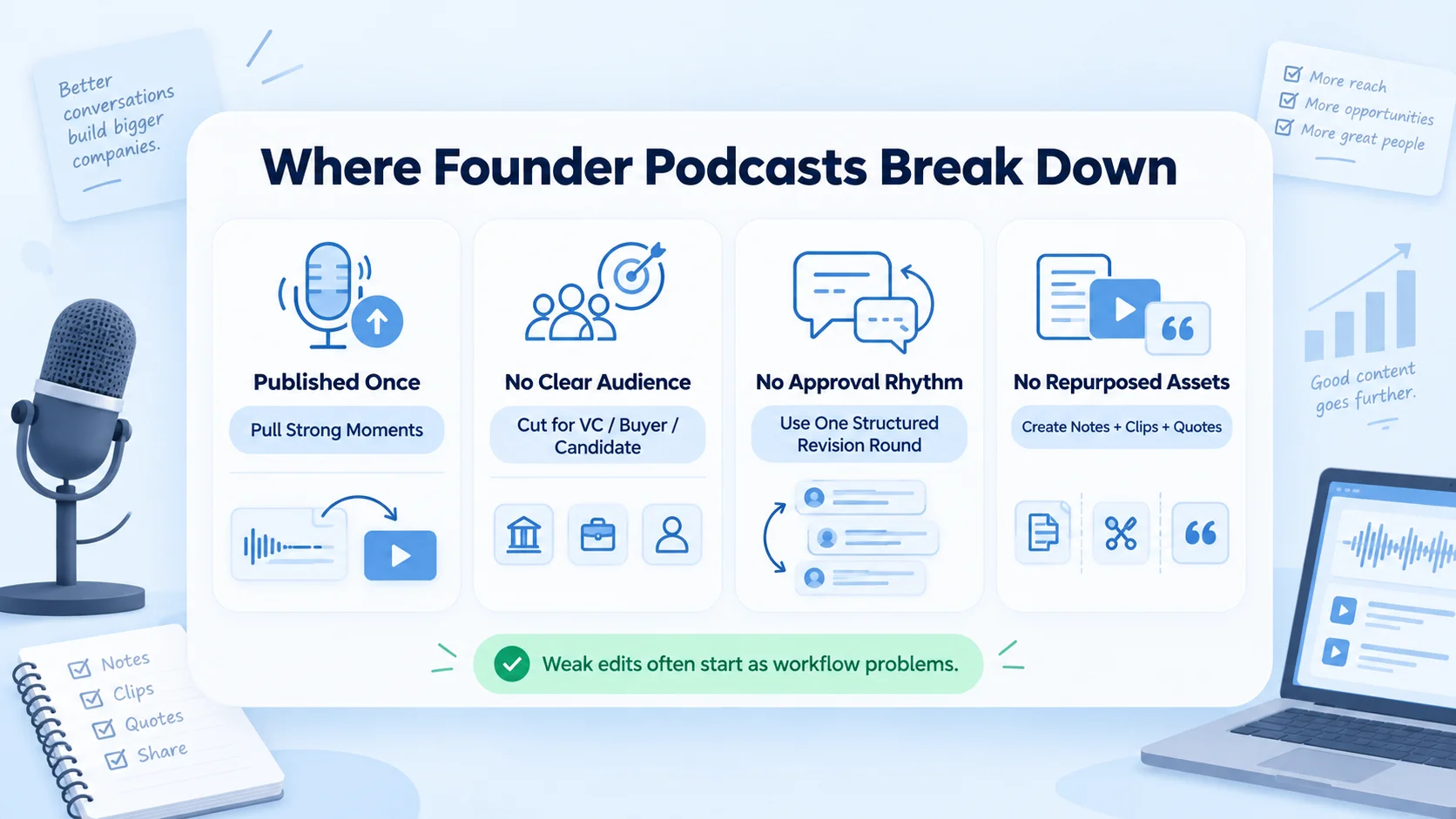
The episode gets published once and never touched again. The team uploads the full audio file, shares it on one channel, and moves straight to the next recording. Nobody goes back to pull the three moments a prospect or candidate would actually want to see.
Editing happens without a clear audience in mind. An editor who does not know whether a clip is meant for a VC's LinkedIn feed, a SaaS demand generation calendar, or a recruiting page will cut generically. The result is technically clean and commercially flat.
There is no revision or approval rhythm. Founders are busy. If every clip requires a long, open-ended back-and-forth before it can go out, the system slows down and episodes start backing up instead of publishing on schedule.
The episode never gets repurposed beyond video. Show notes, transcripts, and pull quotes for sales and recruiting go untouched, even though they often take less time to produce than another round of clips.
None of these are editing problems in the technical sense. They are workflow problems that show up as weak edits and inconsistent publishing.
What Podcast Editing for Founders and CEOs Should Actually Include
A capable podcast editing partner is not just trimming silence and leveling audio. For a founder or CEO, the work usually spans the full path from raw file to published asset.
I would rather produce six sharp clips built around one clear idea than fifteen loosely related ones. Volume without a clear point of view rarely holds attention, and it adds pressure on the editing and approval process without adding much business value.
Not every founder needs the full list from day one. An early-stage team launching its first season might start with a full episode edit and three clips per episode, then add show notes and a wider clip set once the show settles into a rhythm. A later-stage company running a podcast alongside an active VC or PE fundraising push often needs the fuller set from the start, since the content is supporting a specific, time-sensitive goal rather than building an audience gradually.
The deliverable list matters less than the decision behind it. Every item on that table should trace back to a specific audience: a partner at a VC firm, a technical buyer evaluating a SaaS product, a candidate researching a founder before a first call. When the editing decision is made with that person in mind, the same raw recording produces sharper assets.
A Practical Workflow, from Recording to Publish
Founders do not need to understand every technical step, but knowing the shape of the workflow helps set realistic expectations for turnaround and approvals.
- Plan the episode around a distribution goal, not just a guest. Before recording, it helps to know roughly what the episode is meant to support: pipeline for a specific product line, visibility ahead of a funding round, or recruiting for a specific role. That goal shapes which questions get asked and which moments the editor should prioritize later.
- Record with the edit in mind. Clean audio and a stable camera setup save hours later. A short pre-production checklist for microphone placement, lighting, and backup recording prevents most of the problems editors spend time fixing after the fact.
- Review the transcript before editing starts. Marking strong moments in a transcript is faster than scrubbing through raw footage, and it gives the editor a starting map of what matters before a single cut is made.
- Cut the full episode first. This becomes the anchor asset for YouTube, the podcast feed, and the website, and every short clip gets pulled from this version.
- Pull and edit short clips. Each clip should stand on its own, with a clear opening line and a caption that makes sense with the sound off, since most social feeds default to muted playback.
- Adapt exports by platform. A vertical clip built for Instagram Reels needs different framing and pacing than a horizontal cut for YouTube. It helps to know roughly how many clips a single podcast episode can realistically produce before assuming more raw material automatically means more usable content.
- Run one structured revision round. A defined feedback window, with specific timestamps rather than open-ended notes, keeps a founder's limited time focused on the moments that matter most.
- Schedule distribution across channels. Publishing every clip the same day rarely performs as well as spacing them across the two or three weeks following the episode, which gives each piece room to be seen on its own.
Small teams can compress this. A solo founder with a lean marketing hire might skip formal show notes for a while, but skipping clip selection or captions usually costs more reach than it saves in time.
How to Judge Whether the Editing Is Working
Views are not the right first metric for a founder-led podcast, and treating them as one usually leads to disappointment. I would weigh these signals instead:
- Completion rate on the full episode, which tells you whether the pacing and structure are holding attention through to the end.
- Clip-level watch time and saves, which show whether a specific moment resonated enough for someone to keep it rather than scroll past.
- Profile visits and connection requests after a clip goes live, especially on LinkedIn, where founder content routinely outperforms company page content on engagement.
- Sales and recruiting conversations that mention the podcast, even informally. A prospect or candidate referencing a specific episode is a stronger signal than any dashboard number.
- Guest-driven reach, since guests sharing their own episode often extends distribution further than the host's own following can reach on its own.
Attribution here is rarely clean. A founder rarely knows for certain whether a deal closed faster because of a podcast clip someone watched three months earlier. The signals above, taken together over a full quarter, tell you more than any single metric on its own, and they matter more than raw download counts for a show built around relationships rather than mass reach.
A common pattern in our work is a founder who checks download numbers after the first few episodes, sees a modest count, and assumes the podcast is not working. Downloads on a founder-led show usually grow slowly and steadily rather than spiking. The more useful early signal is almost always qualitative: whether the right people are mentioning the episode unprompted, not whether the chart shows a large audience yet.
Freelancer, In-House Hire, or Production Partner
This decision comes up in nearly every conversation about podcast editing for founders and CEOs, and the right answer depends on volume and how much founder time is available to manage the work.
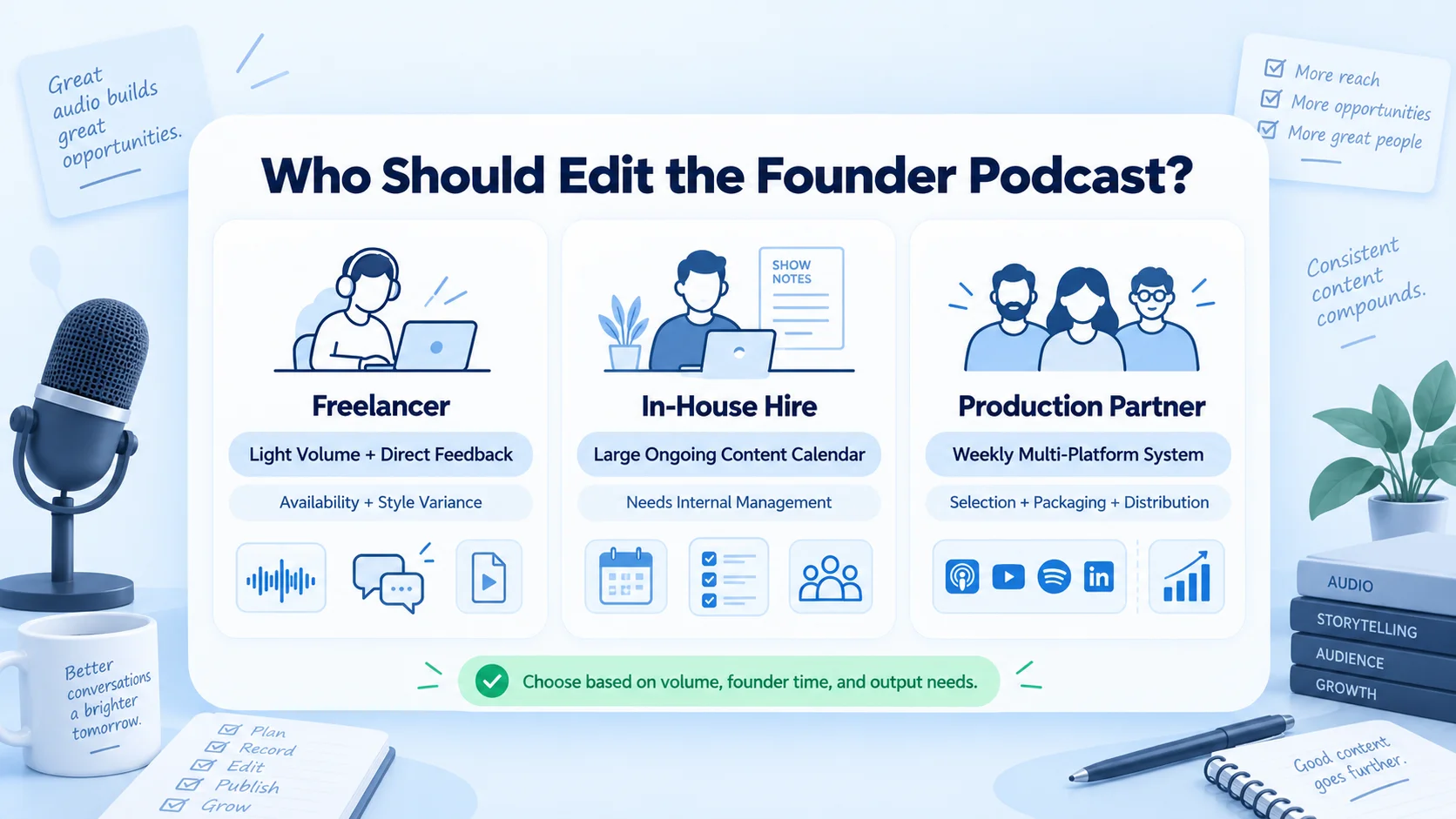
A freelance editor can work well for a single show with light volume, a founder who has time to give direct, specific feedback, and no immediate need for distribution planning beyond the edit itself. The tradeoff is coverage: a single freelancer's availability, style consistency, and capacity to also handle captions, show notes, and platform-specific exports can vary from month to month.
An in-house hire makes sense once video and podcast output becomes a large enough share of the marketing calendar to justify a full-time role, and once there is someone internally who can manage that person's workload and give feedback consistently.
A production partner tends to fit best once a show needs consistent weekly output across multiple platforms, and the founder wants less time spent coordinating the process. A partner that treats editing as one part of a broader system, covering selection, packaging, and distribution planning, closes the gap between a technically clean cut and a clip that actually reaches the right audience. Reviewing a checklist for vetting a podcast editing partner before signing a retainer is worth the hour it takes, because the difference between an editor who cuts files and a partner who builds a system usually shows up in month two, once the novelty of a new podcast wears off and consistency becomes the real test.
Conclusion
The decision that matters most is not which software an editor uses or how fast a single clip gets turned around. It is whether podcast editing for founders and CEOs is treated as a one-off task or as a repeatable system tied to a clear audience and a clear business goal. Founders who get this right are not necessarily publishing more content than everyone else. They are getting more use out of every recording they already make. If you are weighing whether to build this in-house or bring in a partner, our team at Komet Media is glad to talk through what a working system would look like for your show.
FAQ
1) What does podcast editing for founders and CEOs involve?
It covers audio and video cleanup, a full episode cut, short-clip selection, captions, show notes, and platform-ready exports. For a founder or CEO, the packaging and distribution planning around the episode usually matter as much as the raw edit itself.
2) How much does podcast editing cost for a founder-led show?
Pricing depends on episode length, how many clips are needed, motion graphics, revision rounds, and whether distribution support is included. At Komet Media, retainers for this kind of work typically fall between $2,500 and $5,000 per month, with the final number set by scope rather than a fixed package.
3) What does the podcast editing process typically look like?
Most workflows move from transcript review and moment-marking, to a full episode cut, to short-clip selection, captioning, and platform-specific exports, followed by one structured revision round before publishing.
4) How long does it take to edit a single episode?
Turnaround varies with episode length and clip count, but a common range is three to seven business days for a full episode plus its short clips, once the raw files and any show notes requirements are confirmed upfront.
5) What deliverables should a founder expect from a podcast editing partner?
A finished long-form episode, a set of short vertical and horizontal clips, captions on every asset, and often a transcript or show notes. Some partners also include thumbnails and a distribution calendar mapped across the weeks after publish.
6) Should a founder use a freelance editor or a podcast editing agency?
A freelancer can work well for a single show with light volume and a founder who has time to manage revisions directly. An agency tends to fit better once the show needs consistent weekly output across several platforms and less founder time spent on coordination.
7) Does podcast editing make sense for a founder who does not have a large audience yet?
Yes. Audience size affects reach, not whether editing is worth doing. A well-edited early episode is often what makes a show worth sharing with investors, candidates, and early customers in the first place, long before download numbers become meaningful on their own.
8) How does Komet Media approach podcast editing for founders and CEOs?
We treat the episode as source material for a wider system: full-episode editing, clip selection built around a specific audience, captions, show notes, and a distribution plan, rather than treating editing as a standalone deliverable disconnected from what happens after publish.