
🪄 AI Summary
Heading 1
Heading 2
Heading 3
Heading 4
Heading 5
Heading 6
Lorem ipsum dolor sit amet, consectetur adipiscing elit, sed do eiusmod tempor incididunt ut labore et dolore magna aliqua. Ut enim ad minim veniam, quis nostrud exercitation ullamco laboris nisi ut aliquip ex ea commodo consequat. Duis aute irure dolor in reprehenderit in voluptate velit esse cillum dolore eu fugiat nulla pariatur.
Block quote
Ordered list
- Item 1
- Item 2
- Item 3
Unordered list
- Item A
- Item B
- Item C
Bold text
Emphasis
Superscript
Subscript
Most VC firms still rely on reputation alone. The best-deal-flow firms have added something else: a deliberate, always-on video presence that reaches founders before a warm intro, educates LPs without a pitch deck, and builds brand authority at scale. This is The Video Marketing Playbook for VC Firms, built for emerging fund managers, general partners, and investor relations teams who want more than a logo on a website. If you're serious about deal flow, LP communications, and founder-led growth, video is your distribution layer.
TL;DR
- In the competitive world of venture capital, simply having capital to invest is no longer enough to differentiate a firm from its peers. Today's standout firms understand marketing as a strategic pillar for demonstrating unique value and attracting top-tier startups and investors.
- 93% of marketers say video marketing has given them a good ROI, the highest percentage since tracking began.
- Short-form GP talking-head clips, portfolio spotlights, and LP update videos are the three highest-leverage formats for VC firms right now.
- Repurposing one recorded conversation into 8–12 short assets is the most capital-efficient video strategy for small fund teams.
Why VC Firms Can No Longer Ignore Video Marketing
Venture capital is no longer just about who you know. As competition for high-growth startups intensifies, marketing has become a non-negotiable tool for VCs to attract top founders, build trust, and differentiate from the pack. The shift is structural. Historically, VC firms relied on exclusivity and personal networks, but a crowded market now demands greater visibility, thought leadership, and consistent brand messaging.
A founder evaluating three term sheets in 2026 will research every firm on video before taking a first call. If your firm has no video presence, you are invisible at the most critical moment in your deal funnel. If a VC firm isn't actively marketing itself, it risks fading into the background. Visibility isn't about ego; it's about access to the best deals. The firms that invest in their brand are the ones founders trust first. The data reinforces this. 95% of hidden decision-makers say thought leadership makes them more open to sales outreach, according to the Edelman-LinkedIn Thought Leadership Impact Report 2025.
For a VC, those hidden decision-makers are founders who have not yet started fundraising, co-investors evaluating a syndicate, and LPs assessing whether to commit to Fund II. The 2025 B2B Thought Leadership Impact Report from Edelman and LinkedIn draws insights from nearly 2,000 global professionals. The takeaway is clear: thought leadership isn't just content marketing; it's a strategic tool for building trust, driving alignment, and opening doors where ads and traditional sales methods fall short.
The firms that lead on video in 2026 will not just be the ones with the biggest brand budgets. They will be the ones with a repeatable system: one recording session per week, clean post-production, consistent distribution across LinkedIn and YouTube, and a content distribution flywheel that compounds over time.
In 2026, video remains one of the most effective content marketing assets, driving conversions. Recent statistics show that 93% of marketers say video content has given them a solid ROI, and 84% say that video has directly increased sales.
What Types of Videos Should Venture Capital Firms Create?
The mistake most VC firms make is treating video as a one-off exercise rather than a content system. The video types below map to three distinct audiences: founders, LPs, and the broader ecosystem.
Founder-facing formats:
- GP talking-head clips: A 60-to-90-second take from a general partner on a specific investment thesis, a sector trend, or a portfolio observation. These are the highest-trust, lowest-cost format available.
- Deal announcement videos: Short, direct-to-camera announcements paired with a founder story clip. Replaces the standard press release with something shareable.
- "Why we invest" series: Each partner records their investment philosophy in three to five minutes. Founders use these to pre-qualify fit before reaching out.
LP-facing formats:
- Quarterly update videos: Five to eight minutes, recorded by the managing partner, covering fund performance context, portfolio highlights, and what's ahead. Dramatically reduces LP meeting load.
- Portfolio founder spotlights: Two-to-three-minute features on a portfolio company's progress. Gives LPs proof of thesis execution without requiring a read of a long memo.
Ecosystem and inbound formats:
- Webinar and podcast clips: Webinars are packed with great moments that can be quickly turned into shorter video assets for distribution across social channels. A 45-minute fund LP Q&A becomes eight LinkedIn clips.
- Due diligence transparency videos: Short explainers on your firm's evaluation process. Signals rigor and builds trust with founders considering whether you're the right partner.
73% of B2B buyers say video is their preferred way to learn about a product or solution, and 65% of executives visit a vendor website after viewing their video. For a VC firm, swap "product" for "investment thesis" and the principle holds exactly. Founders are buyers. Video is how they evaluate you before you ever evaluate them.
The right mix for most emerging fund managers is roughly: 50% founder-facing thought leadership, 30% portfolio company storytelling, and 20% LP communication. Start with the format you can execute consistently, then layer in the rest.
How Do Top VC Firms Use Video to Build Thought Leadership?
The clearest benchmark in the industry is Andreessen Horowitz. a16z is marking the one-year anniversary of its New Media initiative, a program designed to help startups navigate the increasingly complex landscape of building a brand and capturing audience attention. The firm positions this offering as "go-direct as a service" for its portfolio companies and beyond. a16z leverages its own established platforms, including its X account with over a million followers, a daily newsletter with a quarter-million subscribers, and a podcast that garners a million monthly downloads.
The Andreessen Horowitz media playbook is not a marketing department. It is an owned media company operating inside a VC firm. Ben Horowitz and Marc Andreessen discuss how the media landscape has fundamentally changed and what a16z is doing about it. They cover why offense beats defense, why individuals now matter more than corporate brands, and why speed wins in the new media landscape.
Most VC firms cannot replicate a16z at that scale. They don't need to. What they can replicate is the underlying logic: individual GPs building personal video brands on LinkedIn and YouTube, with the firm's owned channels amplifying the best content.
According to the Content Marketing Institute, 76% of B2B marketers say LinkedIn is the most effective channel for thought leadership. General partner visibility is the core mechanism. When a GP posts a crisp 75-second video analyzing why a specific market is ready for disruption, three things happen simultaneously: founders who fit that thesis self-select to reach out, co-investors begin following the GP's thinking, and the firm's brand authority compounds with every view.
75% of executives have explored products or services they weren't considering after engaging with compelling thought leadership content, according to the Edelman-LinkedIn Thought Leadership Impact Report 2024. For a VC, that translates directly to warm inbound from founders and co-investors who were never in your existing network.
The practical cadence for a two-partner fund: two to three LinkedIn video clips per week per GP, one longer YouTube piece per month (a webinar recording, a panel clip, or a recorded conversation with a portfolio founder), and one repurposed clip from each for the firm's own channel.
The Video Marketing Strategy That Actually Generates Deal Flow
Video marketing for VC firms only generates deal flow when it is built around a content distribution flywheel, not one-off posts. Here's how to build that system in seven steps:
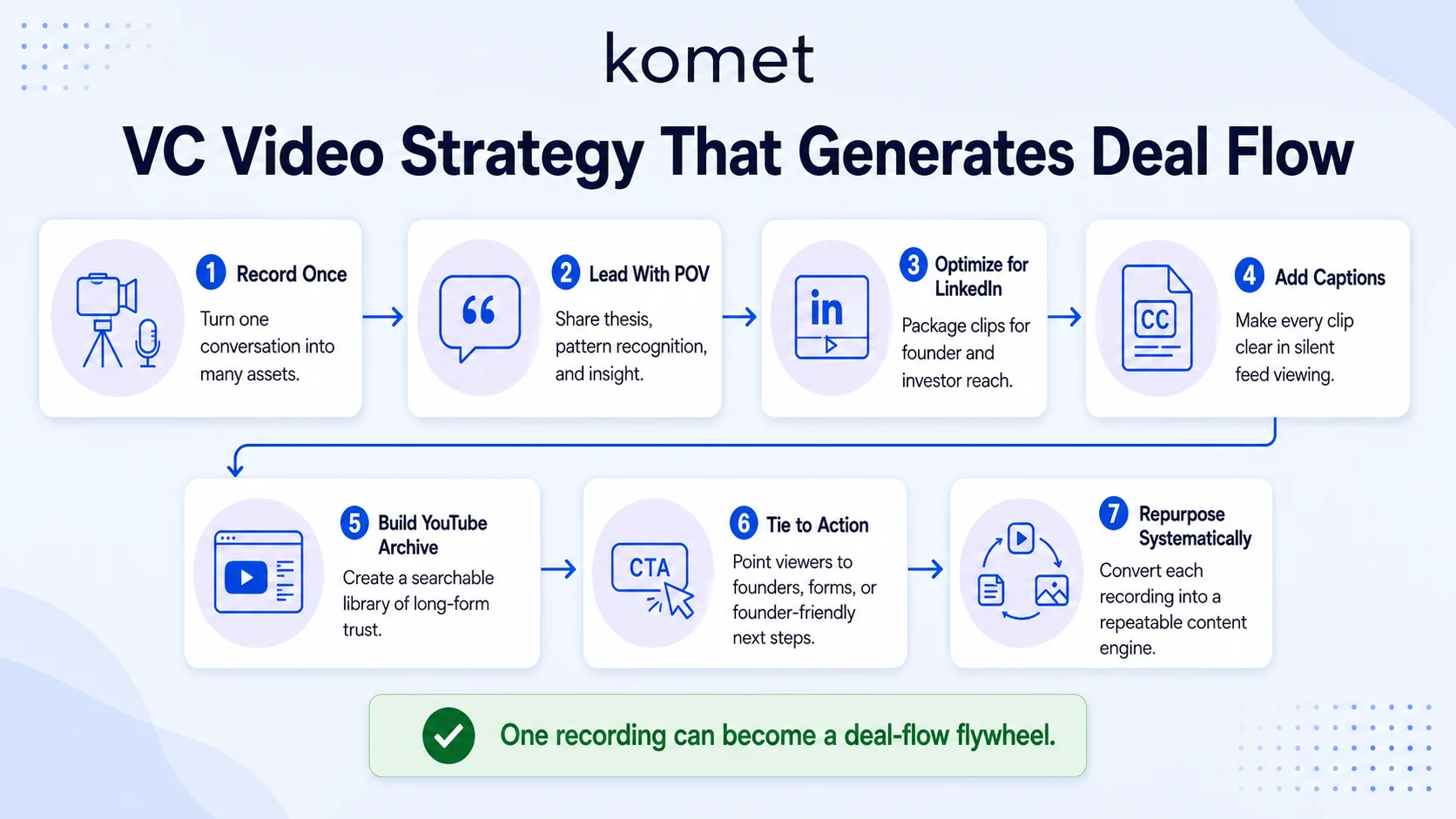
- Record once, distribute many: Every partner podcast appearance, LP webinar, and portfolio founder conversation is a raw content asset. One 45-minute recording yields 8–12 short clips.
- Lead with a point of view: Generic sector updates do not build authority. Specific contrarians do. "Why we passed on 14 AI companies before finding the one we wanted" beats "AI is an exciting space."
- Optimize for LinkedIn video first: LinkedIn saw a 36% increase in video views in 2025, alongside YouTube Shorts' 200 billion daily views. These are the two platforms your founders and LPs are already using.
- Use captions on every clip: With over 85% of social video viewed with the sound off, silent autoplay captions are critical for engagement and completion rates.
- Build a YouTube channel as your long-form archive: YouTube functions as a searchable library for institutional investor outreach. A founder researching your firm at 11pm will find your thesis videos before they find your website.
- Tie every video to an action: Demo request, newsletter sign-up, LP deck download, or podcast follow. Video without a downstream action is awareness spend, not deal flow spend.
- Repurpose systematically: Turn podcast episodes into clips, webinar recordings into short-form assets, and long-form YouTube pieces into LinkedIn teaser clips. This is the exact model Komet Media's B2B content repurposing service is built around.
Companies utilizing video marketing experience 49% faster revenue growth compared to those that don't. For a fund, faster deal flow, shorter LP fundraising cycles, and more inbound from high-quality founders are the direct equivalents of revenue growth.
How to Showcase Portfolio Companies Through Video
Portfolio company marketing is the most underused lever in the VC video playbook. When a VC firm creates video content that features its portfolio founders, three things happen: the portfolio company gets distribution it could not buy, the VC firm demonstrates thesis validation to LPs, and founders in future fundraising rounds see how the firm treats its portfolio publicly.
The formats that work:
- Founder spotlight series: A three-to-five-minute recorded conversation between a GP and a portfolio founder. Shot cleanly on a talking-head setup. Published monthly.
- "Why we invested" videos: The GP explains the investment thesis for a specific portfolio company in 90 seconds. The portfolio company shares it. Both audiences grow simultaneously.
- Milestone announcement clips: Portfolio company hits a funding round, a major customer, or a product launch. The GP records a 60-second celebration clip. This signals active involvement to both founders and LPs.
- Co-created content: Invite portfolio founders to contribute a clip to your regular GP video series. Founder storytelling is native advertising for your investment thesis.
a16z's New Media team has produced launch videos contributing to viral announcements. Portfolio founders have noted: "This entire launch from the video to the socials to the press briefings is genuinely impossible to pull off with any other venture investor in the world."
You don't need a16z's production budget to implement this. A clean camera, consistent lighting, and tight editing are enough. What matters is consistency and framing. Every portfolio video should communicate: here is why this company exists, why this market matters, and why our firm was the right investor. That is your pitch narrative framework, made visible.
For VC firms running short-form video production at volume, repurposing portfolio founder interviews is the most efficient path to a consistent content calendar without increasing recording time.
Video Marketing Mistakes VC Firms Should Avoid
Most VC video content fails for predictable reasons. Knowing the failure modes upfront saves months of wasted effort.

Mistake 1: Producing for polish instead of trust. Over-produced, highly branded firm videos feel like a corporate brochure. In the face of an onslaught of AI-only video, brands need to emphasize authenticity and solid storytelling to connect with viewers. Founders trust GPs who speak directly on camera more than they trust motion-graphic explainers.
Mistake 2: No distribution plan. Publishing a video to a firm website with no LinkedIn or YouTube amplification means almost no one sees it. Distribution is not optional. That is the point.
Mistake 3: Treating video as one-off projects. Every successful firm treated video as a business investment with defined budgets, not as "something we should probably do" funded by whatever's left over. Build a production cadence, not a project list.
Mistake 4: Ignoring LP communications. Most VC video strategy focuses entirely on founder acquisition. LP communications through video, specifically quarterly update clips and portfolio milestone videos, dramatically improves LP retention and re-subscription rates for subsequent funds.
Mistake 5: Measuring vanity metrics. Views and likes are not deal flow. The right metrics are: inbound founder inquiries sourced from video, LP re-ups attributed to content touchpoints, and co-investor relationships initiated through content. Video has the highest engagement of any B2B content format, but it also has the most poorly measured ROI. Marketing teams celebrate view counts while CFOs ask how much of the pipeline the video actually influenced.
Mistake 6: Letting competitors own search. If a founder searches "Series A SaaS investor thesis" on YouTube and your firm has no video results, a competing firm will shape that founder's expectations before you get a meeting. YouTube for finance is a search engine. Treat it like one.
What Makes a Good Venture Capital Firm YouTube Channel?
The major video marketing trends shaping strategy in 2026 show that video will remain central to brand visibility, engagement, and customer journeys as formats and technologies evolve. Short-form video stays essential for brand awareness and engagement across TikTok, Instagram Reels, and YouTube Shorts.
For a VC firm, a high-performing YouTube channel has five characteristics:
- A clear thesis on the channel page: Visitors should know in under 10 seconds who you back, at what stage, and why. Your channel description is your pitch to founders who found you through search.
- Consistent playlist structure: Organised by content type: GP Perspectives, Portfolio Spotlights, LP Updates (public versions), and Series A Insights. Founders and LPs self-navigate to what's relevant.
- Regular upload cadence: Frequent, consistent posting was the common thread among top-performing executives on LinkedIn. Even executives with just a few thousand followers generated meaningful business results when their content was intentional and regular. The same applies on YouTube. Two to four videos per month beats six videos per quarter.
- Searchable titles and descriptions: Titles like "How We Evaluate SaaS Unit Economics Before Series A" rank for exactly the queries your target founders are typing. Generic titles like "Fund Update Q2" do not.
- Repurposed long-form content: Your YouTube video editing workflow should pull from existing recordings: webinars, panel appearances, recorded conversations with portfolio founders. This keeps production cost low while building a deep content library.
Short-form video is now the most leveraged content format and the highest ROI channel. In 2025, 104% more marketers named it their most valuable channel compared to 2024, and it's where investment is growing fastest for 2026.
A VC YouTube channel that publishes 40 to 50 videos per year will outperform a channel with 8 polished videos every time, because volume creates search surface area, and search surface area creates inbound deal flow from founders you have never met.
Conclusion
The Video Marketing Playbook for VC Firms comes down to three commitments:
- Consistency over polish: A GP on camera twice a week beats a branded brand film published once a quarter. Authenticity compounds.
- Distribution is the strategy: Record once, repurpose everywhere. One recorded conversation becomes LinkedIn clips, a YouTube video, a podcast episode, and LP update content simultaneously.
- Measure what moves deals: Track inbound founders, LP re-ups, and co-investor relationships, not views.
The firms that build this system in 2026 will have a structural advantage in deal flow, LP retention, and brand authority that compounds for years. The firms that wait will be playing catch-up to partners who are already visible. Start with one GP, one camera, and one clear point of view. We can help you build the system from there.
Frequently Asked Questions
Q1: How do VC firms use video marketing to attract founders?
VC firms attract founders through GP talking-head clips that communicate investment thesis, portfolio founder spotlight series that prove team quality, and YouTube channels that answer the exact questions founders search before starting a fundraise. Video reaches founders before a warm intro ever does.
Q2: Should an emerging fund manager invest in video content marketing right now?
Yes. Reputation doesn't exist without visibility. A quiet investor in 2025 isn't a mysterious figure working behind the scenes. It's a name founders don't recognize, and worse, don't consider. Emerging managers benefit most from video because it levels the brand playing field against larger, more established firms.
Q3: What is the Andreessen Horowitz media playbook and can smaller funds replicate it?
a16z's New Media initiative is designed to help startups navigate building a brand and capturing audience attention, positioning itself as "go-direct as a service." Smaller funds can replicate the core logic: individual GPs building LinkedIn video brands, repurposing recordings across platforms, and using owned channels for distribution. You don't need a16z's team size to execute the same compounding strategy.
Q4: How often should a VC firm post video content?
Two to three LinkedIn clips per GP per week is the recommended floor. One longer YouTube video per month drawn from a recorded conversation or webinar. Consistency beats frequency. A GP who posts two thoughtful clips every week for 12 months will outperform a firm that posts a polished series twice a year.
Q5: What video formats work best for LP communications?
Quarterly update videos of five to eight minutes, recorded by the managing partner, significantly reduce LP meeting load while improving retention. Portfolio founder milestone clips give LPs proof of thesis execution. Public versions of LP Q&A sessions also build institutional investor trust with prospective LPs for future funds.
Q6: How does content repurposing reduce video production costs for VC firms?
One 45-minute recorded conversation (a GP interview, a panel appearance, a portfolio founder Q&A) yields 8 to 12 short-form clips for LinkedIn, one trimmed YouTube video, and source material for a podcast episode. This repurposing model compounds your content creation efforts and feeds multiple platforms without reinventing the wheel. For small fund teams, this is the only sustainable way to maintain volume without a full production team.