
🪄 AI Summary
Heading 1
Heading 2
Heading 3
Heading 4
Heading 5
Heading 6
Lorem ipsum dolor sit amet, consectetur adipiscing elit, sed do eiusmod tempor incididunt ut labore et dolore magna aliqua. Ut enim ad minim veniam, quis nostrud exercitation ullamco laboris nisi ut aliquip ex ea commodo consequat. Duis aute irure dolor in reprehenderit in voluptate velit esse cillum dolore eu fugiat nulla pariatur.
Block quote
Ordered list
- Item 1
- Item 2
- Item 3
Unordered list
- Item A
- Item B
- Item C
Bold text
Emphasis
Superscript
Subscript
Most founders are producing content. Few are distributing it with any strategy behind it. If your videos are landing with 200 views and a handful of likes from your existing team, the problem is rarely the content itself, it's the system, or more precisely, the lack of one. This is a LinkedIn Video Distribution Playbook built for founders, CEOs, and tech executives who want real visibility with buyers, investors, and future hires. Not viral moments. A repeatable engine.
TL;DR
- LinkedIn video is no longer experimental, in 2026, it generates 3 to 5 times more organic reach than text posts.
- Native upload always beats a YouTube link. Always.
- Your personal profile, not your company page, is the distribution lever.
- Repurposing existing conversations is the fastest path to consistent video output.
How the LinkedIn Algorithm Actually Works for Business Leaders in 2026
Before any distribution tactic makes sense, you need to understand what you're distributing into. The LinkedIn algorithm in 2026 has one primary goal: keep users on the platform. Everything flows from that. LinkedIn's 2026 algorithm is driven by a unified AI ranking system called 360Brew, which replaced the legacy content infrastructure. The practical result is that the algorithm now scores content heavily on dwell time, how long someone actually pauses on your post before scrolling. The longer they stay, the wider your distribution.
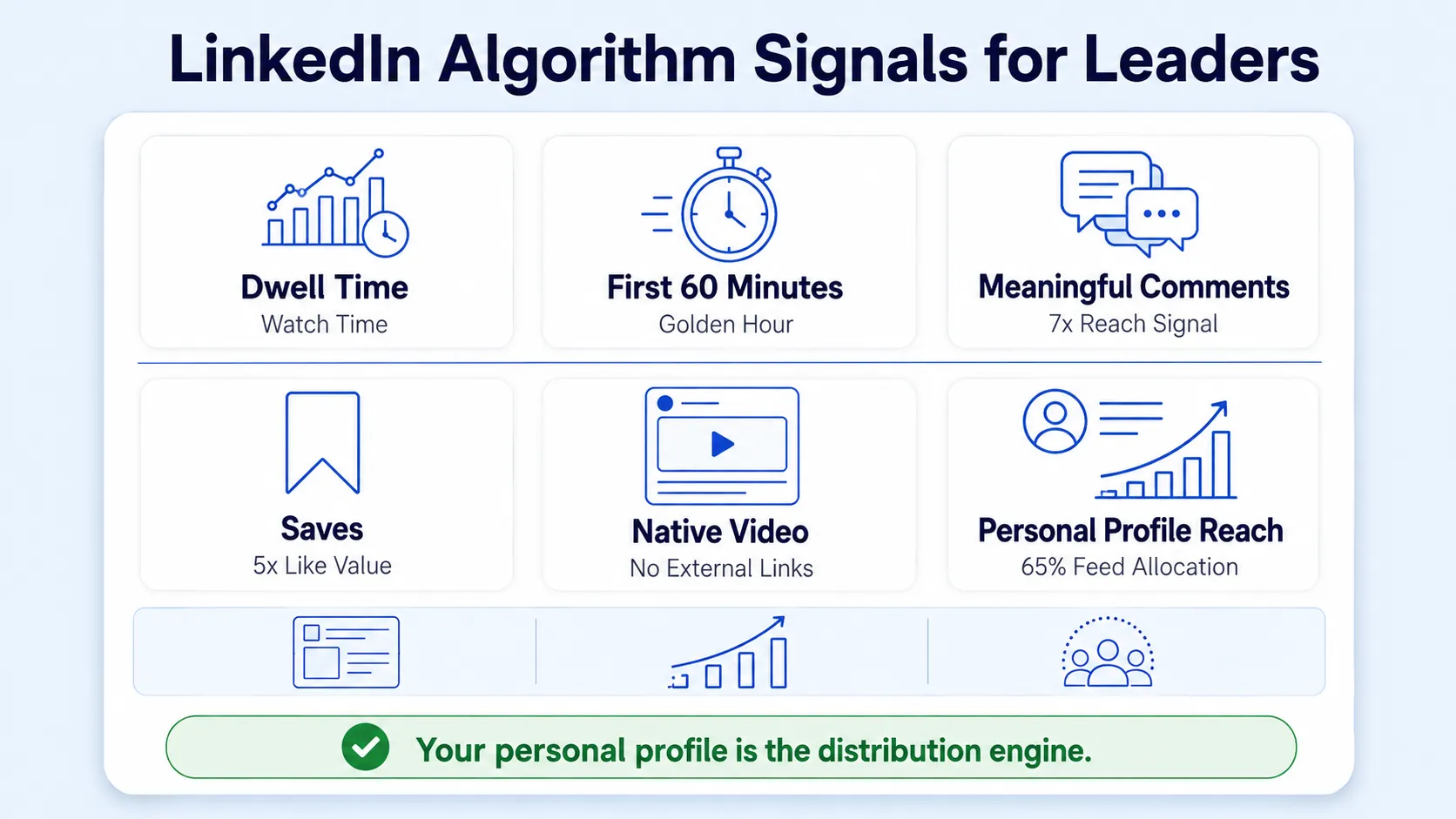
The first 60 minutes after posting determine your post's reach. Comments drive 7x more algorithmic reach than likes, so posts that invite specific, meaningful responses compound faster. A save is worth 5x more than a like, and a meaningful comment boosts reach twice as much as a save. This hierarchy matters enormously for how you structure a video's call to action. For native video specifically, the algorithm has shifted decisively.
Native video uploads, not YouTube links, not Vimeo embeds, but actual uploaded video files, are receiving 2 to 3 times the initial distribution of text-only posts. Posts with external links see approximately 60% less reach than posts without them. This is the single most important technical rule in A LinkedIn Video Distribution Playbook. Put your YouTube link in the first comment. Not the post body. Never the post body. Personal profiles receive 65% of LinkedIn feed allocation, while company pages receive just 5%.
For B2B founders, this is the structural advantage that makes personal brand investment the highest-leverage move on the platform. Your company page is a support channel. Your personal profile is the distribution engine. Consistency beats frequency, three high-quality posts per week for 60 days builds more algorithmic authority than daily posting for two weeks. The algorithm needs topical coherence over time to understand who to show your content to.
What Video Types Perform Best for CEOs on LinkedIn
Not all videos are equal. The format, subject matter, and delivery style all drive meaningfully different outcomes. Talking-head videos featuring founders, marketers, or subject matter experts continue to perform strongly because they feel authentic and personal. When combined with text overlays and captions, this format becomes even more effective, allowing viewers to quickly understand context while building trust with the person speaking.
In 2026, AI-generated text floods professional feeds, and buyers have grown skeptical of written B2B content. Video with a real person on camera cuts through that skepticism in a way text simply cannot. 78% of B2B buyers prefer a message delivered via video compared to just 9% via text. The highest-performing content categories for executive video on LinkedIn:
- Point-of-view takes: Your opinion on an industry shift, a contrarian view on a common assumption, or a reaction to breaking news in your space.
- How-to frameworks: How-to tutorials are the most shared format on LinkedIn, they deliver immediate, concrete value, and a "how to do X in 3 steps" video will be saved and reshared far more than a promotional video.
- Behind-the-scenes: Behind-the-scenes content humanizes professional brands. Showing how a team works, how a product is designed, or what happens backstage at an event generates high identification rates and comment volume.
- Client results: Client results transformed into video format have greater impact than written case studies. Seeing a real person explain their results is more convincing than reading numbers on a page.
On format: Vertical video has become the most effective format for reach on LinkedIn because it aligns with mobile consumption, it takes up more screen space, feels native to modern scrolling behavior, and increases the chances of holding attention. Because LinkedIn videos autoplay without sound, captions are no longer optional. They are a core part of how your message is delivered, and well-designed captions can significantly improve watch time and completion rates.
LinkedIn Video vs. Text Posts: What the Data Says for Founders
This question comes up constantly, and the honest answer is: it depends on the goal. Here is the current format benchmark data that every founder running A LinkedIn Video Distribution Playbook should know:
Source: Socialinsider LinkedIn Organic Benchmarks, Q2 2026.
Video at 5.90% comfortably outperforms text at 3.95%. But the more important distinction is what each format does. Text posts build depth with your existing network. Video builds trust and reach with people who don't yet know you. For founders trying to expand their buyer pool, investor relationships, or executive presence beyond their current followers, video is the format.
The most actionable finding in LinkedIn data remains the personal-versus-company engagement gap. Posts from individual profiles receive 8x the engagement of identical content from company pages, and this gap is widening. LinkedIn video views are up 36% year-over-year in 2026, and comments have increased 37% year-over-year. The platform is rewarding video with real distribution. The founders posting consistently into this tailwind are building compounding authority while their competitors remain text-only.
How to Repurpose Long-Form Video Content for LinkedIn Distribution
This is where most founders leave the most value on the table. A single 45-minute podcast episode, panel recording, or all-hands call contains enough raw material for 8 to 12 LinkedIn video clips. Almost nobody does this systematically. At Komet Media, this is the exact system we build for B2B founders and executives. The idea is simple: you already have the conversation. We turn it into a steady stream of distribution-ready video assets. Here is the content repurposing workflow:
- Identify the source asset: Podcast episode, webinar recording, sales call debrief, investor Q&A, team all-hands, or conference talk. Each of these is a content mine.
- Extract the high-value moments: Look for strong opinions, counterintuitive claims, specific frameworks, or vivid stories. These are your clips.
- Edit to 30 to 90 seconds: Short clips between 30 and 90 seconds work best for discovery, while longer videos of 2 to 5 minutes are better suited for audiences who already know you.
- Add captions and a hook frame: The first three seconds determine everything. A bold statement or unexpected question in text overlay stops the scroll.
- Format for vertical (9:16): Vertical video (9:16, 1080x1920) takes up more screen real estate on mobile, where over 60% of LinkedIn usage happens. It is more immersive, harder to scroll past, and aligns with the short-form video feed.
- Upload natively: Never link to the YouTube version in the post body.
- Write a short post caption: Two to four lines max. Lead with the strongest line from the clip.
One of the biggest missed opportunities in B2B marketing is underutilizing webinar content. Most teams invest heavily in webinars but only use them once as a full-length recording. In reality, webinars are a goldmine of high-quality content that can be broken down into multiple short videos. If your team runs podcast episodes or webinars, you have a content repurposing strategy already waiting to be activated.
A Step-by-Step LinkedIn Video Distribution Strategy for B2B Founders in 2026
Tactics without a system produce inconsistent results. This is the operational framework behind A LinkedIn Video Distribution Playbook that actually compounds over time.
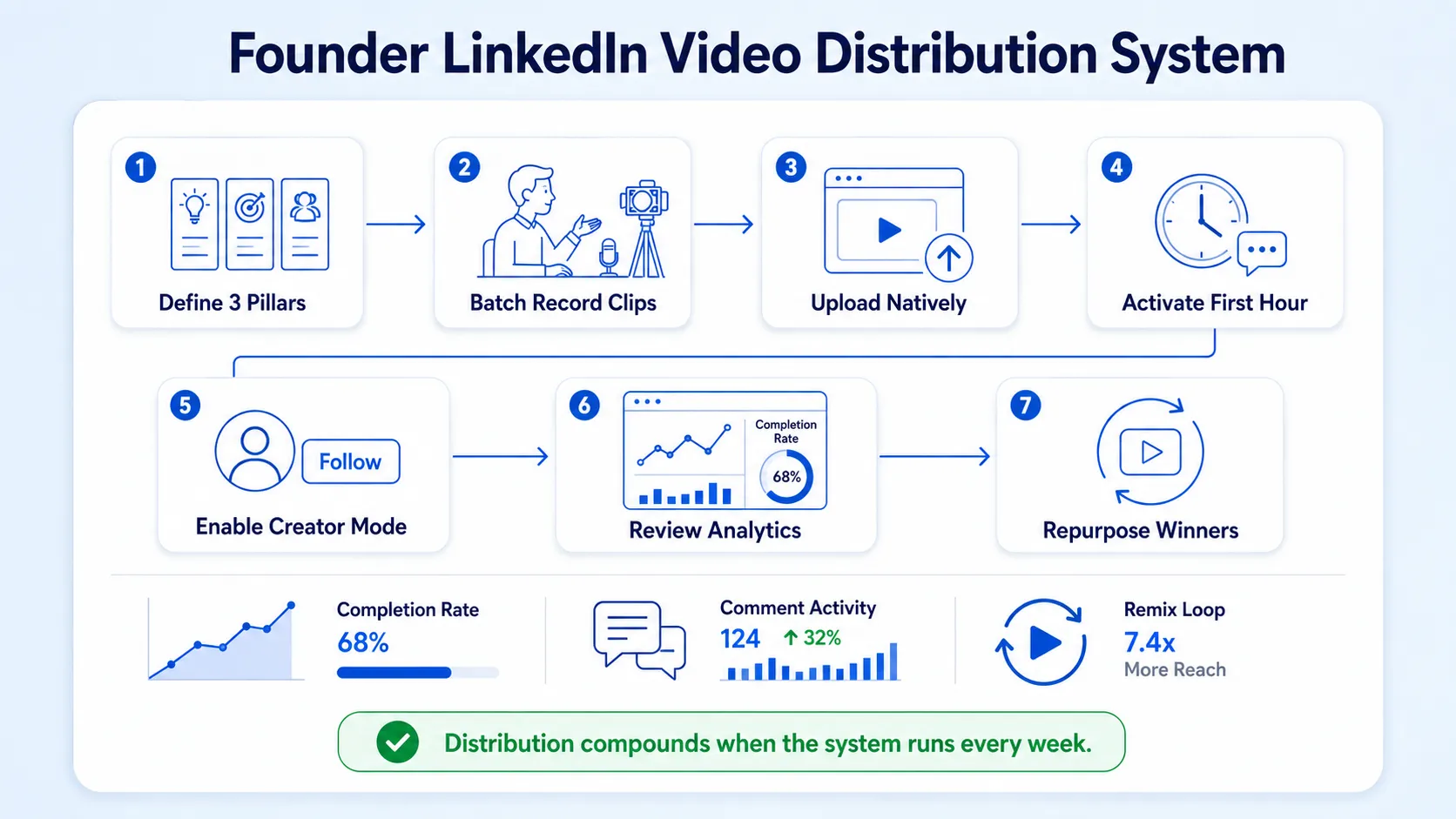
Step 1: Define your three content pillars. Every video you post should map to one of three themes aligned to your business goals, for example: category expertise, company building transparency, and buyer pain points. The algorithm rewards topical coherence. The algorithm analyzes your content's alignment with your profile's listed skills and interests, and consistency on niche topics establishes authority while targeting relevant professional audiences.
Step 2: Set a production cadence, not a posting cadence. Batch-record four to six clips per session. This gives you two to three weeks of content from a single hour of your time.
Step 3: Upload natively and optimize the post. Native video uploaded directly to LinkedIn gets 5 times more organic reach than an external video link. Write a caption that leads with the hook, not the context. Put any external links in the first comment.
Step 4: Activate your first-hour window. Engage with others' content 30 minutes before you post, activate your team to comment within the first hour, and reply to every single comment immediately. This is your distribution lever within the platform's "golden hour" scoring window.
Step 5: Enable LinkedIn Creator Mode. By 2025, over 16 million users had activated Creator Mode. It unlocks LinkedIn Analytics, a "Follow" button prioritized over "Connect," and access to LinkedIn Live, all of which amplify a video-first strategy.
Step 6: Review LinkedIn Analytics weekly. Track video completion rate, not view count. Watch time and completion rate are the most important metrics, LinkedIn wants to surface content that people actually watch, not just scroll past. Low completion signals a weak hook or wrong audience. Adjust both before posting the next clip.
Step 7: Repurpose top performers. A video that hits above your average completion rate contains a format, topic, or hook your audience responded to. Build your next three clips around the same structure. Review your content services to scale this systematically.
Common Mistakes Founders Make with LinkedIn Video Distribution
Knowing what not to do accelerates results faster than any tactic.
Posting YouTube links instead of native uploads: Every external link is an invitation to leave the platform. The algorithm penalizes posts that contain YouTube, Vimeo, or other external links. The correct strategy: upload the video natively to LinkedIn, then put the link to the original video in the first comment.
Treating the company page as the distribution channel: Company page organic reach dropped roughly 60 to 66% between 2024 and 2026. Your personal profile is where distribution happens.
Ignoring the hook: If most viewers drop off in the first three seconds, the algorithm throttles distribution. The first frame is not your logo. It is your strongest claim or most provocative question.
Over-hashtagging: Hashtags are now for categorization and SEO, not reach. Using more than three to five can trigger an algorithmic penalty.
Skipping captions: 85% of users watch LinkedIn videos without sound. A captionless video is a muted message.
Going dark for weeks, then posting in bursts: The algorithm needs four to six weeks of consistent topical signaling to learn what to amplify. Sporadic posting resets that learning window every time.
Producing without a distribution plan: Production is not a strategy. Getting the video into the right feeds, at the right time, from the right profile, that is the work. If you want support building the system, our team is built for exactly this. We help with both repurposing your library and creating original video content from scratch.
LinkedIn Video Distribution Playbook: Building Your Content Calendar
Consistency at volume requires a calendar, not inspiration. Here is how to structure a sustainable content calendar using A LinkedIn Video Distribution Playbook framework.
Weekly posting target: Three native video posts per week, each from your personal profile. One per pillar, rotating weekly so each theme gets equal weight over a month.
Monthly production session: Two recording sessions per month, producing six to eight clips each. That is twelve to sixteen clips per month from roughly two hours of your time.
Content mix by post type: In 2026, native video should represent roughly 40% of your posts, 30 to 120 seconds, usually on camera, talking about an idea, a decision, or a challenge you're working through. Complement video with PDF carousels (frameworks, lists, data insights) and short text posts (reactions, quick takes). This gives the algorithm format diversity while keeping video as your primary reach driver.
Posting windows: Post on Tuesday, Wednesday, or Thursday between 9 and 11 AM for peak decision-maker attention.
Thumbnail optimization: Create a custom thumbnail with a human face. A face in the thumbnail increases click-through before autoplay even triggers. Use consistent visual branding, same font, same color treatment, so your content becomes recognizable in the feed over time.
Distribution amplification: For each video post, share it internally with your team. Employee posts get 2x more engagement than corporate posts. When three colleagues comment within the first 30 minutes, that signals to the algorithm that this content is worth wider distribution.
Track your progress in LinkedIn Analytics weekly. Look for: completion rate trends, follower growth from your ICP, and inbound DM volume from people who found you through content. These are the leading indicators that A LinkedIn Video Distribution Playbook is working. Our video marketing services are designed to help you operationalize this calendar so you never miss a week.
Conclusion
A LinkedIn Video Distribution Playbook is not a content calendar. It is a trust-building system. The founders who win on LinkedIn in 2026 are not posting the most, they are distributing the most strategically.
Key takeaways:
- Native video upload is non-negotiable. Link penalties are real and immediate.
- Your personal profile outperforms your company page by 8x. Post there.
- Repurpose existing conversations, podcasts, webinars, panels, into short clips.
- The first 60 minutes after posting decide your reach. Show up to that window.
- Consistency over 60 days compounds algorithmic authority faster than viral spikes.
Ready to build the system? Start here.
Frequently Asked Questions
Q1: How often should a founder post a video on LinkedIn?
Three times per week is the optimal cadence for most founders. Consistency beats frequency, three high-quality posts per week for 60 days builds more algorithmic authority than daily posting for two weeks. Batch your recording so posting stays consistent even in a busy schedule.
Q2: What is the ideal length for a LinkedIn video in 2026?
For organic B2B content, 60 to 90 seconds is consistently the most effective duration, long enough to make a substantive point and short enough to hold attention in a professional feed. For discovery content targeting new audiences, staying under 90 seconds maximizes completion rate.
Q3: Should I use LinkedIn Creator Mode as a founder?
Yes, without exception. Creator Mode unlocks LinkedIn Analytics, prioritizes your "Follow" button for new visitors, and expands your access to LinkedIn Live. LinkedIn Live generates 24x higher engagement than static posts , making it a powerful accelerant once your video foundation is established.
Q4: Why is my LinkedIn video getting low views even with good content?
The most common culprits: posting a YouTube link instead of uploading natively, posting from your company page instead of your personal profile, or having weak hook frames that cause viewers to drop in the first three seconds. If most viewers drop off in the first three seconds, the algorithm throttles distribution regardless of content quality.
Q5: Can I repurpose the same video across LinkedIn and other platforms?
Yes, with adaptation. What works on LinkedIn (direct-to-camera, caption-heavy, professional framing) differs from Instagram or TikTok. The core clip can be reused, but the caption, hook frame, and aspect ratio should be optimized per platform. Our short-form video editing service handles this natively.
Q6: How long before LinkedIn video content shows measurable business results?
Expect 60 to 90 days before you see consistent inbound signals, DMs from ideal buyers, investor curiosity, or recruit outreach. The algorithm needs four to six weeks to learn your audience, and your audience needs repeated exposures to trust you. Consistency in the first 90 days is the only variable that matters.