
🪄 AI Summary
Heading 1
Heading 2
Heading 3
Heading 4
Heading 5
Heading 6
Lorem ipsum dolor sit amet, consectetur adipiscing elit, sed do eiusmod tempor incididunt ut labore et dolore magna aliqua. Ut enim ad minim veniam, quis nostrud exercitation ullamco laboris nisi ut aliquip ex ea commodo consequat. Duis aute irure dolor in reprehenderit in voluptate velit esse cillum dolore eu fugiat nulla pariatur.
Block quote
Ordered list
- Item 1
- Item 2
- Item 3
Unordered list
- Item A
- Item B
- Item C
Bold text
Emphasis
Superscript
Subscript
B2B buyers don't trust logos anymore. They trust people. That shift is exactly why founder-led content is winning in B2B right now, and why the companies ignoring it are getting outsold before a demo is ever booked. If you lead a SaaS or AI startup and your team is still betting everything on brand channels and outbound sequences, this guide is the strategic wake-up call you need. Every section connects to real data, actionable moves, and the specific reasons this approach drives pipeline and inbound at a scale most companies haven't seen from their content yet.
TL;DR
- Founder content on LinkedIn generates 5–8x more engagement than company page posts.
- 73% of the B2B buying journey is invisible to standard tracking, happening in Slack, private DMs, and peer conversations.
- In 2026, founder-led marketing outperforms traditional B2B campaigns because buyers have lost trust in faceless institutions and AI-generated content.
- Short-form video is the fastest way to scale a founder's voice across every stage of the funnel.
What Is Founder-Led Content, and Why Does It Matter for B2B Companies?
Founder-led content is exactly what the name says: the founder shows up, shares their perspective, and builds trust publicly. Not through a brand account. Not through a polished press release. Through their own voice, their own LinkedIn profile, their own face on video. For B2B companies specifically, this matters because B2B buyers don't form relationships with logos. A founder candidly discussing product development challenges, a marketing director breaking down campaign results, these create the foundation for real business relationships.
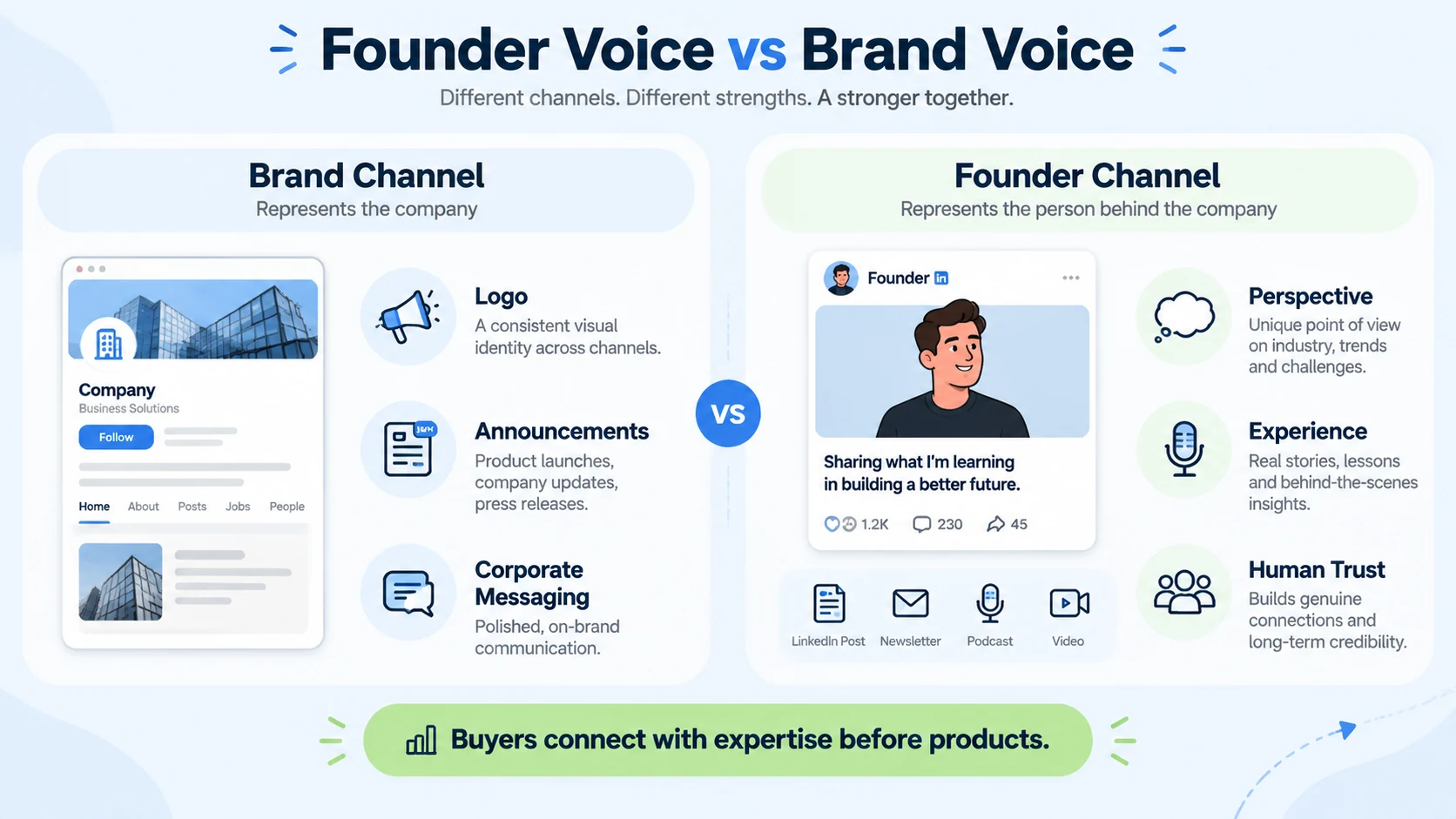
The shift is structural. 52% of B2B marketers plan to invest more in thought leadership, because buyers want insights, not just pitches, and this opens the door for founders, executives, and employees to step into more visible, authentic roles. What counts as founder-led content in practice:
- LinkedIn posts sharing a contrarian point of view, a hard lesson, or a real decision
- Short-form video clipped from a podcast, webinar, or product demo
- Newsletter content written in the founder's actual voice
- LinkedIn audio events, AMAs, and live sessions
- Repurposed keynote or conference clips
Lenny Rachitsky's newsletter now reaches over 1 million subscribers with deep, founder-authored insights on product growth, built almost entirely on one person's authentic perspective, not a brand machine.
At Komet Media, I work with SaaS and AI startup teams to build short-form video assets from scratch or repurpose existing recordings. Founders have the ideas. The bottleneck is always production and consistency, which is a systems problem, not a talent problem.
Why Founder-Led Content Is Winning in B2B isn't a trend you can ignore and revisit later. The buyers you want to reach are already forming their shortlists based on who they've been watching for months. If your founder isn't in that feed, you're not on the list.
Why Is Founder-Led Content Working So Well in B2B Right Now?
Three forces converged to make this the moment for founder-led content.
1. Trust in institutions has collapsed. Seven in ten people believe government officials, business leaders, and journalists deliberately mislead them with things they know are false or gross exaggerations, according to the 2025 Edelman Trust Barometer. The strategic shift toward founder-led marketing in 2026 is structurally tied to unprecedented shifts in global trust, with the 2026 Edelman Trust Barometer, surveying nearly 34,000 respondents across 28 countries, identifying severe contraction in institutional confidence. Buyers are moving their trust to individuals they can read, watch, and verify over time.
2. The buying journey is self-directed and mostly invisible. B2B buyers now complete 70–80% of their purchase journey before ever engaging with a sales rep, and 61% prefer a completely rep-free experience. 6sense's 2025 Buyer Experience Report found that 95% of the time the winning vendor is already on the buyer's Day One shortlist, and the pre-contact favorite wins roughly 80% of deals. That means the trust your team builds through social shapes decisions long before a tracked click ever happens.
3. AI-generated content has flooded every channel. Generic brand content now drowns in a sea of synthetic noise. In 2026, founder-led marketing outperforms traditional B2B campaigns specifically because buyers have lost trust in faceless institutions and AI-generated content, and founders who share transparent operational realities accelerate trust and significantly lower customer acquisition costs.
These three forces are permanent, not cyclical. The founder who starts building now compounds every quarter. The one who waits loses ground that is increasingly expensive to recover.
Why Does Founder Content Outperform Brand Content on LinkedIn?
The data here is unambiguous. Personal profiles consistently outperform company pages by 5–8x on engagement. LinkedIn's algorithm distributes personal profile content through social graphs and interest signals, while company page content primarily reaches followers, making personal content the primary organic growth channel for most B2B businesses. The structural gap is worsening for brand accounts.
LinkedIn company page organic reach sits at 1.6% of followers in 2025, down from 7% in 2021, measured across 1.8 million posts. Between 2024 and early 2026, company page content lost 60–66% of its organic reach, a structural shift, not a temporary dip. Sprout Social's Q1 2026 data puts median engagement at around 4.7% for personal content versus 1–2% for company pages. The algorithm explains the gap.
Richard van der Blom's 2025 analysis of 1.8M posts shows that posts triggering 3+ commenters in the first 60 minutes get approximately 5.2x reach amplification, a window where personal profiles structurally outperform brand pages because peers comment more on personal content than on brand posts. Personal-style videos featuring real people outperform corporate motion graphics by 44% in reactions. This is the argument for getting the founder on camera.
For our clients at Komet Media, short-form video editing done right captures this advantage at scale—whether creating content from scratch or turning a single recording into a week's worth of LinkedIn-native clips designed to trigger early engagement in that critical first-hour window.
The takeaway: LinkedIn is now a person-first platform. Your company page is a proof page. Your founder's profile is your actual distribution engine.
Founder-Led Content Strategy: Real Examples from B2B Companies
The clearest case study is also the most studied. In February 2025, Sam Altman posted OpenAI's developer roadmap on X, explaining plans to simplify OpenAI's product offerings. That post generated 7M views and sparked widespread industry discussion, reinforcing his technical leadership in public, an excellent example of founder-led content positioning driving visibility and credibility.
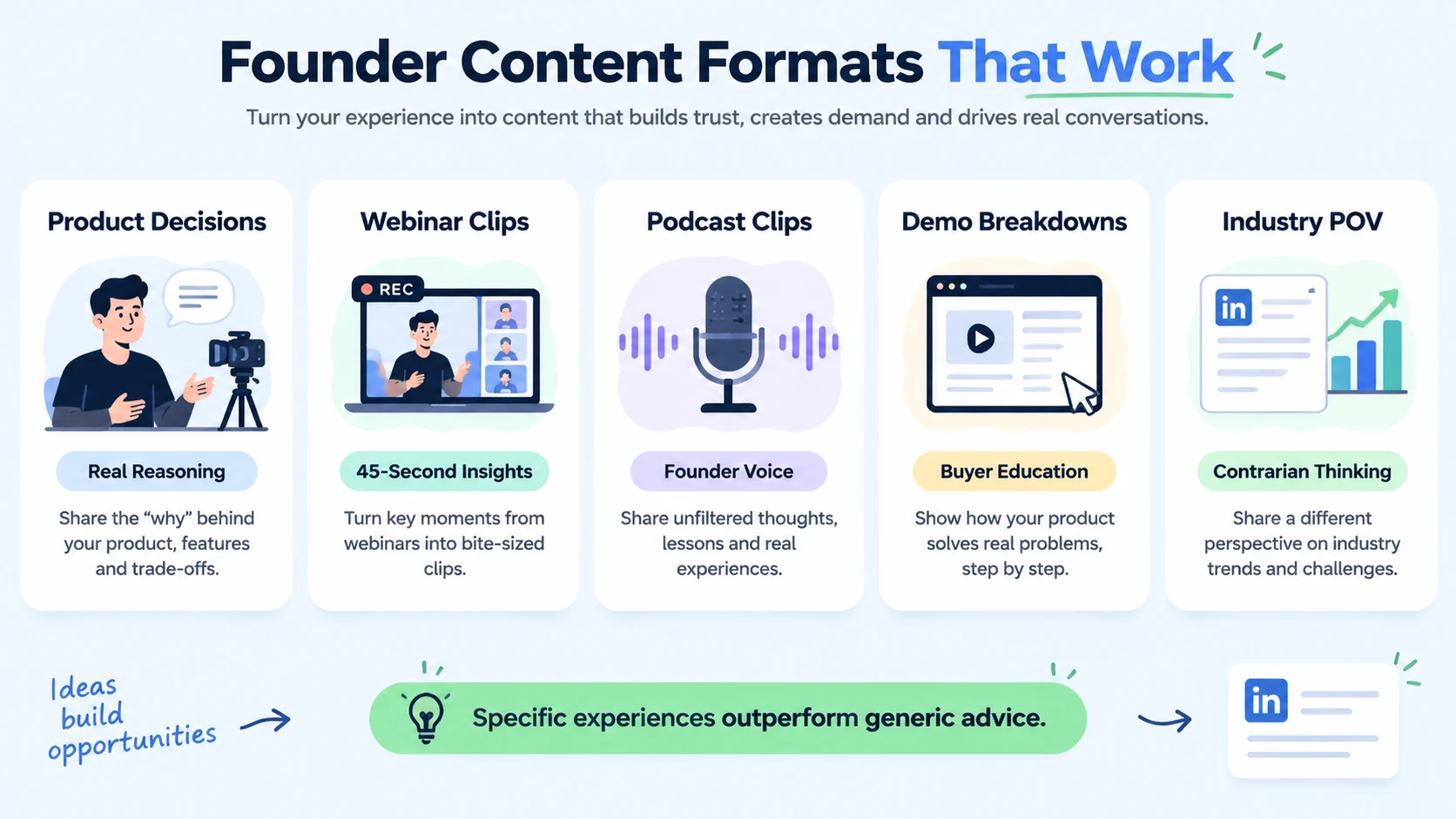
But you don't need Sam Altman's audience to make this work. The pattern scales down:
- Product decision posts: A SaaS founder explains why they killed a feature that users loved. Real reasoning, no PR polish. These outperform company announcements consistently.
- Webinar-to-clip repurposing: A 45-minute webinar becomes 6–8 short LinkedIn videos, each teaching one sharp insight from the session.
- Podcast clipping: A podcast episode featuring the founder becomes 10 vertical clips distributed across LinkedIn, YouTube Shorts, and Instagram Reels.
- Demo breakdowns: Instead of a gated product tour, a 90-second founder walkthrough of a key use case, posted publicly, pre-educates buyers before sales ever reaches out.
Founders with active LinkedIn profiles generate 3–5x more inbound leads than company pages, and founders who share real numbers, real decisions, and real trade-offs outperform those who share tips and frameworks.
The common thread: specificity wins. Generic insights can come from anywhere. Specific decisions, specific failures, and specific product logic can only come from the person who lived it. That's the content no AI can replicate and no brand account can deliver.
How B2B Founders Build Trust Through Content Creation
Trust in B2B isn't a marketing metric. It's a buying condition. 73% of B2B executives say peer recommendations and word-of-mouth are the #1 influence on their purchasing decisions, trust is built in networks, not just on your website.
Founders build trust with content by showing up with honesty and transparency. In B2B startups especially, trust drives deals. In a founder-led business, trust flows directly from the founder's voice to the audience, and that voice doesn't need to be polished, it just needs to be authentic and illustrate how well you understand the problem.
The mechanics of building trust through content:
- Share the thinking, not just the outcome. Explain why you made a decision, not just what you decided. Buyers want to know how you reason.
- Document process in public. Building in public, showing what's working, what isn't, and what you're changing, creates social proof that compounds over time.
- Educate without gating. Put your best product insights into free short videos. 68% of B2B buyers already have a front-runner vendor in mind at the very start of the purchasing process, and that front-runner wins roughly 80% of the time. To be that front-runner, you have to be visible before the buying conversation starts.
- Be consistent, not just occasional. Publishing five posts in one week and going silent for a month confuses the algorithm and trains your audience to forget you exist.
- Use video for the highest-trust format. Seeing someone's face and hearing their voice bypasses the skepticism that text triggers. Our video marketing services exist for exactly this reason.
When a buying committee shares your executive's LinkedIn post in their internal Slack channel, that high-intent action never appears in your reports. The result: social's true pipeline contribution looks weaker than it actually is, and budget decisions get made on incomplete data. Founder content is doing more pipeline work than your attribution model shows.
How to Start Creating Founder-Led Content for Your B2B Business
The biggest objection I hear from founders: "I don't have time to create content." That's a production problem, not a time problem. The founders producing the best content aren't writing, they're talking. The workflow: record a 5-minute voice memo about something that happened this week, have it transcribed and structured. This solves the biggest bottleneck in founder branding: the CEO doesn't have time to write. Here's the system I recommend:
- Record a 10–20 minute founder session, a weekly product reflection, a lesson from a customer call, a take on an industry shift. No script required.
- Repurpose or create short-form clips (60–90 seconds each) for LinkedIn, Instagram Reels, and YouTube Shorts. Our short-form video editing team handles the end-to-end production process, whether starting from scratch or working from existing footage.
- Extract a LinkedIn text post from the same session, one sharp insight, founder voice, first-person.
- Pull a clip for sales enablement, a 2-minute product explainer your reps can drop into outbound sequences and proposals.
- Schedule consistently, 3–4 LinkedIn posts per week, at least 2 videos per week.
- Engage in the first 60 minutes after posting. Comments early signal quality to the algorithm and compound distribution.
This is why Founder-Led Content Is Winning in B2B: it's not about heroic effort. It's about building a repeatable system around the founder's knowledge that already exists. Check our services page to see how we build this for SaaS and AI startup teams end-to-end.
Is Founder-Led Content a Trend or the Future of B2B Marketing?
Short answer: it's structural, not cyclical. Wyzowl's 2026 State of Video Marketing Report, polling 1,140 B2B marketing professionals and 620 B2B buyers across 17 industries, found that 74% of B2B marketers increased their video content investment, up from 61% in 2025. That trajectory doesn't reverse.
94% of B2B buyers are using AI tools like ChatGPT during their buying process, and nearly 29% start their research with an AI tool more often than a search engine, with over half asking AI for vendor shortlists before ever Googling. AI recommendations favor brands and founders with visible, high-credibility public content. Anonymous brand pages don't get cited. Known people do.
The competitive moat of founder content grows with time. A founder who has been posting consistently for 18 months has a body of work, a community, and a reputation that no paid campaign can replicate quickly. Gary Vaynerchuk built an enterprise-level demand generation machine on this exact principle, years before it became the playbook for every B2B category.
Organic social media works best for credibility, founder-led content, employee advocacy, brand point of view, and regular audience engagement. It is slower, but it builds trust and rewards consistent B2B content distribution strategies more than sporadic posting.
The companies that win in B2B over the next three years will be the ones that built personal brand equity early, when it was still compounding cheaply. That window is closing. Why Founder-Led Content Is Winning in B2B isn't a 2026 observation; it's a decade-long structural shift that's now in full acceleration. The brands treating it as optional are the ones that will spend twice as much on compensation later.
Get in touch with Komet Media to build a founder content system that turns your knowledge into a pipeline.
Conclusion
- Personal profiles outperform company pages by 5–8x on LinkedIn engagement, your founder's profile is your most powerful distribution channel.
- Buyers have lost trust in faceless institutions and AI-generated content; founders who share transparent operational realities accelerate trust and lower acquisition costs.
- 73% of B2B executives say peer recommendations are the #1 influence on purchasing decisions, founder content directly feeds that recommendation loop.
- The system beats the effort: record once, repurpose into short-form video, distribute consistently, and let the compound effect work. Why Founder-Led Content Is Winning in B2B is not a debate, it's a distribution strategy ready to be built.
Frequently Asked Questions
Q1: What exactly is founder-led content in a B2B context?
Founder-led content is any content published under the founder's personal brand rather than the company brand, LinkedIn posts, short videos, podcast appearances, newsletters, or public talks. It works because buyers trust people before they trust products. The founder's voice signals authenticity and expertise that a brand account structurally cannot.
Q2: How often should a B2B founder post on LinkedIn?
Company pages benefit from 3–5 posts weekly, while personal profiles perform well with 2–4 posts weekly. For founders focused on pipeline impact, 3–4 posts per week with at least one video is the minimum consistent cadence. Consistency matters more than frequency, showing up weekly for 12 months beats a burst of daily posts followed by silence.
Q3: Does founder-led content actually influence pipeline and revenue?
Yes, though it's often undercounted. Self-reported attribution consistently reveals that 30–50% of pipeline originates from channels digital attribution cannot see. Founder content drives dark social recommendations, pre-contact brand recognition, and AI assistant citations, none of which show up in last-touch reporting but all of which shape whether a buyer puts you on the shortlist.
Q4: What types of content work best for B2B founders?
Short-form video, opinion-led LinkedIn posts, and decision breakdowns consistently outperform generic tips content. Posts about what went wrong outperform posts about what went right by a wide margin, failure stories feel honest and provide lessons the reader can apply. Specificity and real stakes beat polished frameworks every time.
Q5: How do I convince a skeptical founder to start creating content?
Show them the math on dark social and pre-contact shortlisting. 68% of B2B buyers already have a front-runner vendor in mind at the very start of the purchasing process, and that front-runner wins roughly 80% of the time. If your founder isn't visible before buying conversations start, someone else's founder is. Frame it as competitive defense, not personal branding vanity.
Q6: Can a founder's content be repurposed efficiently without taking hours each week?
Absolutely, this is exactly what a video growth system solves. Whether building a creative library from scratch or recording a 10–20 minute session once per week, a team like Komet Media handles script writing, production, short-form clips, LinkedIn posts, sales enablement videos, and podcast edits, so the founder's time investment stays minimal while content output stays consistent and high-volume.