
🪄 AI Summary
Heading 1
Heading 2
Heading 3
Heading 4
Heading 5
Heading 6
Lorem ipsum dolor sit amet, consectetur adipiscing elit, sed do eiusmod tempor incididunt ut labore et dolore magna aliqua. Ut enim ad minim veniam, quis nostrud exercitation ullamco laboris nisi ut aliquip ex ea commodo consequat. Duis aute irure dolor in reprehenderit in voluptate velit esse cillum dolore eu fugiat nulla pariatur.
Block quote
Ordered list
- Item 1
- Item 2
- Item 3
Unordered list
- Item A
- Item B
- Item C
Bold text
Emphasis
Superscript
Subscript
Your buyers are doing more research independently than ever before, and they're not trusting your pitch deck. What they trust is proof, specifically, a real customer, on camera, describing the exact problem you solved. Case study videos are the highest-trust asset you can put in front of a decision-maker at the consideration stage, and if your sales team isn't using them systematically, you're losing deals you should be winning. This guide covers everything, structure, length, production, and distribution, so your team can build a video proof library that actually moves the pipeline.
TL;DR
- 53% of B2B buyers prefer video case studies over written testimonials (favored by 29%).
- Case study videos belong in your mid-funnel, not as passive website assets but as active sales tools.
- The right length, structure, and customer selection all directly impact completion rates and purchase intent.
- Getting customers on camera is a system, not a favor, and this guide shows you how to build it.
What Are Case Study Videos for B2B Buyers?
Case study videos are short-form documentary-style pieces that follow a real customer through a problem, a solution, and a measurable outcome, all on camera. They sit squarely in the middle of the B2B buyer journey, where buyers are comparing options and need evidence, not promises. The format combines the persuasive power of social proof with the emotional impact of video.
Customer testimonials, case studies, and use-case demonstrations presented via video make abstract benefits tangible for prospective clients and get them to "yes" faster. That's especially critical in SaaS and funded tech, where the product is often invisible until it's deployed. 67% of B2B purchasing decisions are made before the first contact with sales, according to Forrester Research (2025).
That means the majority of your pipeline is self-educating. A well-placed case study video can answer evaluation-stage questions, neutralize objections, and move a buyer forward, without a single sales rep involved. According to Gartner, 75% of B2B buyers now prefer a rep-free buying experience, making async video in digital sales rooms a critical buyer enablement channel. Case study videos differ from generic testimonials in one key way: specificity. A testimonial says "this was great." A case study video shows the before state, explains the exact implementation, and delivers a named metric at the end. For enterprise buyers and procurement teams, that specificity is what separates a shortlisted vendor from a forgotten one.
Case studies significantly influence the purchasing process for 73% of B2B decision-makers, yet only 34% of companies use them effectively, according to the Content Marketing Institute (2025). That gap is your opportunity. At Komet Media, I help B2B teams close exactly that gap, turning existing customer conversations, interviews, and demos into structured case study video assets that work across the full sales cycle.
How Case Study Videos Accelerate B2B Sales Cycles
Long sales cycles are the norm in B2B. Multiple stakeholders, long evaluation windows, and risk-averse procurement teams all drag timelines out. Case study videos compress that timeline by doing three things simultaneously: educating buyers, building trust, and pre-handling objections.

On average, B2B video content shortens the sales cycle by 23%. For a SaaS deal that typically closes in 90 to 180 days, that's a meaningful compression. The mechanism is buyer psychology. 61% of B2B buyers report that video helped them better understand complex products, compared to 35% who felt the same about written materials.
When a decision-maker watches a peer from a similar company describe the same problem they're facing, they stop evaluating and start projecting, they're already imagining the outcome for their own business.
72% of B2B buyers report that video content from vendors influences their vendor shortlist decisions.
Getting onto that shortlist early, before a formal RFP is issued, is where case study videos do their best work. Buyers who've watched your customer success videos arrive at the first sales conversation already half-convinced. There's also a multi-stakeholder benefit. B2B buyers are 44% more likely to share a product video with colleagues than a brochure.
A case study video your champion shares internally reaches procurement, finance, and the executive sponsor, all in one asset, without your sales rep having to repeat the pitch five times. Case study videos that include specific ROI numbers are 44% more likely to influence purchase decisions than generic testimonials.
The implication: vague social proof is worth little. Named metrics, specific timelines, and real customer faces are what actually move purchase intent. You can explore our video marketing services to see how we structure these assets for SaaS and tech teams at every deal stage.
How to Structure a Case Study Video for B2B Audiences
The structure of a case study video is not a creative choice, it's a psychological one. Buyers at the consideration stage are evaluating risk. Your structure needs to mirror their mental checklist: "Does this apply to me? Did it actually work? Can I trust these numbers?" Lead with the outcome. The strongest case study videos open with the result and work backwards to the problem. This respects the busy decision-maker's time and earns their attention before you ask them to sit through the full story.
Use this six-part structure:
- Cold open: Lead with the result, a specific metric, in the customer's voice.
- Customer context: Company name, industry, team size, and the specific role of the person speaking.
- The problem: What was breaking, what they had tried, and why it wasn't working.
- The evaluation: Why they chose your solution over the alternatives they considered.
- The solution in action: What implementation looked like, timeline, team, friction points.
- The outcome: Specific, quantified results. Revenue, time saved, leads generated, churn reduced.
Brightcove's 2025 analysis "What Works in B2B Video" identifies optimal structure as including at least 50% direct customer quotes. Your customer's voice carries far more credibility than any narration you can write. Case study videos with a clear problem-solution-outcome structure outperform written case studies for B2B buyers because they build trust faster and require less reading effort.
For distribution inside the sales process, matching your case study video to the right pipeline stage, awareness, evaluation, or decision, directly impacts watch rate and completion rate. A 90-second highlight clip works for LinkedIn outreach. A full 2-to-3-minute structured piece works in a proposal follow-up or digital sales room.
How Long Should a B2B Case Study Video Be?
Length depends on where the video will be used and who will watch it. There is no single correct answer, but there are clear benchmarks. A video case study of 2 to 3 minutes is the standard for YouTube and website placement, allowing for direct customer quotes and sufficient narrative depth. For social distribution and cold outreach, shorter cuts are necessary.
Here's a practical length guide by use case:
Case study video length can vary widely, but viewers are likely mid or late-stage prospects who are more likely to consume 5 to 10 minutes of video. That said, front-loading the outcome remains critical regardless of length, you earn extended viewing by proving value in the first 20 seconds.
The average B2B video length has compressed from 168 seconds in 2024 to just 76 seconds in 2026, reflecting platform algorithm changes and the preference of busy professionals for concise, high-value content. This reinforces the case for a modular approach: produce one full 2-to-3-minute version, then edit 60-to-90-second cuts for paid social, LinkedIn, and email sequences. According to Wistia, 2 minutes is the sweet spot for maintaining viewer engagement. If your full story cannot be told in 3 minutes, you're probably trying to say too much. Cut, don't pad.
What Makes a Compelling B2B Customer Success Video?
The difference between a case study video that moves deals and one that collects dust is specificity. Generic praise is noise. Specific proof is signal. Videos featuring customer testimonials have a 44% higher conversion rate in the decision stage than videos without testimonials, which convert at 21%.
But not all testimonials are equal. High-performing case study videos share five elements:
- A mirror customer: The person on camera closely matches your ICP, same industry, similar company size, recognizable challenge. Choose customers whose company profile, size, growth stage, industry, closely mirrors your ideal prospect profile. The closer the match, the less your prospect has to work to see the relevance.
- A named metric: "We reduced churn by 34%" beats "we saw significant improvement" every time. Case study videos that include specific ROI numbers are 44% more likely to influence purchase decisions than generic testimonials.
- Authentic delivery: Scripted-sounding customers destroy credibility. Brief with questions, not a script. Let them speak in their own words.
- A before/after frame: The contrast between the before state and the result is what creates emotional resonance. Without the before, the outcome has no weight.
- Stakeholder-relevant framing: An executive cares about revenue impact. A practitioner cares about workflow. Produce cuts that speak to each.
Videos featuring testimonials have a 44% higher conversion rate at the decision stage, and embedded testimonials can increase average time on case study pages by 68 seconds. That additional time on page signals deeper buyer engagement, and correlates with higher conversion intent. Our short-form video editing service is built specifically to extract these high-signal moments from longer customer interviews and shape them into assets your sales team can actually use.
Case Study Videos vs. Written Case Studies: Which Works Better for B2B?
The honest answer: both, but for different moments. The smart play is to produce them together and treat them as a system.
53% of B2B buyers prefer video case studies over written testimonials, favored by only 29%. Video wins on preference, but written case studies still carry strong SEO and PDF-distribution value that video alone cannot replace.
The production workflow that serves B2B teams best: conduct a single recorded customer interview, produce the full written case study from the transcript, and edit the video version from the same raw footage. One shot, two assets, maximum coverage across buyer touchpoints. 58% of B2B marketers have integrated video into their account-based marketing strategies as of 2025.
In account-based marketing, where you're targeting named accounts with tailored content, a vertical-specific case study video matched to the prospect's industry is one of the highest-performing personalization tactics available. Platforms like Wistia and HubSpot make it straightforward to gate longer versions, track watch completion at the contact level, and trigger sales alerts when a named prospect watches more than 80% of a case study video, turning passive content into active pipeline intelligence.
How to Get Customers to Participate in Case Study Videos
This is where most B2B teams stall. The content plan is solid. The production workflow is ready. But getting a happy customer on camera feels like pulling teeth. The reason it's hard: you're asking for a favor. The fix: make it a value exchange. According to a CMI study (2025), customer willingness to participate increases by 73% when they recognize a concrete business benefit, and by 64% when the time commitment is less than 60 minutes.
Follow this recruitment process:
- Time the ask correctly: Approach customers 60 to 90 days post-implementation when results are most visible.
- Lead with their benefit: Co-marketing exposure, backlinks, LinkedIn amplification, and joint content are all real value you can offer.
- Reduce friction upfront: Make it easy for them to say yes. Include the expected time commitment, questions you will ask, and whether their team will have a chance to review before publication.
- Send questions in advance: Customers who know what they'll be asked give better, more specific answers on camera.
- Keep approval simple: One review round. One set of contacts. Keep the approval process simple: one review round with legal and marketing contacts.
- Offer optionality: Customers trust anonymous case studies nearly as much as named ones, according to UserEvidence's 2025 Evidence Gap Report. If a customer won't go on record, offer an industry-identified version, "a 200-person SaaS company in the HR tech space."
Co-marketing value, including backlinks from your domain, speaking slots, and joint webinars, alongside early access to features or training credits are effective participation incentives. Build a formal customer story program inside your customer success workflow so the task is systematic, not ad hoc. Every QBR is a recruitment opportunity. Every positive NPS response is a lead. Check out our video marketing services for production workflows designed around this exact process.
Best Practices for Creating B2B Case Study Videos That Convert
Production quality matters, but it does not need to mean expensive. What it must mean is intentional. Production doesn't have to be expensive, but it does have to be professional. Shaky camera work, poor audio, and bad lighting kill credibility faster than any weak messaging can. A clean remote recording with a USB microphone and ring light outperforms a poorly lit on-location shoot every time.
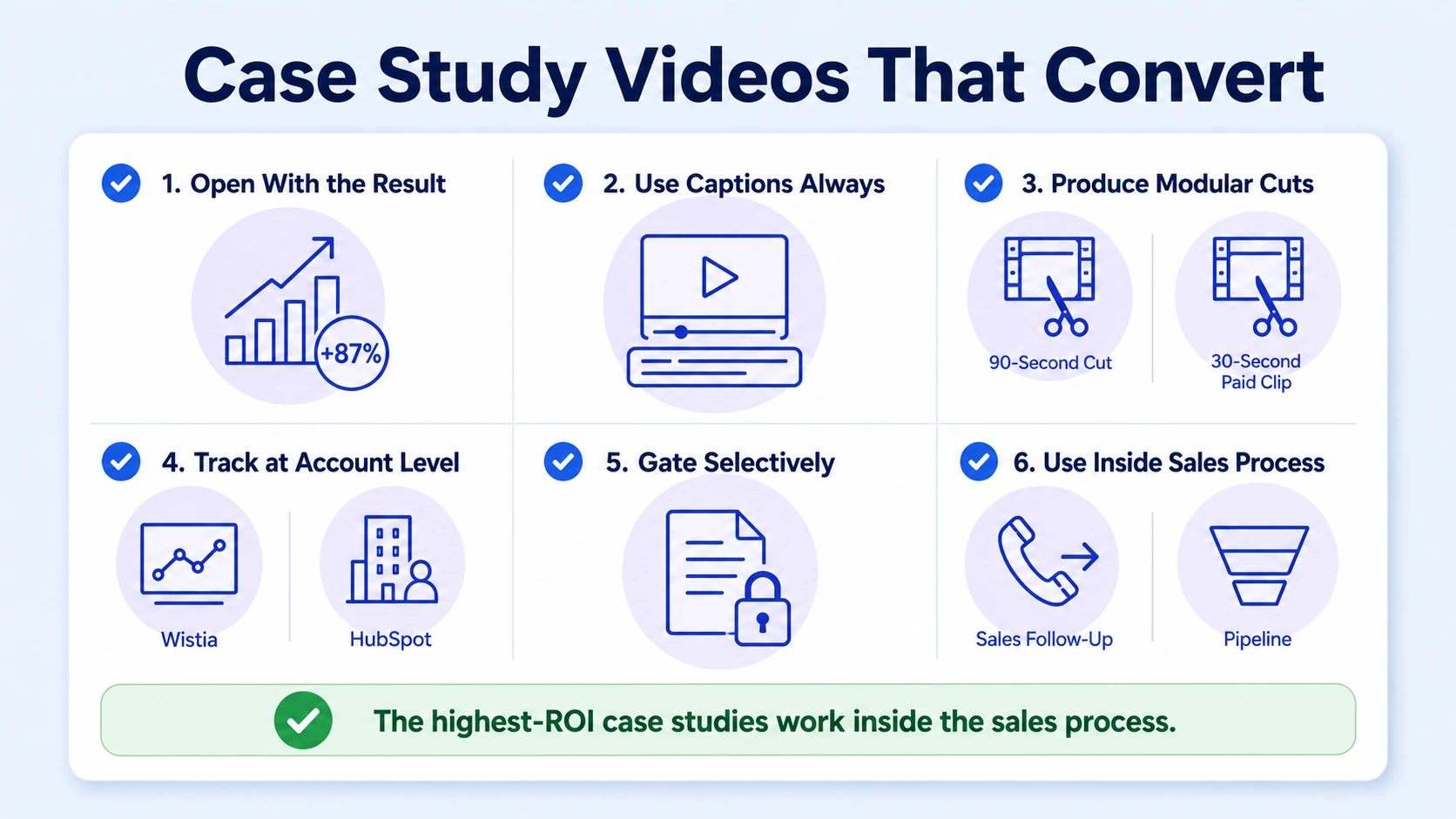
Key production and distribution best practices for 2026:
- Open with the result: The first 8 seconds determine whether a buyer keeps watching. Lead with the metric, not the backstory.
- Use captions always: 81% of testimonial views are projected to be on mobile by 2026, and vertical or square edits drive 44% more engagement than horizontal versions. Mobile-first means captions-first.
- Produce modular cuts: One full-length master, one 90-second highlight for LinkedIn, one 30-second stat-focused clip for paid social and email.
- Track at the account level: Use Wistia or HubSpot video tracking to monitor which contacts watch which videos and for how long. Trigger a sales follow-up when a prospect hits 75% completion.
- Gate selectively: Freely available 90-second clips build awareness. Gated 3-minute versions generate qualified leads and signal real purchase intent.
- Distributed inside the sales process: The B2B video examples with the highest ROI are often the ones inside the sales process, not the ones on the homepage.
According to Forrester's 2026 predictions for B2B marketing, buyer trust will be the defining competitive advantage in B2B over the next eighteen months, and video content, measured against trust-tier outcomes rather than vanity metrics, is the format that consistently moves the needle.
If your team has existing webinars, podcast episodes, or demo recordings, those are raw material for case study video content. Our video editing services and podcast editing workflows are built to extract and repurpose exactly this kind of existing content into structured, sales-ready assets.
Conclusion
Case study videos are not a nice-to-have content type, they are the most efficient trust-building tool available to B2B sales and marketing teams operating in long, multi-stakeholder cycles.
Key takeaways:
- Structure every video around a clear problem-solution-outcome arc, with the result stated in the first 8 seconds.
- Target 2 to 3 minutes for mid-funnel website and sales use; edit 60-to-90-second cuts for social and outreach.
- Get customers on camera by making participation a value exchange, not a favor, and time the ask 60 to 90 days post-implementation.
- Distribute inside the sales process, proposals, digital sales rooms, and personalized email sequences, not just on your homepage.
- Track completion at the account level and use that data to trigger sales actions.
The gap between knowing this and having a working system is where Komet Media operates. Reach out when you're ready to build yours.
Frequently Asked Questions
Q1: What should be included in a B2B case study video?
Every case study video needs six elements: customer context (company, role, industry), the specific problem before your solution, alternatives the customer considered, what implementation looked like, a named quantified result, and at least one direct quote from the customer in their own words. ROI-specific numbers are the single most persuasive element.
Q2: How long should a B2B case study video be?
For mid-funnel website and sales use, 2 to 3 minutes is the standard. For LinkedIn outreach, keep it under 90 seconds. Mid-to-late-stage prospects are typically willing to consume 5 to 10 minutes when watching on a dedicated platform like YouTube, but always front-load the outcome regardless of length.
Q3: How do case study videos help with sales enablement?
Sales reps can send case study videos directly to prospects at specific pipeline stages, track who watched them via tools like Wistia or HubSpot, and use that engagement data to time follow-ups. Personalized follow-up videos sent by sales reps increase response rates by 36%, compared to 19% for standard email follow-ups.
Q4: How do I choose which customers to feature in case study videos?
The most persuasive case studies feature customers that mirror your target buyers: same industry, similar company size, and a recognizable challenge. Prioritize customers who can speak to measurable business outcomes and whose profile matches your highest-priority ICP segments.
Q5: Can I produce effective case study videos without a large production budget?
Yes. Remote recordings with quality audio, good lighting, and professional editing consistently outperform expensive on-location shoots with poor preparation. The quality of the story and the specificity of the results matter far more than cinematic production value. A focused 2-minute video with real numbers beats a polished 4-minute video with vague praise.
Q6: Where should I distribute B2B case study videos?
Distribute across your website case study pages, LinkedIn (both organic and paid), email nurture sequences, proposal follow-ups, digital sales rooms, and directly inside sales outreach. Seed them into product pages, sales decks, and pricing pages; arm SDRs with a short email blurb and the one-pager; and post 60-to-90-second clips on LinkedIn and YouTube.