
🪄 AI Summary
Heading 1
Heading 2
Heading 3
Heading 4
Heading 5
Heading 6
Lorem ipsum dolor sit amet, consectetur adipiscing elit, sed do eiusmod tempor incididunt ut labore et dolore magna aliqua. Ut enim ad minim veniam, quis nostrud exercitation ullamco laboris nisi ut aliquip ex ea commodo consequat. Duis aute irure dolor in reprehenderit in voluptate velit esse cillum dolore eu fugiat nulla pariatur.
Block quote
Ordered list
- Item 1
- Item 2
- Item 3
Unordered list
- Item A
- Item B
- Item C
Bold text
Emphasis
Superscript
Subscript
Most B2B teams treat LinkedIn like a press release board, posting company updates and hoping buyers magically appear. That's not a LinkedIn strategy for B2B brands. That's content for the void. The platform has fundamentally changed. 80% of all B2B social leads now flow through LinkedIn , and the algorithm has moved on from rewarding volume. This guide covers every layer: content, thought leadership, posting cadence, paid strategy, metrics, and how to build from zero, so your LinkedIn presence actually drives the pipeline.
TL;DR
- 4 out of 5 LinkedIn members drive business decisions, your buyers are already here.
- Personal profiles generate 8x more engagement than company pages, founder and executive voices must lead.
- Organic builds trust; paid scales it. Running both together outperforms either alone.
- Content repurposing, turning webinars, demos, and podcasts into short videos, is the most efficient way to feed a consistent LinkedIn engine.
How to Build a LinkedIn Strategy for B2B Brands from Scratch
Most B2B teams start with a company page and wonder why nothing moves. The page matters, but it is not your main vehicle. Here is the correct build sequence:
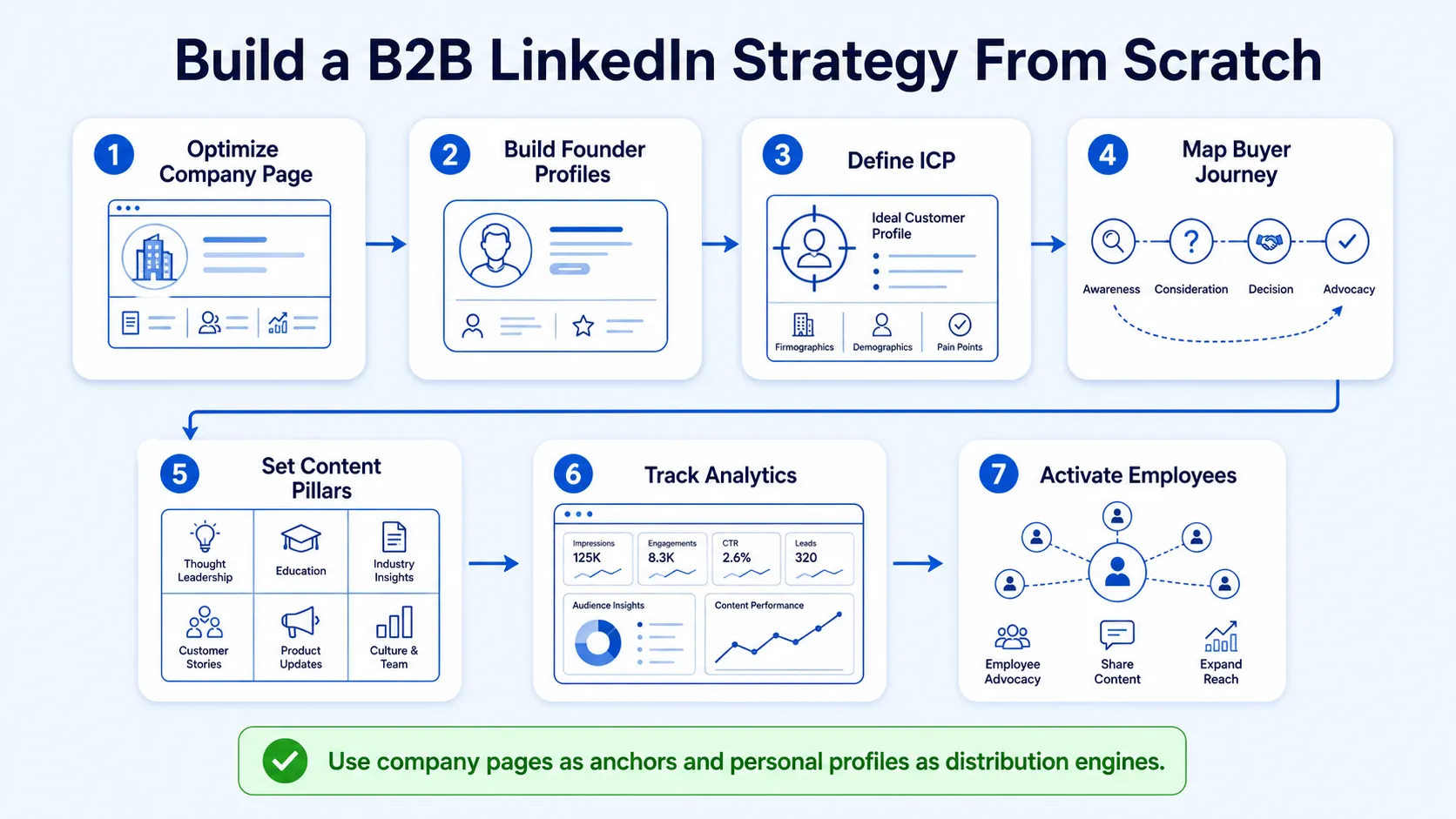
- Optimize the LinkedIn Company Page: Fill every field, tagline, about section, specialties, and featured content. Treat the company page more like your website than a hub of social activity, it's the anchor buyers check after they've already been convinced by a person.
- Build founder and executive profiles first: Posts from named executives, with personal voice and perspective, outperform posts from company pages on most engagement metrics . These profiles are your primary distribution engine.
- Define your Buyer Persona and ICP: Know exactly who you're posting for, title, industry, company size, and the problems they wake up thinking about. Every content decision flows from this.
- Map your content to the B2B Buyer Journey: Awareness content builds trust early. Consideration content (case studies, demos, breakdowns) moves buyers toward a decision. Both need to live on LinkedIn consistently.
- Establish your content pillars: Pick 3–4 repeatable topic categories that connect your product expertise to your buyer's problems. For a B2B SaaS team, that might be product education, founder POV, customer results, and industry takes.
- Set up LinkedIn Analytics from day one: You need a baseline before you can optimize. Track follower growth, impressions, engagement rate, and which content types pull the most qualified profile visits.
- Activate employee advocacy early: Shares from real people inside your company amplify reach without ad spend. Audiences exposed to a brand's LinkedIn content are 50% more likely to convert later, and employee shares drive roughly 30% of engagement on company posts .
This sequence works for a team starting with zero following. Consistency for 60–90 days is the real prerequisite, not a big budget.
What Types of Posts Perform Best for B2B Brands on LinkedIn?
The LinkedIn Algorithm has shifted hard toward quality and depth.
LinkedIn's new unified AI ranking system, 360Brew, replaced the legacy content infrastructure entering 2026 , and its priorities are clear: substance over shortcuts.
Here is how the main formats rank right now:
For B2B SaaS teams specifically, the formats that drive demo demand and buyer education are short native videos and carousels built from existing content, webinar clips, product demos, podcast soundbites. That is exactly the system we build at Komet Media, offering comprehensive LinkedIn strategy from scratch alongside expert content repurposing, whether starting with zero presence or utilizing your existing assets: take what your team already knows, extract the insight, and put it in front of your buyers in the format LinkedIn rewards.
What the algorithm penalizes is equally important: generic AI content and superficial engagement bait are now actively penalized, causing a massive drop in visibility for traditional playbooks. Post with a real point of view or don't post.
How to Build Thought Leadership on LinkedIn as a B2B Brand
Thought leadership is not a content type, it is a positioning outcome. And the data on its business impact is hard to ignore. The 2025/2026 Edelman-LinkedIn B2B Thought Leadership Impact Report reveals that 95% of decision-makers say thought leadership directly influences their purchasing decisions.
The implication: your buyers are forming opinions about vendors before they ever fill out a form. Thought leadership isn't just content marketing, it's a strategic tool for building trust, driving alignment, and opening doors where ads and traditional sales methods fall short.
For B2B SaaS founders and marketing heads, here is how to build it systematically:
- Choose a tight content territory: Claim 2–3 specific topics you can own. Broad takes get ignored. Narrow expertise builds authority.
- Use the founder's real voice: AI engines do what B2B buyers have always done: trust people over brands. Ghost-written content that sounds like a press release loses to a direct, opinionated founder take every time.
- Prioritize saves and shares over likes: Likes and follows count for less than saves and time spent reading under the current algorithm. Write content people want to return to.
- Publish original insights, not reposts: B2B content with original research receives 67% more engagement than opinion-based content , per a 2025 Content Marketing Institute report.
- Repurpose long-form assets into short video: 48% of worldwide B2B marketers say interactive experiences, live/virtual events, and video content make thought leadership more impactful; 41% of B2B video marketers say short-form social videos generate the highest ROI.
If your team runs webinars or podcasts, you already have thought leadership content. The gap is converting it into the short-form clips that actually surface in LinkedIn feeds. Komet Media provides end-to-end LinkedIn strategy that covers both initial build-outs from scratch and sophisticated repurposing of your existing content library. Our video marketing services close that gap directly.
How Often Should a B2B Company Post on LinkedIn?
Posting frequency is one of the most debated questions in any LinkedIn strategy for B2B brands. Here is what the data says and what actually works in practice. The LinkedIn algorithm prioritizes 2–3 substantial, valuable posts per week over daily superficial updates. Quality signals, dwell time, comment depth, saves, now outweigh raw post count.
Aim for 3–5 posts per week as the highest-ROI range, mixing formats (text, image, video). Weekly posting alone doubles engagement versus monthly, but what you do after posting, replying and engaging in the first 90 minutes, matters more than raw frequency.
For timing: the middle of the working week (Tuesday through Thursday) sees the highest engagement , though your specific audience's behavior is the real benchmark. Use LinkedIn Analytics to find your peak window.
What to avoid:
- Posting more than once per day (it cannibalizes your own reach)
- Hashtag stuffing, more than 3–5 hashtags reduces distribution
- Sporadic bursts followed by silence, irregular posting patterns trigger algorithmic warning flags; consistent, predictable engagement behavior establishes profile credibility
For a lean B2B SaaS team without a content library, the fastest path to consistent output is a content repurposing system. One webinar can yield 8–10 LinkedIn posts. One podcast episode becomes 4–5 video clips and 3 text posts. That is a full week of content from a single long-form asset, no new ideas required.
LinkedIn Organic vs Paid Strategy for B2B Lead Generation
Both have a role. Neither is sufficient alone. Here is how to think about the split:
Inbound leads close at 14.6% versus 1.7% for outbound, the authority you build organically converts far better than interruptive outreach. That is the core argument for leading with organic. For paid, the highest-ROI format in 2026 is Thought Leader Ads. Thought Leader Ads are the highest-ROI LinkedIn ad format, you promote an executive's organic LinkedIn post as a paid ad, the ad appears in feeds from the person's profile rather than a company page, and the benchmarks show a $2.29 median CPC versus $10.24 for single-image company ads.
Native LinkedIn Lead Gen Forms reduce CPL by 25–35% versus external landing pages, always start there before testing to external pages. The smart play for most B2B SaaS teams is: build organic authority for 60–90 days, then activate paid to amplify your best-performing content to your target Account-Based Marketing list. Use organic content to test ideas and build trust, then use paid ads to scale best-performing content and retarget interested users.
What Metrics Should B2B Brands Track on LinkedIn?
Vanity metrics (impressions, follower count) tell you almost nothing about pipeline. Here is the metric stack that actually connects LinkedIn activity to revenue:
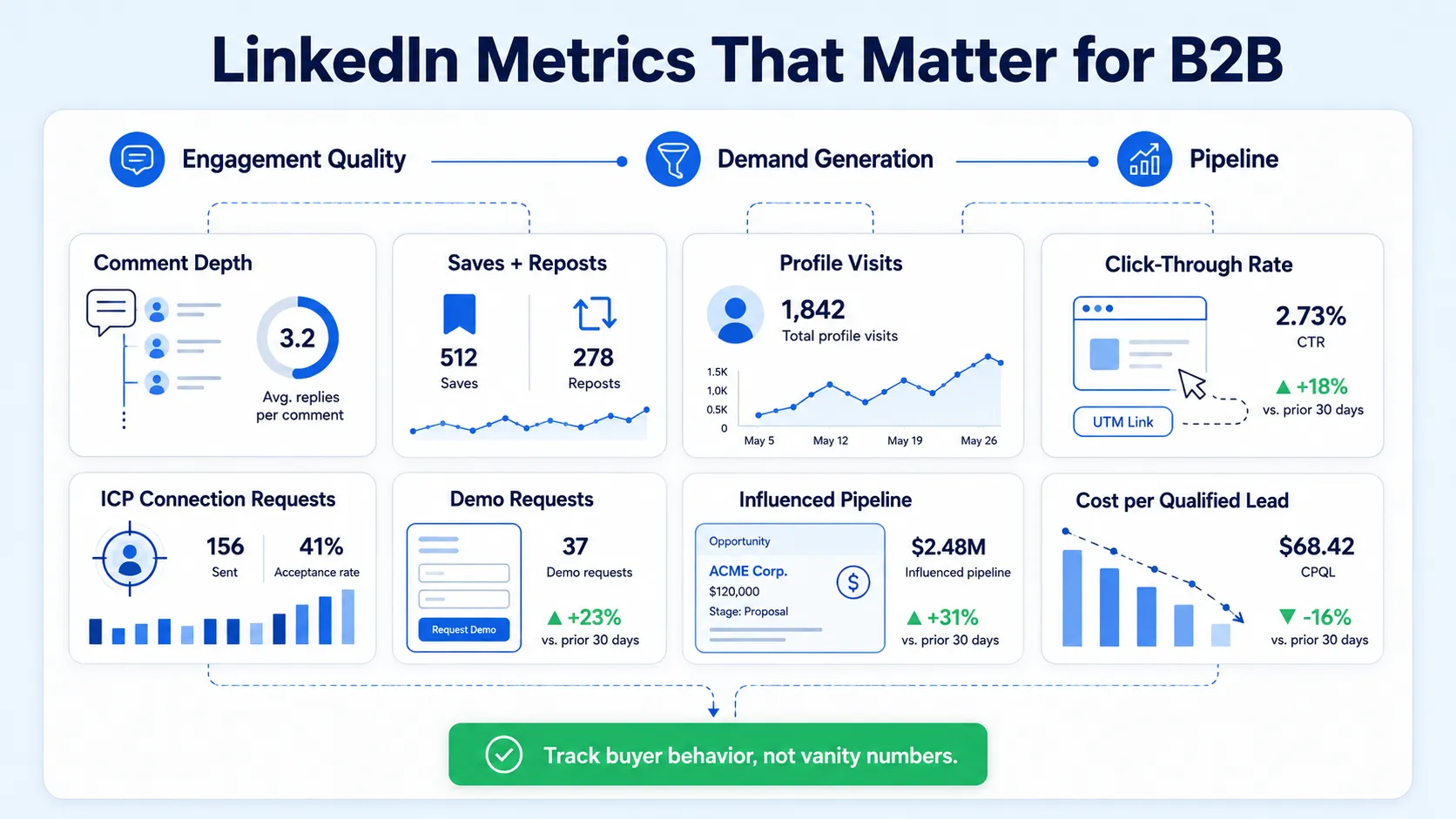
Engagement Quality Metrics
- Engagement rate: Small businesses under 1,000 followers benchmark 4–8%; mid-market accounts with 1,000–50,000 followers benchmark 2–4%
- Comment depth: Substantive comments signal content quality to the algorithm far more than likes
- Saves and reposts: High save rate means the content is reference-worthy, the clearest sign of genuine value
Demand Generation Metrics
- Profile visits from posts: A strong signal that content is creating buyer curiosity
- LinkedIn Analytics click-through rate: Measures how many readers take the next step
- Inbound connection requests from ICPs: A leading indicator of Social Selling Index improvement and relationship-stage awareness
- Lead Gen Form conversion rate: Lead Gen Forms convert 3–5x better than traditional landing pages because they pre-fill LinkedIn profile data
Pipeline Metrics (the ones that matter most)
- Demo requests attributed to LinkedIn (tracked via UTM and CRM)
- Influenced pipeline, deals where a LinkedIn touchpoint appeared before a sales conversation
- Cost per qualified lead from paid campaigns
Thought leadership metrics should connect to the pipeline, not vanity. Expect first inbound inquiries at 60–90 days, measurable pipeline influence at 4–6 months, and compounding returns at 6–12+ months. Track these inside LinkedIn Analytics weekly and pull them into your CRM monthly. The pattern that emerges over a quarter tells you which content formats, topics, and posting times are actually driving buyer behavior, not just feed impressions.
Conclusion
A LinkedIn strategy for B2B brands in 2026 is not about posting volume or follower counts. It is about building a system.
- Lead with founder and executive voices, personal profiles generate 8x more engagement than company pages.
- Post 3–5 times per week using content your team already has: webinars, demos, podcasts, and customer results repurposed into native video and carousels.
- Combine organic trust-building with Thought Leader Ads to scale what's already working.
- Track pipeline metrics, not vanity metrics, impressions don't close deals.
If your team is starting with a blank slate or sitting on recorded content that isn't reaching buyers, Komet Media builds the LinkedIn strategy from scratch and the content repurposing system that turns it into a consistent revenue engine.
Frequently Asked Questions
Q1: What is a LinkedIn strategy for B2B brands and why does it matter?
A LinkedIn strategy for B2B brands is a documented plan for using LinkedIn to build authority, generate demand, and support pipeline. It matters because 80% of all B2B social leads flow through LinkedIn, no other social platform comes close to reaching professional buyers.
Q2: How long does it take to see results from a LinkedIn B2B strategy?
Organic traction typically appears within 60–90 days of consistent posting. First inbound inquiries usually arrive at the 60–90 day mark, with measurable pipeline influence at 4–6 months. Paid campaigns can generate leads immediately, but cold audiences convert at lower rates without organic trust already established.
Q3: Should a B2B SaaS company post from the company page or personal profiles?
Both, but prioritize personal profiles. Posts from individual profiles receive 8x the engagement of identical content from company pages, and this gap is widening, not closing. Use the company page as your credibility anchor; use founder and team profiles as your primary content distribution.
Q4: What content formats work best for a LinkedIn strategy for B2B brands?
Document posts and native video lead the pack. Multi-image posts generate the highest engagement on LinkedIn, averaging 6.60%. Native video views are growing fast, while polls have been depressed by LinkedIn's Authenticity Update. Short-form clips repurposed from webinars and demos are consistently high performers for SaaS buyers.
Q5: How does LinkedIn Sales Navigator fit into a B2B LinkedIn strategy?
Sales Navigator enables precision targeting and relationship tracking that the standard LinkedIn interface doesn't support. It is the tool for Account-Based Marketing outreach, allowing sales teams to monitor intent signals, follow target accounts, and reach decision-makers directly. It works best when organic content is already warming the audience.
Q6: How is a LinkedIn strategy for B2B brands different from a B2C strategy?
B2B LinkedIn strategy is built around trust cycles and buying committees, not impulse purchases. Buying decisions are shaped by a broader group of internal influencers, "hidden buyers", and more than 40% of B2B deals stall due to internal misalignment within buying groups. B2B content must educate and de-risk across multiple stakeholders, not just persuade one person.