
🪄 AI Summary
Heading 1
Heading 2
Heading 3
Heading 4
Heading 5
Heading 6
Lorem ipsum dolor sit amet, consectetur adipiscing elit, sed do eiusmod tempor incididunt ut labore et dolore magna aliqua. Ut enim ad minim veniam, quis nostrud exercitation ullamco laboris nisi ut aliquip ex ea commodo consequat. Duis aute irure dolor in reprehenderit in voluptate velit esse cillum dolore eu fugiat nulla pariatur.
Block quote
Ordered list
- Item 1
- Item 2
- Item 3
Unordered list
- Item A
- Item B
- Item C
Bold text
Emphasis
Superscript
Subscript
When Silicon Valley founders look for the best video editing companies San Jose has to offer, they often realize that finding an editor is only half the problem. I have seen strong interviews lose most of their value because the team stopped after publishing the full episode. The real challenge is turning long recordings into a consistent content engine. B2B software companies and venture firms need more than clean cuts. They need platform-specific adaptation, clear hooks, and reliable distribution. This guide compares the leading agencies and explains how to build a dependable production system.
Which Are the Top 10 Video Editing Companies in San Jose for 2026?
The best video editing companies San Jose tech leaders rely on include Komet Media for repurposing and distribution, Vidico for commercials, and Clear Digital for local enterprise production. Review the full comparison table below to match your commercial goals.
Comparing the 10 Best Video Editing Companies San Jose Provides
Choosing an external partner requires matching your business goals with the right agency model. Here is a closer look at the top providers serving the San Jose and broader Silicon Valley market.
1. Komet Media
We built Komet Media to solve the exact problems buyers face when comparing the best video editing companies San Jose has on the market. Many agencies will edit a file and send it back. We noticed that services specifically tailored to B2B SaaS, AI, and tech startups & teams, private equity firms, and founders were missing from the market.
When we work with clients, we do not just cut footage. We provide full from-scratch video production alongside our established content system and repurposing services. We turn podcasts into short clips, webinars into multi-week content, and founder interviews into LinkedIn posts. Our team handles content selection, editing, platform adaptation, and distribution. We usually work through mid-tier retainers ranging from approximately $2,500 to $5,000. This model gives growing technology firms a reliable publishing engine without the overhead of an internal team. We take a long recording, identify the most commercially valuable moments, write the supporting social copy, and build a distribution calendar that sales and marketing teams can actually use.
2. Vidico
Vidico focuses on brand videos and commercial production for technology companies. They are well known for live-action shoots and high-quality animation. If a startup is launching a major product and needs a polished commercial, Vidico is a strong option. Their project-based model suits teams that need a large campaign asset rather than a daily social media content engine. They work heavily with product marketing teams to translate complex software features into highly visual, narrative-driven advertisements. Their pricing is custom and depends heavily on whether the project requires location scouting, actors, and advanced motion graphics.
3. Clear Digital
Clear Digital is frequently listed among the best video editing companies San Jose buyers choose for website and brand videos. They operate locally and specialise in B2B web experiences. Their video work usually supports large enterprise website redesigns and digital marketing campaigns. They are a project-based agency that works closely with corporate marketing departments. Because they are a full-service digital agency, their video team often collaborates with web developers to ensure the final video assets integrate perfectly into a new site architecture. This makes them highly suitable for established enterprise brands undergoing digital transformation.
4. Spoke
Spoke focuses on repurposing recordings into supporting marketing assets. They help lean marketing teams turn existing webinars and meetings into video content. Their subscription model is designed for speed and volume. This works well for companies that already know exactly what they want to say and just need an external team to execute the cuts quickly. The client is responsible for providing clear instructions and managing the overall distribution strategy. This execution-focused model is helpful for demand generation teams that have strong internal copywriters but lack the software skills to process raw video files efficiently.
5. BLARE Media
BLARE Media earns its place among the best video editing companies San Jose offers by handling complex local and national commercial shoots. They have a strong Bay Area presence and provide full end-to-end production. This includes crew sourcing, lighting, and advanced post-production. They are a strong fit for corporate communications teams needing on-location filming. If a private equity firm needs to film executive interviews at their San Jose headquarters, BLARE Media can deploy the physical equipment and personnel required to capture premium footage before moving the project into their post-production suite.
6. TastyEdits
TastyEdits provides subscription video editing for businesses and creators. They offer a structured process with public pricing. This service is helpful for companies that produce high volumes of raw video and need a predictable monthly cost. Their model works best when the internal marketing team handles all the strategy, distribution, and performance measurement themselves. They focus heavily on maintaining fast turnaround times. If a marketing manager has the capacity to review several video drafts per week and write their own LinkedIn copy, a volume-based subscription like this can be a highly efficient way to clear a backlog of raw footage.
7. Reel to Render
Reel to Render is a local San Jose production company. They focus on corporate video, event coverage, and local commercial projects. If a technology firm is hosting a live summit in Silicon Valley and needs a local camera crew to capture and edit the event, Reel to Render provides dependable on-the-ground support. They understand the logistics of filming in corporate environments and convention centres. Their post-production work typically focuses on delivering highlight reels, full keynote recordings, and promotional materials designed to drive ticket sales for future corporate events.
8. ShortVids
ShortVids specialises strictly in monthly short-video editing. They edit content for TikTok, Instagram Reels, and YouTube Shorts. Their service is designed for founders and creators who film themselves on their phones and need quick turnarounds for social platforms. Their public pricing makes them accessible for early-stage startups testing short videos for the first time. They focus on fast pacing, aggressive subtitling, and trending audio. This approach suits consumer-facing brands or solo founders who want to build a rapid audience through highly engaging, fast-moving vertical content.
9. Vidpros
Vidpros operates on a dedicated video editor model. When a company signs up, they get a specific editor assigned to their account. This is useful for agencies or large in-house teams that need to add reliable production capacity without hiring a full-time employee. The client manages the editor and provides the creative direction. Over time, the dedicated editor learns the specific brand guidelines, pacing preferences, and typography requirements of the client. This model requires the client to act as the creative director, ensuring the editor has a steady stream of briefs to work on each week.
10. Motionvillee
Motionvillee focuses on explainer videos and motion graphics for SaaS and technology startups. When a software company needs to explain an abstract technical product, standard talking-head video is not always enough. Motionvillee creates animated assets that clarify complex systems. They work primarily on a per-project basis. Their process usually involves scriptwriting, storyboarding, voiceover casting, and custom animation. This makes them a strong partner for product marketing leaders who need a highly polished two-minute asset to sit at the top of a primary software landing page.
What Is the Difference Between Video Editing and a Content System?
Many technology teams do not have a content shortage. They have a production and distribution problem. They sit on hours of valuable recordings without turning them into usable assets.
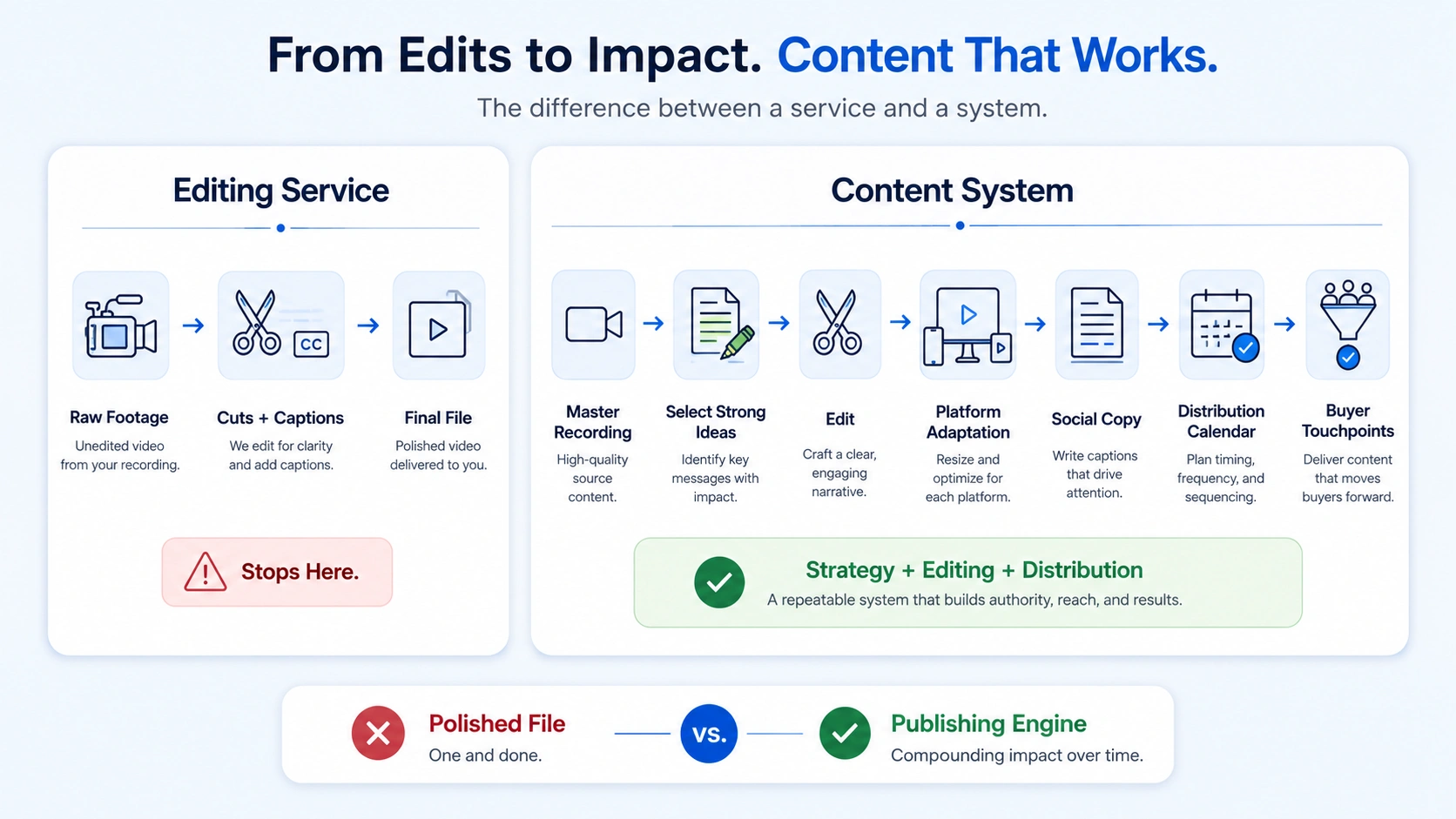
I often speak with venture capital partners and SaaS founders who record brilliant forty-minute conversations. They upload the file to YouTube, share the link once on LinkedIn, and never mention it again. The production quality might be excellent, but the business value is minimal because the distribution is weak.
According to the HubSpot 2026 State of Marketing Report, 80% of marketers now use AI for content creation. Software has made basic editing faster than ever. However, the same report highlights that human-led marketing wins trust. Audiences tune out generic, highly automated content. They want specific insights from practitioners who have actually done the work.
A standard editing service will apply cuts and captions to whatever footage you provide. A proper content system involves strategic decisions. When we edit a founder interview, we do not just remove the pauses. We look for clear arguments, proof points, stories, and buyer objections within the raw footage. We ask whether a specific two-minute segment would perform better as a text post with a supporting image or as a vertical video on a company page. The edit is rarely the only problem. A polished video with no distribution plan is still an underused asset.
How Do You Set Up a Reliable Video Production Workflow?
If you want to repurpose podcasts and webinars effectively, you need a repeatable process. A strong workflow prevents bottlenecks and keeps publishing consistent. I have seen internal marketing teams abandon video programs entirely because the approval process took three weeks for a single social media clip.
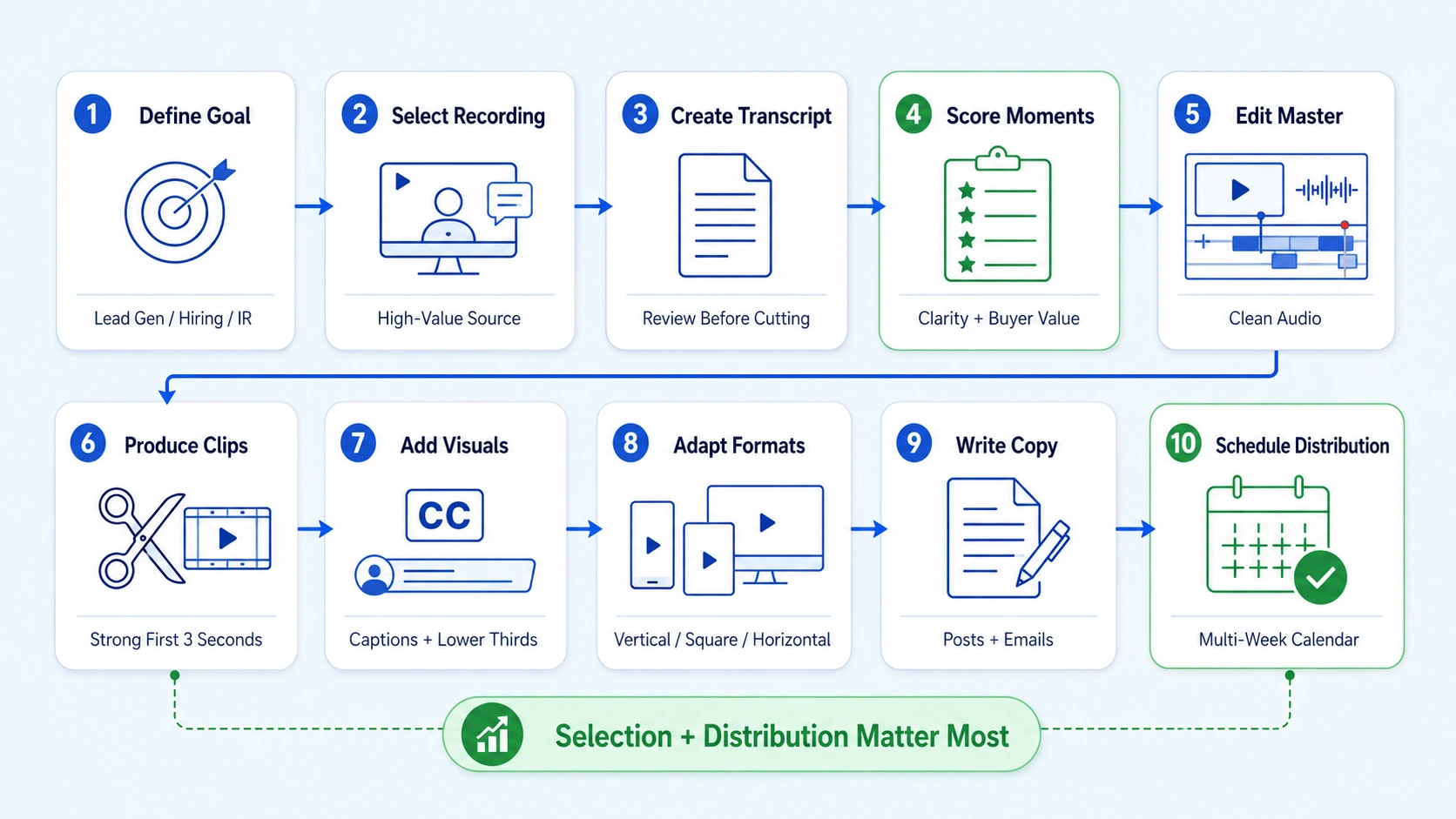
A reliable B2B production workflow should include these steps:
- Define the business goal: Decide whether the video is for lead generation, hiring, or investor relations.
- Select the master recording: Choose a high-quality interview, webinar, or founder conversation.
- Create the transcript: Use transcription tools to review the conversation text before cutting any video.
- Score moments by clarity: Find the most valuable answers. Look for moments where the speaker challenges an industry norm or provides a specific framework. Mark these for extraction.
- Edit the master asset: Clean the audio, remove dead space, and format the primary long video.
- Produce short clips: Cut the marked moments into short, impactful segments. Ensure the first three seconds establish immediate context.
- Add supporting visuals: Include captions, lower thirds, and brand colours to keep viewers engaged.
- Adapt by platform: Export in vertical, square, and horizontal formats. A video file sized for YouTube Shorts will not look right on a company website.
- Write the supporting copy: Draft the LinkedIn posts, email newsletters, and YouTube descriptions that will carry the video to the audience.
- Schedule distribution: Plan the release across your channels over several weeks.
You do not always need a fifteen-step process for a simple social post. However, skipping the selection and distribution phases usually leads to content that looks good but produces no commercial results. I would rather produce six strong clips with a clear distribution plan than fifteen weak clips that get dumped into a shared folder and forgotten.
How Do You Measure Commercial Value Beyond Video View Counts?
Working with the best video editing companies San Jose has available means measuring more than just view counts. A short clip is not automatically good just because it gets high reach. A viral spike that brings thousands of unqualified viewers to your profile does not help a B2B sales team close a complex software deal.
The Demand Gen Report 2026 B2B Buyer Behavior Survey highlights that B2B buyers now consume more video content before ever speaking to a sales representative. Furthermore, 8 out of 10 B2B teams now say LinkedIn is their primary place to share business videos, far surpassing YouTube for direct commercial engagement.
When you evaluate video performance, match the metric to the intent of the video. For awareness, track viewer retention, completion rates, and profile visits. If you post a short video and viewers drop off after four seconds, your hook is weak. For engagement, track comments from your actual target audience. A thoughtful reply from a chief marketing officer is worth more than fifty likes from bot accounts. For commercial impact, track website visits, demo requests, and the number of times your sales team uses the video to support a deal.
I always ask clients if their sales team is using the content we produce. If an account executive shares a founder video in a follow-up email to answer a common buyer objection, that video is highly successful, even if it only has twenty public views. Attribution may be imperfect. Use several signals rather than relying on one dashboard metric. If your venture capital partners are sharing original viewpoints on video, success might look like higher quality conversations with founders rather than massive social media fame.
Conclusion
Choosing the best video editing companies San Jose provides comes down to what you want the video to achieve. The market is full of talented editors, but technical skill alone does not guarantee a return on investment.
If you need a one-off corporate advertisement to play at an industry summit, a local project-based production house is the right choice. If you want a specific animated sequence to explain your software architecture, you need a motion graphics specialist.
However, if you want to turn a monthly podcast or a series of executive interviews into a steady stream of LinkedIn posts, YouTube Shorts, and email assets, you need an agency that understands distribution. You need a partner that will write the posts, schedule the content, and manage the publishing calendar.
Focus on finding a partner that connects content decisions to business outcomes. Producing more clips does not always guarantee more reach. Strong selection and consistent distribution matter more than volume alone. The best agencies will push back on weak raw footage and guide your team toward producing material that actual buyers want to consume.
Frequently Asked Questions
1. What is the average cost among the best video editing companies San Jose offers?
Costs vary heavily based on the delivery model and the scope of work. Basic subscription services can start around $1,000 per month for simple cuts without strategic support. Mid-tier retainers that include content selection, repurposing, copywriting, and distribution usually range from $2,500 to $5,000 per month. Large custom commercial shoots often exceed $10,000 per project. You can read more about how to evaluate video editor costs here.
2. How long does it take to edit a short B2B video?
A simple cut with standard captions might take a few hours. However, a proper B2B workflow involves reviewing the transcript, writing a strong hook, adding motion graphics, formatting the video for specific platforms, and drafting the social media copy. This comprehensive process usually takes two to three days per batch of clips to ensure high quality and commercial relevance.
3. Should a SaaS startup hire an internal editor or use an agency?
An internal editor gives you absolute control and immediate physical availability. This is great for daily, unstructured content or behind-the-scenes office culture posts. An external agency provides immediate expertise, established workflows, and strategic distribution advice without the costs of recruiting, healthcare benefits, and managing expensive production software.
4. What deliverables should a video editing retainer include?
A standard B2B retainer should include the full edited episode or webinar, multiple short-form clips optimized for vertical and horizontal platforms, professional captioning, thumbnail design, and basic motion graphics. Stronger partners will also provide written social media copy, a distribution schedule, and strategic feedback on how to improve your recording process next time.
5. How does Komet Media handle video distribution?
We do not just hand over a Google Drive folder of video files and leave you to figure out what to do with them. We help teams plan exactly where each video belongs. We adapt the exports for LinkedIn, YouTube, and Instagram, provide the supporting text, and build a publishing cadence so the content actually reaches the target buyer over a sustained period.
6. Is unlimited video editing worth it for B2B teams?
Unlimited services work well if you have an internal manager who can write clear briefs, review all footage, and manage the daily revisions. If your team lacks the time to manage production and just wants a finished asset ready to publish, a structured retainer usually provides much better commercial value because it removes the management burden from your staff.
7. What is the difference between a freelance video editor and a video agency?
A freelancer handles the specific technical tasks you assign them. This requires your internal team to manage the strategy, scriptwriting, distribution, and quality control. An agency provides a complete system. They bring their own workflows, strategic advice, dedicated account management, and contingency planning if a specific editor falls ill or goes on leave.
8. Do these agencies shoot original video or just edit existing footage?
Project-based local agencies like Clear Digital and BLARE Media will source locations, provide camera crews, and shoot original footage on the ground in San Jose. Retainer-based agencies and repurposing partners typically work with footage you record remotely, such as Zoom webinars, Riverside podcast recordings, or mobile phone footage captured by your executive team.