
🪄 AI Summary
Heading 1
Heading 2
Heading 3
Heading 4
Heading 5
Heading 6
Lorem ipsum dolor sit amet, consectetur adipiscing elit, sed do eiusmod tempor incididunt ut labore et dolore magna aliqua. Ut enim ad minim veniam, quis nostrud exercitation ullamco laboris nisi ut aliquip ex ea commodo consequat. Duis aute irure dolor in reprehenderit in voluptate velit esse cillum dolore eu fugiat nulla pariatur.
Block quote
Ordered list
- Item 1
- Item 2
- Item 3
Unordered list
- Item A
- Item B
- Item C
Bold text
Emphasis
Superscript
Subscript
FEvery B2B team records great conversations, founder interviews, product demos, webinars, and industry deep-dives, and then publishes them once. That single publisher is where most of the value gets buried. What is podcast repurposing? It's the system that digs it back up. This guide breaks down exactly how podcast repurposing works, why it belongs at the center of your content strategy, and how to build a repeatable process that turns one episode into a full content calendar, without recording anything new.
TL;DR
- Podcast repurposing transforms a single episode into clips, blog posts, audiograms, show notes, and social content.
- One 30–45 minute episode can produce 12+ distinct content assets across channels.
- For B2B SaaS teams, it drives pipeline, buyer education, and founder-led growth simultaneously.
- The biggest mistake teams make is publishing once, then going quiet for a week.
What Is Podcast Repurposing, Explained Simply
Podcast repurposing is the practice of taking a recorded audio episode and converting it into multiple formats for distribution across different channels, video clips, transcripts, blog posts, audiograms, LinkedIn carousels, email sequences, show notes, YouTube Shorts, Instagram Reels, and TikTok clips, among others. Think of your podcast recording as raw material, not a finished product. The episode itself is the starting point. Everything extracted from it, the insight-dense two-minute clip, the quotable pull quote, the SEO blog post, the audiogram, are the actual marketing assets.

A podcast repurposing approach takes one recorded episode and transforms it into multiple content assets designed for different marketing channels. Instead of treating the episode itself as the final product, it treats the recording as the starting point for a full content engine. For B2B SaaS teams, that distinction matters enormously. Your buyers are not all on Spotify. Some find you through a YouTube Short. Others through a LinkedIn post. Some through a Google search that surfaces your blog. Repurposing creates multiple entry points so your content meets buyers where they already spend time, not where you wish they'd go.
Audio content cross-platform distribution focuses on deconstructing a single audio episode into numerous micro-assets and distributing them across channels where your target audience is already active. That's the practical mechanics of podcast repurposing in a single sentence. What is podcast repurposing at its strategic core? It's the decision to stop treating distribution as an afterthought and start treating every recording as a multi-channel campaign waiting to be built.
How Does Podcast Repurposing Work, Step by Step
The process follows a consistent, repeatable sequence regardless of episode topic or format:
- Record and finalize the audio: Produce the episode through your standard podcast production workflow, edit audio, remove filler, balance levels.
- Transcribe the episode: Run a full transcription to generate a text layer. This is the raw material that feeds blog posts, show notes, email content, and social copy.
- Identify highlight moments: Scan the transcript for the sharpest insights, counterintuitive statements, and quotable moments. These become short-form video clips.
- Create short-form video clips: Edit 60–90 second clips optimized for YouTube Shorts, Instagram Reels, and TikTok, with captions burned in for silent viewing.
- Produce audiograms: Generate audiogram assets, waveform animations synced to audio, for platforms where video is secondary.
- Write SEO blog posts and show notes: Use the transcript and highlight moments to build a searchable article and clean show notes with timestamps.
- Build social copy: Extract pull quotes and key takeaways to create platform-native LinkedIn posts, X threads, and email newsletter snippets.
- Schedule across your content calendar: Distribute assets across channels over the following 1–2 weeks, extending the life of one episode across the entire period.
A 30-minute episode can yield 3 two-minute video clips, 5 audiograms, 10 pull quotes, 3 LinkedIn articles, and 15 social posts. That's a full two weeks of content from a single recording session. What makes the system work is the content calendar layer, a distribution plan that sequences each asset for maximum reach rather than dumping everything at once.
What Does It Mean to Repurpose a Podcast Episode for a B2B Audience?
For B2B teams, podcast repurposing means something more specific than simply reposting content on a second platform. It means engineering each derivative asset around a buyer's job-to-be-done at a specific stage of the funnel.
A clip pulled from a founder explaining a product philosophy lands differently on LinkedIn than a clip of a customer sharing a specific outcome. A blog post built from a technical deep-dive episode creates SEO surface area for buyers researching the problem category. Show notes with timestamped insights serve the sales team who need quick references to send prospects.
For B2B companies, podcast repurposing is not just about content marketing. It is about building trust at scale.
This is why podcast repurposing looks different for SaaS and funded tech teams compared to a media brand or creator. The goal is not impressions, it's a pipeline. Every asset needs a job:
- Short-form clips: Top-of-funnel awareness on LinkedIn, YouTube Shorts, and Reels
- SEO blog posts: Mid-funnel discovery for buyers actively researching
- Audiograms: LinkedIn and X to reach audio-first audiences in the feed
- Show notes: Internal sales enablement and episode SEO
- Email sequences: Nurture content for leads already in the funnel
- Transcripts: Accessibility and AI search indexing
Repurposing turns conversations into long-term marketing assets that continue generating value long after the interview ends. For a SaaS team running a 26-episode podcast per year, that's a compounding asset library, not a content hamster wheel.
Why Should B2B SaaS Teams Repurpose Podcast Content?
The audience opportunity alone justifies the investment. Around 584 million people worldwide will listen to podcasts in 2025, and that figure is projected to exceed 650 million by 2027 as growth continues. But relying on podcast apps alone to grow that audience is the core mistake most B2B teams make.
Most podcasts struggle to grow because they rely on a single distribution channel. Podcast repurposing solves this structurally. Instead of one channel, your content lives on four to six simultaneously, each with its own discovery mechanism.

The business case for B2B SaaS is particularly sharp:
- Pipeline acceleration: One SaaS company discovered 47% of their enterprise deals had podcast touchpoints that traditional attribution missed.
- Buyer education at scale: Short clips that explain product thinking reach buyers before they're ready to book a demo, creating familiarity that shortens sales cycles.
- Founder-led growth: Repurposed clips of founder thinking build personal brand authority without requiring the founder to produce original social content daily.
- Sales enablement: Clips and show notes give SDRs and AEs content to share in outreach that is native and credible, not a product brochure.
- SEO compound returns: Blog posts and transcripts from episodes build topical authority over time, driving inbound discovery without ongoing ad spend.
Most B2B podcast content produces value once, the day it publishes. Repurposing makes every episode a rolling campaign that generates pipeline weeks after recording. Effective content repurposing strategies don't just save time; they amplify your message, boost SEO by creating topic clusters, and turn a single piece of content into a powerful engine for sustainable growth.
Best Ways to Repurpose a Podcast Episode: The Full Asset Map
Here is every asset type a single episode can produce, mapped to channel and funnel stage:
The most underused asset in B2B is the sales enablement clip, a 60-second segment from a podcast episode that an AE can attach to a follow-up email instead of a generic case study PDF. It builds credibility through voice and specificity, not polish.
Micro-content multiplication transforms one episode into an omnichannel campaign. From a single 30-minute recording, you can extract 3 LinkedIn articles, 10 social posts, 5 email sequences, 2 blog posts, and 15 sales enablement assets.
The critical rule: every asset must be optimized for its destination platform. A 16:9 clip cut for YouTube Shorts needs captions, a punchy hook in the first three seconds, and vertical crop. A LinkedIn carousel needs formatted pull quotes. A blog post needs its own headline structure, not just a pasted transcript. Repurposing is not copy-pasting. It's platform-native reformatting.
For podcast editing and short-form video editing that produces assets built for each platform, this is the exact workflow we run at Komet Media for B2B teams.
Podcast Repurposing Strategy for Beginners: Where to Start
If you're recording podcast content and not repurposing it yet, start here, in this exact order:
- Audit your existing episodes first. You likely have 10–50 episodes sitting untouched. That is your content goldmine. Identify the three to five with the best ideas, sharpest insights, or most relevant topics for your current buyers.
- Transcribe all existing episodes. Use your transcription tool of choice to generate full text. This unlocks every downstream asset, blog posts, show notes, social copy, email, without any new recording.
- Create one short-form clip per episode. Find the single best 60–90 second moment. Add captions. Publish to LinkedIn and YouTube Shorts. This is your highest-leverage starting move.
- Write one SEO blog post per episode. Use the transcript as source material. Restructure it as a standalone article with its own introduction, headers, and conclusion.
- Build show notes with timestamps. These serve SEO, podcast app discoverability, and sales enablement simultaneously.
- Create a simple content calendar. Map each episode's assets to a two-week publishing schedule. This prevents the "dump everything at once" mistake.
- Establish a repeatable workflow. Document the steps so every future episode generates the same asset stack without starting from scratch.
Instead of publishing a podcast episode once and moving on, a strategic approach allows each conversation to fuel your marketing efforts for weeks or months.
At Komet Media, we help B2B SaaS, AI Native companies, and funded tech teams build this exact system, either from an existing content library or from scratch when teams don't yet have episodes to pull from. The workflow becomes a machine: record once, distribute everywhere. You can explore our podcast production and podcast marketing services, or learn more about our approach.
How to Turn Your Podcast Into Blog Posts and Videos: The Practical Workflow
The two most requested repurposing outputs for B2B teams are blog posts and short-form video. Here's how both work in practice.
Blog posts from podcast episodes:
- Start with the full transcript, not a summary.
- Identify the core argument of the episode, the one idea a reader should leave with.
- Build a new headline that targets a search query your buyers actually type.
- Write a proper introduction (the transcript's opening is never suitable as-is).
- Pull the best three to five insights from the episode as H2 sections with original commentary.
- Add internal links, a meta description, and a clear CTA.
The output should read as a standalone article, not as "here's what we talked about on the pod." When adapting audio content for a blog post, don't just publish the transcript. Reframe the content as a standalone article. Add an introduction and conclusion, and ensure the piece flows logically without relying on the original audio for context.
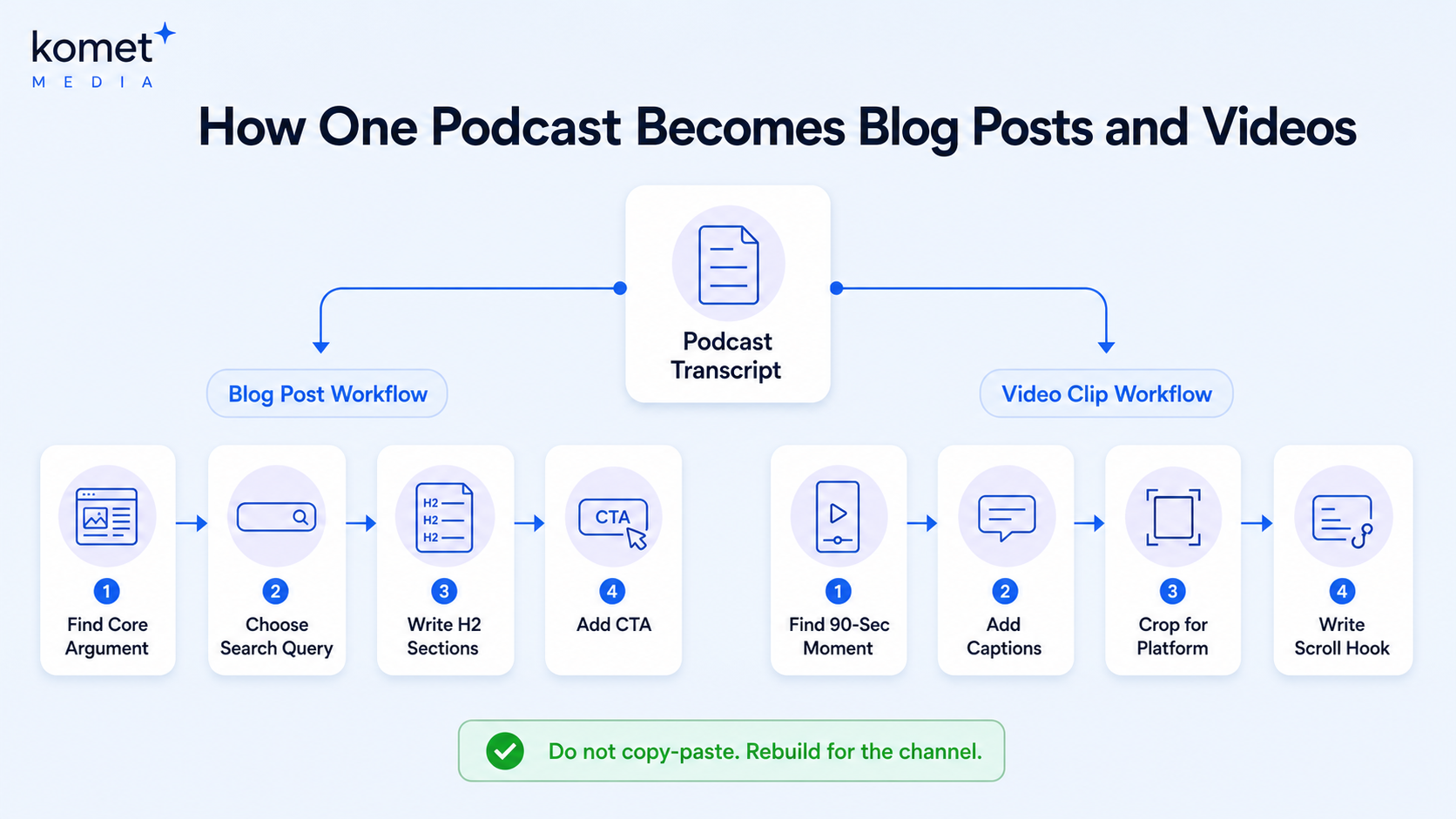
Short-form video from podcast episodes:
- Watch or skim the transcript for moments with a clear beginning, middle, and end in under 90 seconds.
- Prioritize moments where the speaker makes a counterintuitive point, tells a specific story, or delivers a memorable line.
- Export the clip, add captions (essential, most social video is watched silently), and optimize the aspect ratio for the target platform.
- Write a hook in the first frame that stops the scroll.
Gen Z listeners discover podcasts through clips on YouTube, TikTok, and Instagram, meaning short-form clips are also a top-of-funnel discovery mechanism that feeds your main show. The clip serves as both a standalone piece of content and a trailer for the full episode.
For teams that want this handled end-to-end, our video marketing services and podcast transcription and podcast show notes services are built for exactly this workflow.
Conclusion
Podcast repurposing is not an optional add-on to your content strategy, it is the strategy for B2B SaaS teams that want pipeline, visibility, and trust without publishing new content every single day. Here's what to carry forward:
- One episode, executed well, produces 12+ assets across search, social, email, and sales channels.
- Start with transcription, it unlocks every other asset in the stack.
- Short-form video clips are the highest-leverage top-of-funnel output for SaaS buyers on LinkedIn and YouTube.
- Treat every recording as a rolling two-week campaign, not a single publish event.
Ready to build a repurposing system for your team? Talk to Komet Media.
Frequently Asked Questions
Q1: What is podcast repurposing in simple terms?
Podcast repurposing means taking one recorded episode and converting it into multiple formats, clips, blog posts, audiograms, show notes, and social content, so it reaches more people across more channels without recording anything new.
Q2: How many assets can I get from one podcast episode?
A 30-minute episode can yield 3 two-minute video clips, 5 audiograms, 10 pull quotes, 3 LinkedIn articles, and 15 social posts, typically 12 or more distinct assets depending on your workflow and distribution channels.
Q3: Is podcast repurposing worth it for B2B SaaS companies?
Yes. It turns a single recording into buyer education, sales enablement, and SEO content simultaneously. For teams with longer sales cycles, repurposed content builds the repeated touchpoints that create trust before a buyer is ready to engage with sales.
Q4: What's the first thing I should repurpose from a podcast episode?
Start with a 60–90 second short-form video clip. It's the fastest to produce, highest in engagement, and works natively on LinkedIn, YouTube Shorts, Instagram Reels, and TikTok, giving your episode immediate multi-platform distribution.
Q5: Do I need to produce new episodes to start repurposing?
No. Your existing episode archive is your starting point. Audit your back catalog, identify the strongest episodes, and begin extracting clips and blog posts from content you've already recorded. Most B2B teams are sitting on months of untapped content.
Q6: What's the difference between a podcast transcript and show notes?
A transcript is the full verbatim text of the episode, used for accessibility, SEO indexing, and content extraction. Show notes are a curated summary with timestamps, key takeaways, and links, published on the episode page to serve both listeners and search engines.