
🪄 AI Summary
Heading 1
Heading 2
Heading 3
Heading 4
Heading 5
Heading 6
Lorem ipsum dolor sit amet, consectetur adipiscing elit, sed do eiusmod tempor incididunt ut labore et dolore magna aliqua. Ut enim ad minim veniam, quis nostrud exercitation ullamco laboris nisi ut aliquip ex ea commodo consequat. Duis aute irure dolor in reprehenderit in voluptate velit esse cillum dolore eu fugiat nulla pariatur.
Block quote
Ordered list
- Item 1
- Item 2
- Item 3
Unordered list
- Item A
- Item B
- Item C
Bold text
Emphasis
Superscript
Subscript
Is an Instagram growth service worth it? For a B2B company the honest answer is: sometimes, and the type of service decides almost everything. A managed program that builds content around your expertise can pay back through conversations with real buyers. A service that sells followers, automated follows or "engagement packs" usually cannot, and it can create legal and platform risk. This guide helps you tell them apart before you spend.
Quick Answer: Instagram Growth Service Value
Is an Instagram growth service worth it? Yes, when the service produces content and distribution tied to your buyers and you can measure conversations, not just followers. It is not worth it when it sells follower counts or automation.
What "Instagram Growth Service" Actually Means
The phrase covers three very different products, and most bad purchases come from confusing them.
The first two sell numbers. The third sells production and judgment. If a proposal does not say what content will be published, who will appear in it and how results are measured, you are probably looking at the first or second type.
The Risks of the Wrong Kind of Instagram Growth Service
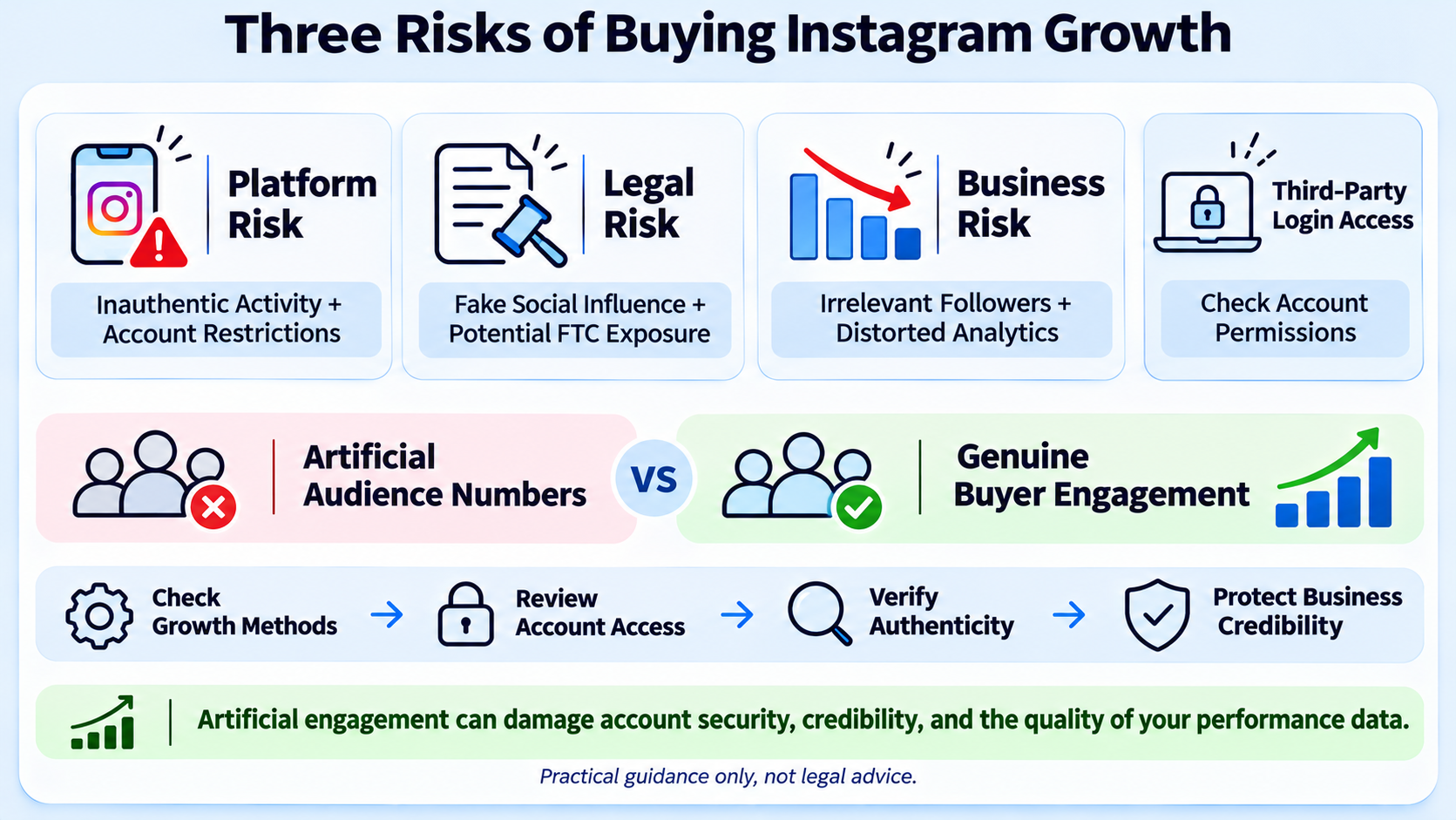
Platform risk. Instagram has long taken action against inauthentic activity. In a November 2018 announcement, the company said it would remove inauthentic likes, follows and comments from accounts using third-party apps to boost popularity, ask affected accounts to change their passwords, and warned that those who kept using such apps might see their Instagram experience impacted. That announcement is old, and enforcement details change, so check Instagram's current rules before buying. The direction of travel has not reversed.
Handing a service your login is a separate problem. If an automation tool needs your password, you are giving a third party control of an account that may represent your brand.
Legal risk. In the United States, the Federal Trade Commission's final rule on fake reviews and testimonials, announced in August 2024, also prohibits selling or buying fake indicators of social media influence, such as followers or views generated by a bot or a hijacked account. The FTC says the prohibition applies where the buyer knew or should have known the indicators were fake and misrepresents their influence for a commercial purpose, and that the agency can seek civil penalties against knowing violators. I am not a lawyer, so take this to counsel if you are considering anything near this line. For a B2B brand that wants to look credible to investors, customers and candidates, the reputational risk alone is reason enough to avoid it.
Business risk. The question is not only whether an Instagram growth service is worth it in money terms. A bought audience does not read your content, attend your webinars or buy your software. It also distorts your own data. Engagement rates fall, content tests become unreadable, and prospects who check your account may notice the mismatch between followers and real interaction.
What a Good Instagram Growth Service Should Deliver
A managed program that suits B2B should include most of the following:
- Strategy tied to your buyer. A clear audience, pillars and goals, not a generic template.
- Production. Edited Reels, carousels, captions and covers made from your recordings or interviews.
- Publishing and engagement. A calendar, scheduling and replies to comments and messages.
- Distribution across channels. Adaptation for LinkedIn, YouTube Shorts and other platforms where relevant.
- Reporting. Sends, saves, profile visits, messages and, where possible, mentions in sales conversations.
- Compliance. A review step for claims, customer names and regulated language.
Komet Media's own Instagram growth program, for example, is built around creating content from scratch, repurposing founder and executive recordings, and publishing and distributing it, rather than chasing follower counts. Details of the model are on the Instagram growth service page.
What Instagram Growth Results Are Realistic
No honest vendor can promise a follower number or a lead number, and you should be wary of any who do. What the public data does show is that organic growth is slower and flatter than it used to be. Socialinsider's 2026 Instagram benchmarks, using 2025 data, report average audience growth of about 22% for brand accounts with 1,000 to 5,000 followers, falling to around 11% for accounts with 100,000 to 1 million, and overall engagement down about 24% year over year. Engagement there is likes and comments divided by followers, so it understates saves and sends.
Format also matters. In the same report carousels averaged a 0.55% engagement rate, Reels 0.52% and images 0.37%. These are averages across many account types, so they describe the platform rather than what any single B2B account will earn.
A better definition of a result for a B2B program is a set of signals you review over a quarter:
- Non-follower reach and profile visits rising.
- Sends and saves from accounts that match your ICP.
- Direct messages and replies from real buyers, partners or candidates.
- Sales calls where prospects mention your content.
Allow at least twelve weeks before judging. The early weeks are for finding hooks, formats and topics.
Instagram Growth Service Cost: What Drives the Price
Prices vary widely and I would not trust a number without a scope. The main drivers are:
- Number of pieces per month and the mix of Reels, carousels and Stories.
- Production difficulty: talking heads, motion graphics, captions styling, b-roll.
- Source quality and how much cutting is needed.
- Revision rounds and turnaround speed.
- Whether publishing, community management and reporting are included.
- Whether the partner records with you or edits supplied footage.
Komet Media's typical working range for ongoing B2B engagements is roughly $2,500 to $5,000, with final pricing based on scope, volume and distribution needs. Cheaper options exist, including freelancers and subscription editors, but they usually cover editing only. Compare like with like. A low monthly fee that covers ten edits is not the same product as a higher one that covers strategy, editing, publishing and reporting.
Ask every vendor whether the price covers editing only or a larger service, how many revision rounds it includes, and what happens if you want more volume.
An Instagram Growth Service Vetting Checklist
Use this before you sign.
- Ask for the plan, not the pitch. What will be published in the first month and why?
- Ask how the audience is built. If the answer involves purchasing, automation or engagement pods, walk away.
- Ask who appears in the content. A program for founders and executives needs access to them.
- Ask for examples from similar buyers. Look at the actual accounts, check that the engagement is real, and read the comments.
- Ask what you must provide. Recordings, approvals, product access. Underestimating your own time is common.
- Ask about reporting. What is reported, how often, and in what format?
- Ask about contract terms. Minimum term, notice period, who owns the content and the account.
- Ask about login access. You should not need to share a password, and you should keep ownership of the account.
- Ask what happens when a post underperforms. Good partners explain what they will change.
Red Flags in an Instagram Growth Service Proposal
Some warning signs show up before any money changes hands.
- A guaranteed follower or lead number. Nobody controls how Instagram distributes content.
- No named deliverables. "Growth strategy" without a count of Reels, carousels and Stories is a promise with no content behind it.
- Vague language about how followers are gained. Phrases such as "organic boost" or "proprietary network" deserve a direct question.
- A request for your password. A reputable partner can work through scheduling tools or role-based access.
- No reporting beyond follower count. A report that ignores saves, sends, profile visits and conversations is a vanity report.
- No limit on revisions, or no description of them. This is where scope disputes start.
- Pressure to sign quickly. A good program survives a week of due diligence.
Questions for an Instagram Growth Service Discovery Call
Prepare these before you speak with any vendor, and write down the answers.
- Which of my buyers have you worked with, and can I see the accounts?
- Who writes, edits and publishes, and who is my day-to-day contact?
- How much of my time will you need each week?
- How do you choose which moments to clip from a long recording?
- What does the first month look like, concretely?
- How do you handle claims, customer names and compliance review?
- What happens if results are slower than we both hope?
The best vendors answer plainly and say what they do not do. A vendor that says yes to everything is selling, not scoping.
Three Situations and What I Would Do
These are generic scenarios, not client stories.
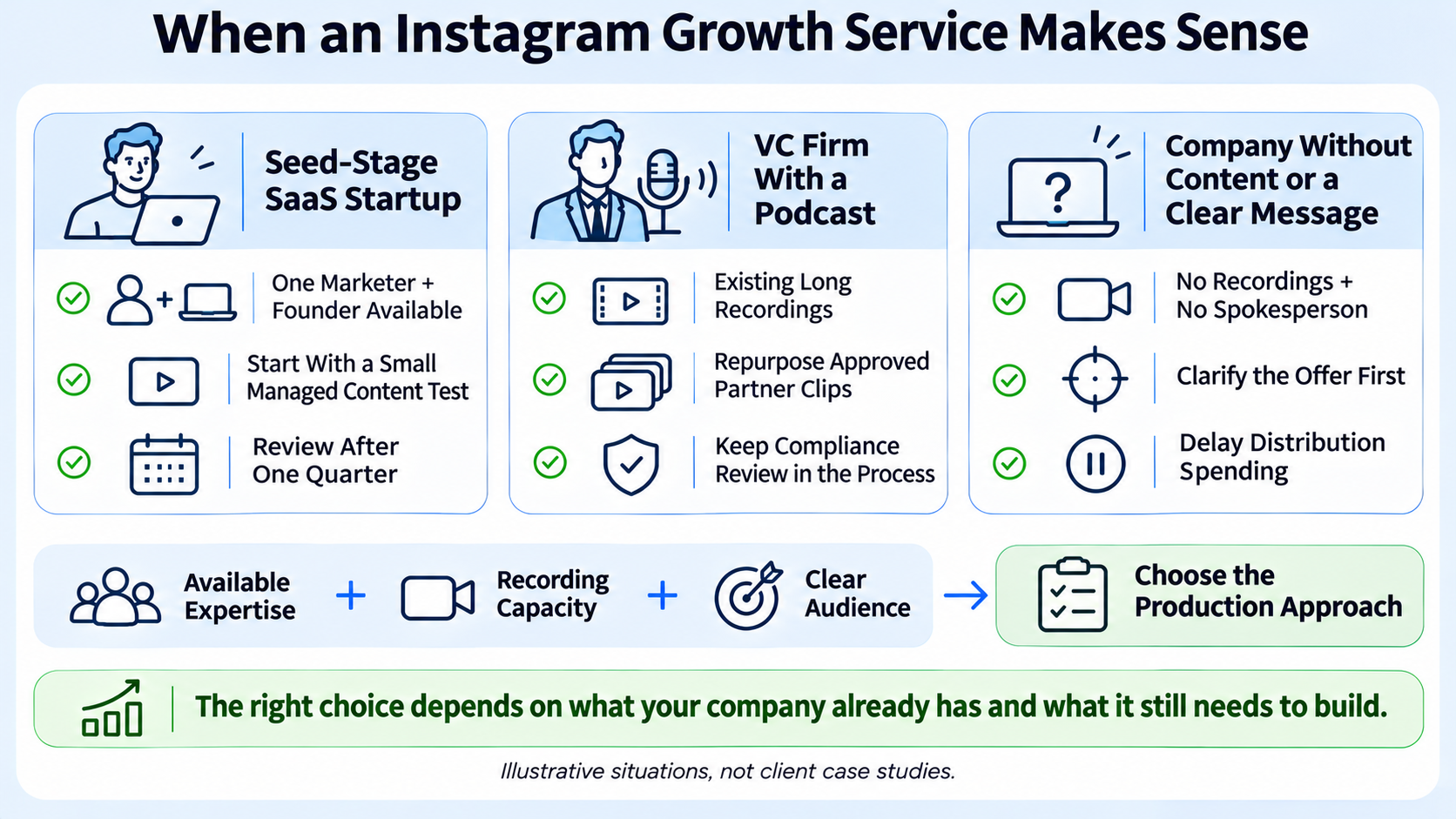
A seed-stage SaaS team with one marketer and a founder who will record. A managed program or a strong freelance editor can work. The limit is founder time, so test with a small scope for a quarter.
A VC firm with a podcast and little time. Repurposing existing recordings is usually the lowest-effort route. Is an Instagram growth service worth it here? Often yes, if partners will appear on camera and compliance can review quickly.
A company with no recordings, no spokesperson and no clear offer. Fix those first. Spending on distribution before there is something worth distributing usually wastes money.
A Simple Way to Put Numbers on the Decision
Founders often ask, in a direct form, is an Instagram growth service worth it in dollars? You can frame it without inventing figures. Start with what a qualified conversation is worth to you: your average contract value, your close rate from a first call, and how much of your pipeline you want from this channel. Those numbers come from your own sales data, not from a benchmark.
Then divide the program cost for a quarter by the number of qualified conversations you would need to break even given those numbers. If that target looks plausible against the reach and messages you see in the first six weeks, continue. If it looks far out of reach, change scope or stop. This turns a vague worry into a testable threshold.
Two cautions apply. First, Instagram rarely closes deals alone, so count assisted conversations, such as a prospect who mentions a Reel in a sales call, and be clear about how you count them. Second, brand value is real but hard to price. So is an Instagram growth service worth it when the payoff is mostly brand? Set a smaller test budget and a clear end date instead of a long contract.
For many B2B teams the cleaner test is time to first conversation: how many weeks pass before a buyer, candidate or partner starts a thread that traces to a post. Track it from day one.
A Deeper Look at the Three Service Types
The first table in this guide sorts services into three types. Each deserves a closer look, because the same sales pitch can hide very different operations.
Automation and bot tools. These tools perform actions from your account, such as following, liking and commenting at scale. The appeal is low cost and speed. The problems are relevance, because the actions are broad, and risk, because platform rules treat inauthentic activity as a problem. Instagram said in 2018 that it would remove inauthentic likes, follows and comments from accounts using third-party apps and that accounts could see their experience affected. For a B2B account, a follower who clicked back because of an automated follow is not a buyer.
Follower and engagement sellers. These services deliver numbers to an account. The numbers do not read, share or buy. The legal point is separate from the practical one. The FTC's 2024 rule prohibits buying or selling fake indicators of social media influence in defined circumstances, and the practical point is that your own data becomes useless, because engagement rates and tests are distorted.
Managed content and distribution. These services plan, produce, publish and report. They vary widely. Some create content from scratch, from topic planning and scripting to production. Others work only from recordings you supply. Others manage engagement with a targeted audience and publish nothing. When you see "managed", ask which of these it means.
How the Economics Change by Company Stage
The question of whether the spend is justified depends on where your company is.
Pre-seed and seed. Cash is tight and the founder is the main asset. A full managed program may be out of reach, but a small test built around founder recordings can be affordable. Spend time before money: record a few answers and see whether the content gets a response.
Series A and B. There is a marketing team and a need to scale pipeline. Here, the question is capacity. A partner can add production and distribution without a hire. The risk is a program that runs in a silo, disconnected from sales, so involve sales from the first month.
Growth stage and beyond. Brand consistency, governance and multiple stakeholders matter more. A partner needs to work inside your brand rules and approval chain. Judge it on process maturity as well as creative quality.
Investment firms. Compliance review and partner availability shape the program. The value is trust with founders, which is slow to measure. Set expectations accordingly and review qualitative signals, such as founders mentioning content on calls.
What Good Reporting Looks Like
A monthly report should help you decide, not just prove activity. Ask for:
- A summary of what was published, with the format, topic and goal of each piece.
- Reach and attention metrics, including non-follower reach and profile visits.
- Engagement that signals value, meaning sends and saves, not only likes.
- Conversation log, a short list of direct messages, comments and sales mentions.
- A learning section, stating what worked, what did not and what will change next month.
- Next month's plan, with topics and decisions that need your input.
Reports that contain only charts of followers and impressions are not enough. A good partner will tell you plainly when a month underperformed and propose a change.
Contract and Exit Considerations
Read these clauses before you sign.
- Term and notice. Shorter initial terms reduce risk. If a vendor requires a long term, ask for a pilot period with a clear exit.
- Ownership. You should own the account, the content, the source files and the data. Ask for the right to download edited files and captions at the end.
- Access. Specify the method, who holds credentials and how they are revoked.
- Confidentiality. Customer names, unreleased product details and financial information should be covered.
- Approval rights. State which content needs your approval before publishing.
- Scope changes. Describe how volume, formats and platforms can be changed and what each change costs.
- Performance language. Treat any guaranteed number of followers or leads as a warning. A fair contract promises deliverables and process, not outcomes the vendor does not control.
Have counsel review the final agreement, especially for regulated businesses.
When an Instagram Growth Service Is Not Worth It
Even a good service is the wrong buy in some situations. Is an Instagram growth service worth it for you? That depends on your fit as much as on the vendor.
- You cannot spare recording time. Without access to your people, the program becomes generic.
- Your buyers are not on Instagram. If they are narrow, highly technical or procurement-led, other channels may serve them better.
- You need results in a few weeks. Organic programs take a quarter or more to show a pattern.
- You do not have a clear offer or message. Fix the positioning first.
- You want followers for vanity. That is a poor reason to spend.
Freelancer, In-House Team, or Agency
There is no universal answer. A freelancer is a good fit for a limited, well-defined number of edits. An in-house hire gives control and context but is costly to build, and one person rarely covers strategy, editing, design and community. An agency suits teams that want a managed process and wider capability. See our comparison of an Instagram growth service versus in-house for a deeper look at the tradeoffs.
How to Run a Fair Test of an Instagram Growth Service
Treat the first quarter as an experiment with rules you set in advance, because that is the only reliable way to answer whether an Instagram growth service is worth it for you.
- Define three metrics tied to your goal, for example profile visits from non-followers, qualified messages and mentions in sales calls.
- Record a baseline before the program starts.
- Agree a minimum number of pieces and a cadence.
- Review every two weeks and make one change at a time.
- At week twelve, decide whether to continue, change scope or stop.
Keep a log of every time someone says they saw your content. These mentions are imperfect but often more convincing than dashboards.
Conclusion: Weighing an Instagram Growth Service
So, is an Instagram growth service worth it? Judge it by what it produces and what you can measure, not by what it promises. Services that sell followers or automation add risk without adding buyers. A managed content and distribution program, with real people on camera and a clear view of results, can be a sound investment for the right company, and it should be tested honestly over a quarter before you decide.
FAQs on Instagram Growth Service Value
What does an Instagram growth service do?
It depends on the type. Managed services plan, produce, publish and report on content. Automation and follower-selling services try to raise numbers directly and are poor fits for B2B.
Is an Instagram growth service worth it for a B2B company?
It can be, if it builds content and distribution around your buyers and you can measure conversations. It is rarely worth it if it sells followers or automation.
How much does an Instagram growth service cost?
Pricing depends on volume, production difficulty, turnaround and whether publishing and reporting are included. Komet Media's typical working range is roughly $2,500 to $5,000 for ongoing engagements, with final pricing based on scope.
How long does it take to see results?
Plan on twelve weeks of steady publishing before judging. No result is guaranteed.
What deliverables should I expect?
Edited Reels, carousels, captions, platform exports, a content calendar, publishing support and a regular performance review.
Should I hire a freelancer or an agency?
Use a freelancer for a defined set of edits and an agency if you want strategy, production, distribution and reporting handled together.
Should I build this in house or outsource it?
Keep topic choice and product knowledge in house. Outsource production and publishing if capacity is the limit.
How does Komet Media approach Instagram growth?
Komet Media creates content from scratch and repurposes recordings from founders and executives into Reels and carousels for VC firms, B2B SaaS teams and funded startups, then handles distribution and reporting. It is not built for consumer or lifestyle accounts.