
🪄 AI Summary
Heading 1
Heading 2
Heading 3
Heading 4
Heading 5
Heading 6
Lorem ipsum dolor sit amet, consectetur adipiscing elit, sed do eiusmod tempor incididunt ut labore et dolore magna aliqua. Ut enim ad minim veniam, quis nostrud exercitation ullamco laboris nisi ut aliquip ex ea commodo consequat. Duis aute irure dolor in reprehenderit in voluptate velit esse cillum dolore eu fugiat nulla pariatur.
Block quote
Ordered list
- Item 1
- Item 2
- Item 3
Unordered list
- Item A
- Item B
- Item C
Bold text
Emphasis
Superscript
Subscript
Knowing how to choose a podcast editing service sounds simple until you're buried in vendor tabs and pricing tiers that tell you nothing about quality. Most guides describe what editing services exist. This one helps you decide which type is right for your B2B show, your budget, and your growth goals. I'm Rajan Soni, Founder and Video Director at Komet Media, and this is the framework I use with every serious business team that asks us about podcast production.
TL;DR
- A podcast editing service covers far more than trimming audio: audio post-production, show notes, transcription, and distribution all factor in.
- Pricing ranges from ~$50 per episode for basic freelance cleanup to $6,000+/month for B2B-specialist agencies.
- The freelancer vs. agency decision turns on reliability and operational overhead, not just per-episode cost.
- B2B teams should prioritize turnaround consistency, scope clarity, and content repurposing capability.
What Does a Podcast Editing Service Actually Do?
Most buyers picture a single person trimming awkward pauses. The reality is more layered. Professional podcast editing services combine editorial judgment, audio engineering, file management, and packaging.
Here is what a full-scope service typically covers:
- Technical cleanup: Noise reduction, dynamic range compression, removal of plosives, clicks, room reverb, and remote recording inconsistencies. Tools like Adobe Audition, Audacity, Descript, and Hindenburg Journalist are common in professional DAW software workflows.
- Content editing: Filler word removal, dead-air trimming, and restructuring for pacing and listener retention.
- Mixing and mastering: Volume balancing across multiple speakers, EQ, and exporting to platform-ready specs.
- Show notes creation: Written summaries, timestamps, and SEO-formatted descriptions for RSS feed distribution.
- Transcription: Full episode transcripts for accessibility and content repurposing strategy.
- Publishing support: RSS feed upload, ID3 metadata tagging, and platform scheduling.
A podcast editing service polishes raw recordings by removing mistakes, background noise, filler words, and long pauses, then mixes in music, sound effects, and adjusts volume levels for a professional sound. For B2B teams using platforms like Riverside.fm for remote recording cleanup, the raw files often arrive with inconsistent audio quality across guests. A strong editing service has a quality assurance checklist for exactly this scenario.
Basic audio processing covers background noise reduction, volume matching, and mastering a final MP3, while advanced tiers add plosive management, sibilance reduction, hum removal, and de-reverbing using tools like Izotope RX-11 Advanced.
Where most teams leave value on the table: they hire editing without thinking about what happens to the episode after it publishes. At Komet Media's podcast production service, we treat the edited episode as the starting point, not the finish line. Short-form clips, repurposed LinkedIn content, and audiograms belong inside the same workflow.
What Should I Look For in a Podcast Editing Service?
This is the filter most buyers skip. They compare prices before they define requirements, which leads to paying for scope they don't need or discovering gaps after episode one.

Before you evaluate any vendor, answer these six questions:
- What is your episode format: interview, solo, panel, or narrative?
- How many speakers per episode, and are they recording remotely or in-person?
- What is your publishing cadence: weekly, bi-weekly, or monthly?
- Do you need show notes, transcription, or clip creation included?
- What is your turnaround time requirement: 24 hours, 48 hours, or 72 hours?
- Is episode consistency tied to a broader content repurposing strategy?
Once those are clear, evaluate vendors against these criteria:
- Audio quality: Request a before/after sample with noise reduction and dynamic range compression applied. Listen on both earbuds and speakers.
- Scope transparency: Every deliverable should be listed. Vague language like "full editing" hides add-on billing.
- Turnaround time: Editing-only episodes should return within 48 hours; all-in-one packages with editing, show notes, and transcripts within 72 hours is a reasonable industry standard to benchmark against.
- Podcast workflow automation: Does the service use a defined submission and review process, or is everything managed by email?
- Revision policy: How many rounds of revisions are included, and at what cost per extra round?
- Content repurposing capability: Can the service produce short-form clips or audiograms, or is audio the only output?
The right choice depends on output volume, internal approval culture, brand risk tolerance, and whether you need only editing or a broader production system. The biggest mistake is choosing based on price alone.
How Much Does Professional Podcast Editing Cost?
Here is the honest breakdown for 2026: Podcast editor rates in 2025–2026 run from $50 to $600 per episode for freelancers, depending on experience and scope. Managed agency services start at around $500 per month and scale to $6,000+ per month for specialist B2B providers.
B2B podcasts tend to run longer (45–90 minutes), involve multiple remote guests, and require show notes and transcript production. A realistic budget for a professionally edited B2B episode with show notes and transcript runs $300–$500 on the freelance side. A managed agency service for a bi-weekly B2B show typically starts at $1,500 per month.
Key cost drivers to watch:
- Episode length over 45 minutes
- Multiple remote speakers with inconsistent audio
- Rush turnaround under 48 hours
- Video podcast editing and caption requirements
- White-label editing for agencies managing multiple client shows
A professionally edited hour-long B2B episode averages around $199 at the episode level, but that number rarely includes show notes, transcription, or repurposed clips, all of which a serious show needs.
Our podcast editing service is structured around B2B workflows where a single episode should fuel multiple content touchpoints, not just one published audio file.
Podcast Editing Service vs Hiring a Freelancer: Which Is Better?
The freelance vs. agency cost comparison gets oversimplified. On paper, the freelancer often looks cheaper. In reality, the right answer depends on what costs you are counting.
Here is the side-by-side:
Freelancers do disappear. They get better-paying opportunities, burn out, have life events, or simply stop responding. When this happens, you are back to square one: searching for a replacement, onboarding them in your show's style, and dealing with weeks of disrupted production.
A freelancer may charge less per episode, but your internal team still absorbs guest scheduling, review rounds, publishing, copywriting, repurposing, and coordination. That hidden labor can swallow the savings. An agency may quote more, yet remove a pile of admin and decision fatigue.
The verdict: freelancers work when your format is simple and your team has bandwidth to manage the relationship. Agencies work when your podcast is tied to pipeline, thought leadership, or demand generation, and episode consistency is non-negotiable.
Signs You Need to Outsource Your Podcast Editing
Most B2B teams wait too long. By the time they decide to outsource, they've already published inconsistent episodes, burned founder or marketing-head hours, and let the show drift in quality. Here are the clearest signals:
- Editing is eating your calendar. A single 30–45 minute episode can take 3 to 6 hours to edit if you're doing it right, including cutting filler, fixing levels, syncing tracks, inserting music, and exporting files.
- Episode quality varies episode to episode. If listeners notice audio inconsistency, it signals brand indiscipline, especially for B2B shows sitting next to webinars and thought leadership content.
- Publishing cadence is slipping. Episode consistency is one of the top podcast growth metrics that determines audience retention. When episodes are delayed and quality is slipping, that is the signal to level up.
- You have no repurposing system. If your 45-minute conversation publishes once and then disappears, you're leaving substantial pipeline fuel untouched.
- You're growing your guest roster. More guests, recorded remotely, means more variable audio. The 2025 Independent Podcaster Survey of 558 creators reveals that DIY podcasters spend 4–8 hours per episode on average, with 21% spending 9 or more hours per episode.
- Your show is tied to revenue goals. The moment a podcast is connected to demo demand, inbound, or sales enablement, amateur post-production becomes a brand liability.
At Komet Media's podcast page, we work with B2B teams that have hit exactly this wall. The good news: switching to a managed service is faster than most founders expect.
Difference Between Podcast Editing and Podcast Production Services
These two terms are used interchangeably, but they describe very different scopes. Choosing the wrong one is a common and expensive mistake.
Podcast editing covers audio post-production: everything that happens to the raw file after recording ends. It produces a polished, listener-ready audio file.
Podcast production is the full-stack operation: full production editing means working through the entire content creation process, including planning, scheduling, finding guests, writing questions, and editing the final audio file.
Editing is a deliverable. Production is a system. If your show is a business tool, you need the system.
Our podcast production service and show notes service are both built around this distinction. Most B2B teams start by hiring editing and realize within 60 days they actually needed production.
Questions to Ask Before Hiring a Podcast Editor
These are the eight questions that separate a vendor who will compound your growth from one who will create problems you'll have to clean up later.
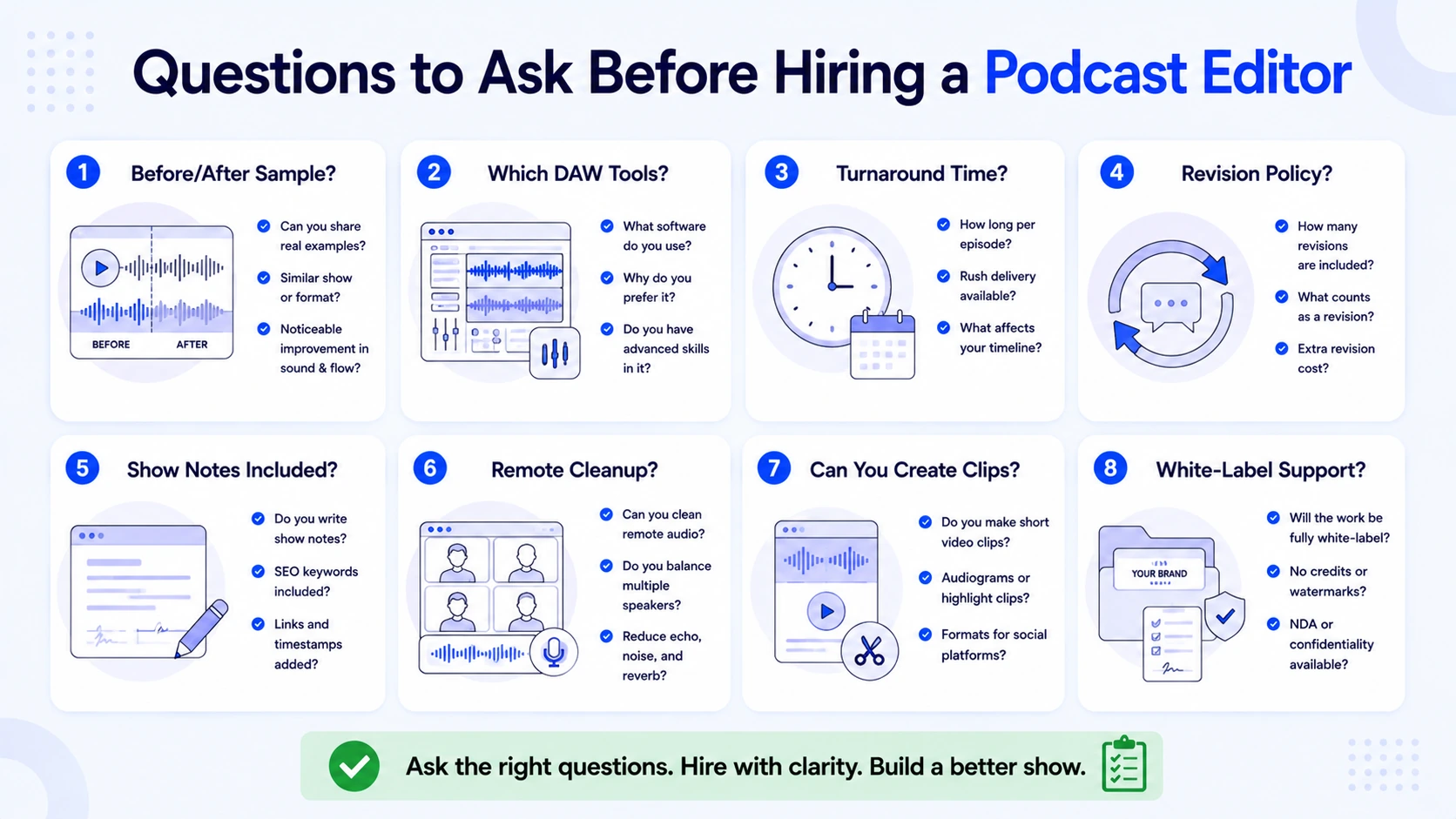
- Can I hear a before/after sample from a show in my format? Generic samples don't prove anything. You want to hear remote recording cleanup specific to interview-style B2B shows.
- What DAW software do you use, and do you use noise reduction tools beyond basic filters? Professional editors work in Adobe Audition, Hindenburg Journalist, or Descript with tools like Izotope RX for advanced repair.
- What is your turnaround time, and what happens if you miss it? Get this in writing.
- What does your revision policy cover? Unlimited revisions sounds great until you realize they apply only to technical errors, not content decisions.
- Do you include show notes creation and podcast transcription, or are those add-ons? Scope creep on deliverables is the most common source of invoice disputes.
- How do you handle remote recording cleanup from platforms like Riverside.fm? This is a technical qualifier that separates experienced editors from generalists.
- Can you produce short-form clips or audiograms for social distribution? If you want a content repurposing strategy, this needs to be in-scope from day one.
- Do you offer white-label editing for teams managing multiple shows or brands? Relevant for marketing agencies, investor relations teams, and SaaS companies managing multiple product lines.
If a vendor cannot answer questions 2, 3, 4, and 6 with specifics, they are not at the professional tier, regardless of price. Check Komet Media's services page for how we structure scope, turnaround, and repurposing across all podcast and video engagements.
How Do I Know If a Podcast Editing Service Is Worth It?
This is the right question, and the answer is not about audio quality in isolation. Podcast editing services de-risk a branded audio program because they create repeatable quality. That's their core value. You're not buying cleanup alone. You're buying reliability in how your brand sounds every time someone presses play.
For B2B teams specifically, here is how to evaluate ROI:
- Pipeline attribution: Is your show generating inbound inquiries, demo requests, or warm intros? If yes, every dollar of production cost is justified against pipeline value. If not, the issue is usually content strategy, not editing quality.
- Founder time reclaimed: If your founder or marketing head is spending 6+ hours per episode on production, the opportunity cost at executive rates almost always exceeds what a professional service charges.
- Episode consistency: Your podcast represents your brand. Every episode, every clip, every thumbnail shapes how your audience perceives you. Consistency is undervalued.
- Content leverage: A professionally edited episode should become 5–10 additional assets: short-form clips, show notes, a LinkedIn post, a transcript, and an email snippet. If it doesn't, the editing service is one piece of an incomplete workflow.
- Podcast growth metrics: Are listens growing month-over-month? Are completion rates above 60%? These are the numbers that tell you whether production quality is serving the show or just maintaining it.
A podcast that feeds brand authority, demand generation, or thought leadership usually needs more than a tidy waveform. It needs packaging and a repeatable way to move from raw recording to public-facing content. If you want to see how editing integrates with a full content repurposing strategy, our approach at Komet Media treats every long-form episode as a content engine, not a one-time publish.
Conclusion
Choosing how to choose a podcast editing service comes down to four decisions:
- Scope first: Define whether you need editing, production, or a full content system before pricing a single vendor.
- Match tier to stakes: A show tied to pipeline and founder-led growth needs agency-level reliability, not a budget freelancer.
- Evaluate total cost: Factor in internal time and coordination overhead, not just the invoice.
- Demand repurposing capability: The edited episode is the start of the content flywheel, not the finish line.
If your podcast is a growth tool, treat it like one. Talk to us at Komet Media about building a system around it.
Frequently Asked Questions
Q1: How long does podcast editing typically take?
Most services provide a 72-hour turnaround. Editing-only episodes typically return within 48 hours; all-in-one packages including show notes and transcripts return within 72 hours. Rush options under 24 hours exist but typically carry a premium fee.
Q2: Is a podcast editing service worth it for a new show?
Yes, if you're publishing more than twice per month and your show represents your brand. The risk of inconsistent quality early in a show's life is underestimated. Episode consistency is a top podcast growth metric, and first impressions with new listeners are permanent.
Q3: What is the difference between mixing and mastering in podcast audio post-production?
Mixing balances levels and EQ across multiple tracks so all speakers sound coherent together. Mastering applies a final dynamic range compression pass and loudness normalization to meet platform standards (typically -16 LUFS for Spotify, -19 LUFS for Apple Podcasts). Both belong in every professional podcast workflow.
Q4: Can a podcast editing service also handle video podcast editing?
Many can, but not all. Premium editing includes video editing, social media clip creation, detailed show notes, transcriptions, and strategic content advice. Always confirm video scope explicitly, including multi-camera sync, caption generation, and short-form clip creation for LinkedIn and Instagram.
Q5: How do I evaluate a podcast editing service's audio quality before committing?
Request a before/after sample from a show that matches your format (remote interview, solo, panel). Listen for clean noise reduction without artifacts, natural pacing after filler word removal, and consistent volume across speakers. A professional freelance audio engineer or agency will have samples ready without hesitation.
Q6: What is white-label podcast editing and who needs it?
White-label editing is audio post-production delivered unbranded so the buyer can resell it under their own name. Some providers offer specialized services for network, agency, and white-label programs. It is most relevant for marketing agencies producing podcasts for multiple clients, or B2B SaaS companies managing multiple product-specific shows.