
🪄 AI Summary
Heading 1
Heading 2
Heading 3
Heading 4
Heading 5
Heading 6
Lorem ipsum dolor sit amet, consectetur adipiscing elit, sed do eiusmod tempor incididunt ut labore et dolore magna aliqua. Ut enim ad minim veniam, quis nostrud exercitation ullamco laboris nisi ut aliquip ex ea commodo consequat. Duis aute irure dolor in reprehenderit in voluptate velit esse cillum dolore eu fugiat nulla pariatur.
Block quote
Ordered list
- Item 1
- Item 2
- Item 3
Unordered list
- Item A
- Item B
- Item C
Bold text
Emphasis
Superscript
Subscript
If your team is evaluating whether a podcast belongs in your demand generation mix, stop guessing. The B2B podcast statistics for 2026 now paint a clear, data-backed picture. Decision-makers are listening, engagement rates dwarf every other content format, and pipeline attribution is no longer theoretical. This guide compiles the most current benchmarks across audience size, listener demographics, publishing cadence, format performance, ROI, and market growth so you can make the call with confidence.
TL;DR
- The worldwide podcast audience is projected to reach 619.2 million listeners in 2026.
- 83% of senior executives reported listening to a podcast in the past week.
- The average guest-to-client conversion rate on B2B podcasts is 10%, with top performers converting 48% of strategically selected guests into pipeline opportunities.
- Podcasts command 80%+ listener retention through entire episodes, compared to just 12% completion for video content.
What the Latest B2B Podcast Statistics for 2026 Actually Show
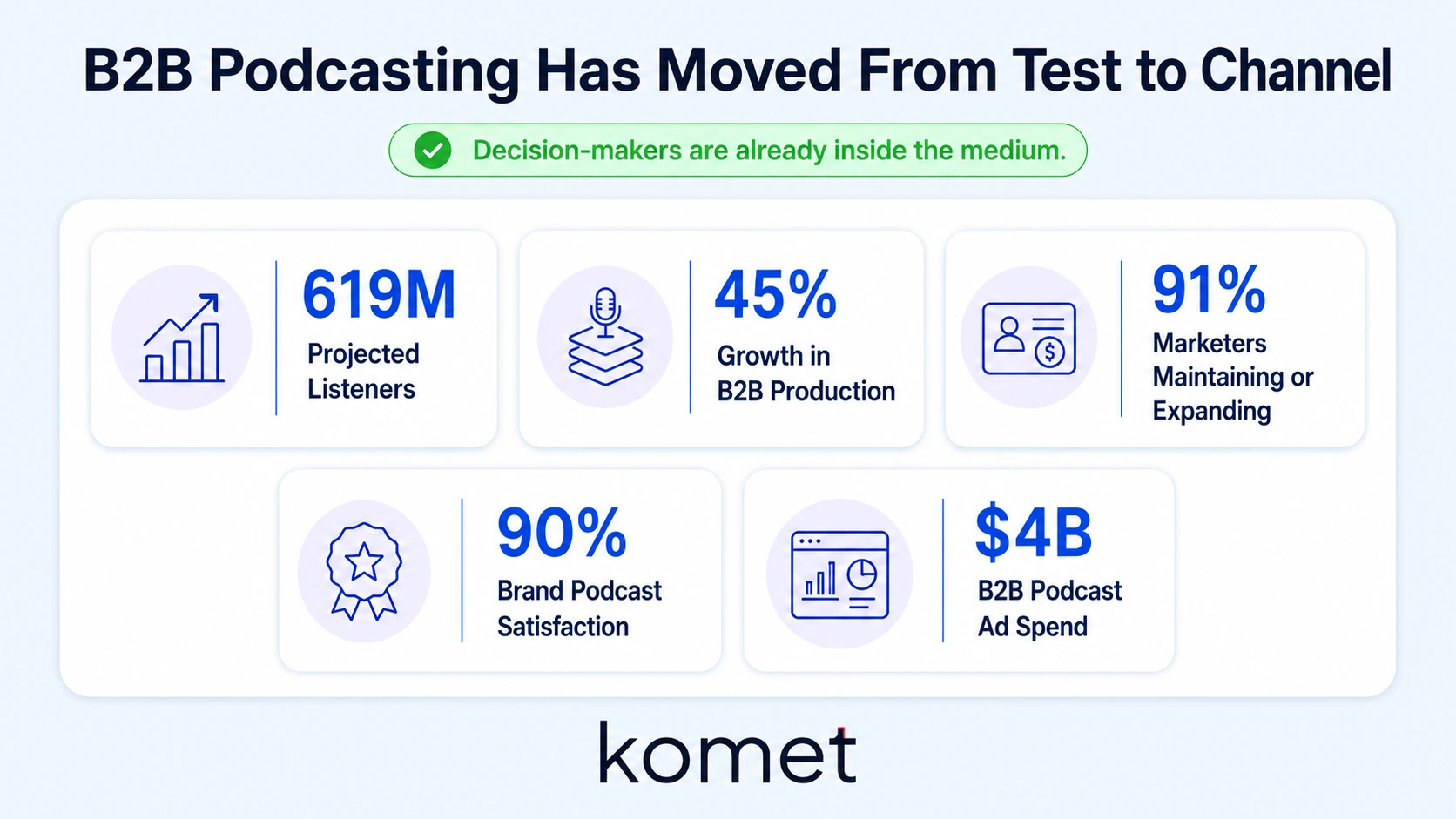
The numbers no longer leave room for debate. The worldwide podcast audience is projected to reach 619.2 million listeners in 2026, driven by demand for on-demand, niche-specific content. According to eMarketer, worldwide podcast listeners grew from around 507 million in 2023 to roughly 547 million in 2024, and an estimated 584 million in 2025 , making the 2026 trajectory a continuation of consistent year-over-year expansion.
The global podcasting market was valued at USD 32.48 billion in 2025 and is projected to reach USD 362.99 billion by 2035, growing at a 27.3% CAGR (2026–2035). That is not a niche channel. That is infrastructure. For B2B specifically, adoption is accelerating.
B2B podcast production has increased by over 45% in the last two years. Over half of B2B brands now allocate part of their marketing budget to podcast production or guest appearances. In 2025, 91% of marketers planned to maintain or expand their podcast and audio content investments. 91% of marketers plan to maintain or expand their podcast and audio content investments, and 90% of companies investing in their brand's podcast are satisfied with their results.
The signal is clear: B2B podcast statistics for 2026 show the channel has moved from experiment to expected. If your competitors are already running shows, the question is not whether to start, it is whether you can afford to wait. The spending figures reinforce that confidence.
Global podcast advertising spend is projected to hit $4.46 billion in 2025, with B2B-specific ads accounting for $4 billion of this. U.S. podcast ad spending crossed $2.51 billion in 2025 and is expected to exceed $3 billion by 2028.
At Komet Media, we watch these macro numbers as confirmation that the buyers our clients want to reach are already inside the medium.
B2B Podcast Listener Demographics and Engagement Benchmarks
The demographic case for B2B podcasting is now stronger than ever. 75% of B2B decision-makers listen to podcasts, with 51% listening daily. 78% of business leaders consume podcasts weekly, carving out 54+ minutes daily for audio content that directly influences their strategic thinking. Age distribution is favorable for pipeline targeting.
Podcasting spans generations, but its fastest growth is in younger professionals. In 2025, 66% of people aged 12–34 and 61% of those aged 35–54 in the U.S. said they watched or listened to podcasts monthly. That 35–54 cohort is squarely in the decision-making zone for most B2B companies. Platform distribution matters for distribution strategy. The 2025 Cumulus Media and Signal Hill Insights Podcast Download report found YouTube was the most-used podcast platform among weekly podcast consumers in Q3 2025 at 41%, followed by Spotify at 25% and Apple Podcasts at 11%.
Engagement metrics separate podcasts from every other format:
- While video content struggles with 12% completion rates, podcasts command 80%+ listener retention through entire episodes.
- 75% of podcast listeners stay attentive through entire branded podcast episodes, with branded podcasts achieving up to 90% completion rates compared to 60–70% for typical B2B podcasts.
- 52% of listeners say they feel closer to podcast hosts than other media personalities, and 59% consider podcast hosts more trustworthy than influencers.
- 68% of B2B podcast listeners say they trust the companies featured on podcasts more than those advertised on other media.
Trust at this depth does not come from a banner ad or a sponsored LinkedIn carousel. It comes from 40 minutes of uninterrupted access to a founder's thinking.
What Percentage of B2B Buyers Listen to Podcasts?
According to Edison Research's Infinite Dial 2025, 55% of Americans, about 158 million people, listen to podcasts monthly, and weekly podcast consumption has reached 115 million listeners. For B2B marketers targeting professional audiences, the penetration numbers are even sharper. B2B podcasting is booming because decision-makers increasingly use podcasts to research vendors and form opinions before they ever take a sales call. The 2025 data shows executives and buyers listening to industry shows, trusting expert guests, and acting on what they hear. For B2B brands, podcast guesting and hosting now reach buyers earlier and more credibly than most paid channels.
74% of podcast listeners engage specifically to learn new things, and 76% of businesses launch podcasts explicitly for thought leadership purposes, with 65% of shows treating the guest as the thought leader. The C-suite is especially active. 83% of senior executives reported listening to a podcast in the past week, and business leaders spend an average of 54+ minutes per day on audio content influencing strategic decisions.
For SaaS founders and marketing heads: your buyers are in these feeds during commutes, between calls, and at the gym. The question is whether your brand's voice is part of that 54-minute daily window.
Average B2B Podcast Episode Length and Download Benchmarks
The data on episode length is directionally clear. The average episode length across all podcasts is approximately 38 minutes. For B2B audiences targeting C-suite attention, shorter wins. 22-minute episodes achieve 85% completion rates among C-suite listeners, versus 45% for hour-long shows. The sweet spot for most B2B companies is 20–35 minutes.
Download benchmarks, broken down by percentile, from Share Your Genius analysis:
A podcast with 1,000 downloads per episode is already in the top 20% globally. For B2B, the threshold to matter is far lower than most teams assume. The average B2B podcast performs modestly by consumer standards but wildly effectively by pipeline standards. The average B2B podcast gets 127 downloads per episode, that is not a failure number if those 127 listeners are VP-level buyers in your ICP.
Key benchmark: Target a consumption rate above 60%, with 70% as the strong performance threshold. Monthly download growth of 10%+ signals a healthy show trajectory.
For our podcast production clients at Komet Media, we prioritize consumption rate and ICP-alignment of listeners over raw download counts. A small, highly engaged professional audience converts at rates consumer shows cannot touch.
Do B2B Podcasts Actually Generate Leads and Pipeline?
Yes, and the data is specific. The average guest-to-client conversion rate on B2B podcasts is 10%. One company converted 48% of strategically selected podcast guests from target accounts into pipeline opportunities. A cybersecurity firm attributed $2.3M of new pipeline in 9 months to relationships with podcast guests.
One SaaS company attributed 47% of enterprise deals to podcast listeners. Podcasts lead to 25x more conversions than blogs. A top-performing B2B SaaS brand realized $1.2 million in closed-won revenue, directly attributed to podcast-sourced relationships, even when download numbers were average.
The mechanics behind these outcomes are straightforward:
- Guest-as-pipeline: Invite ICP-matched prospects as guests. The interview builds a relationship before any sales conversation happens.
- Attribution via CRM: Marketers are tying podcast metrics directly to lead generation, pipeline contribution, and closed-won deals, with attribution dashboards connecting listening activity with CRM and marketing automation systems.
- Content repurposing: Each 30-minute episode contains enough content for 15 LinkedIn posts, 3 blog articles, 5 email sequences, and 10 sales enablement assets. Yet most teams publish once and move on, leaving 90% of the content value untapped.
At Komet Media, our podcast repurposing system is built around this exact principle. The episode is the raw material. Short-form clips, LinkedIn video, email sequences, and sales assets are where the pipeline actually lives. Companies generate up to 47 pieces of additional content from one podcast interview, amplifying SEO efforts and reach across channels.
B2B Podcast ROI Compared to Other Content Marketing Channels
The ROI comparison is where b2b podcast statistics become genuinely persuasive. Podcasts lead to 25x more conversions than blogs, and these statistics reveal how podcast content can directly generate leads, especially for SaaS companies targeting high-value accounts. After hearing podcast episodes, 61% of podcast listeners feel more favorable toward a brand. Companies with branded podcasts achieve 89% higher brand awareness and 57% higher brand consideration.
From an advertising efficiency standpoint, podcast formats outperform most programmatic channels. Host-read advertisements outperform programmatic placements by 1.7x, making native advertising and sponsorships more valuable than automated ad insertion. CPM rates range from $18–$50 depending on audience niche. Niche B2B podcasts command CPMs up to $100+.
The ROI framework that matters most for B2B teams:
According to Fame's analysis of 100+ B2B podcasts, shows that prioritize guest relationships over audience size generate 25–50% higher ROI within the first year. Companies implementing pipeline-first podcast strategies see 3x higher ROI, with attribution rates jumping from 5% to 47% of influenced deals. For growth teams weighing podcast investment against paid social: Google Shopping CPCs increased 33.72% in 2025, and Meta CPMs averaged $22.98 in Q4 , making owned-audience channels like podcast marketing structurally more defensible over time.
Publishing Cadence, Format Performance, and Market Growth Trends for 2026
Publishing frequency: The data favors sustainability over volume. Most B2B podcasts should publish at least twice per month. Weekly publishing can work, but consistency matters more than frequency. High-growth shows tend to publish episodes every 14 days, not weekly. Publishing consistency is the #1 predictor of podcast survival.
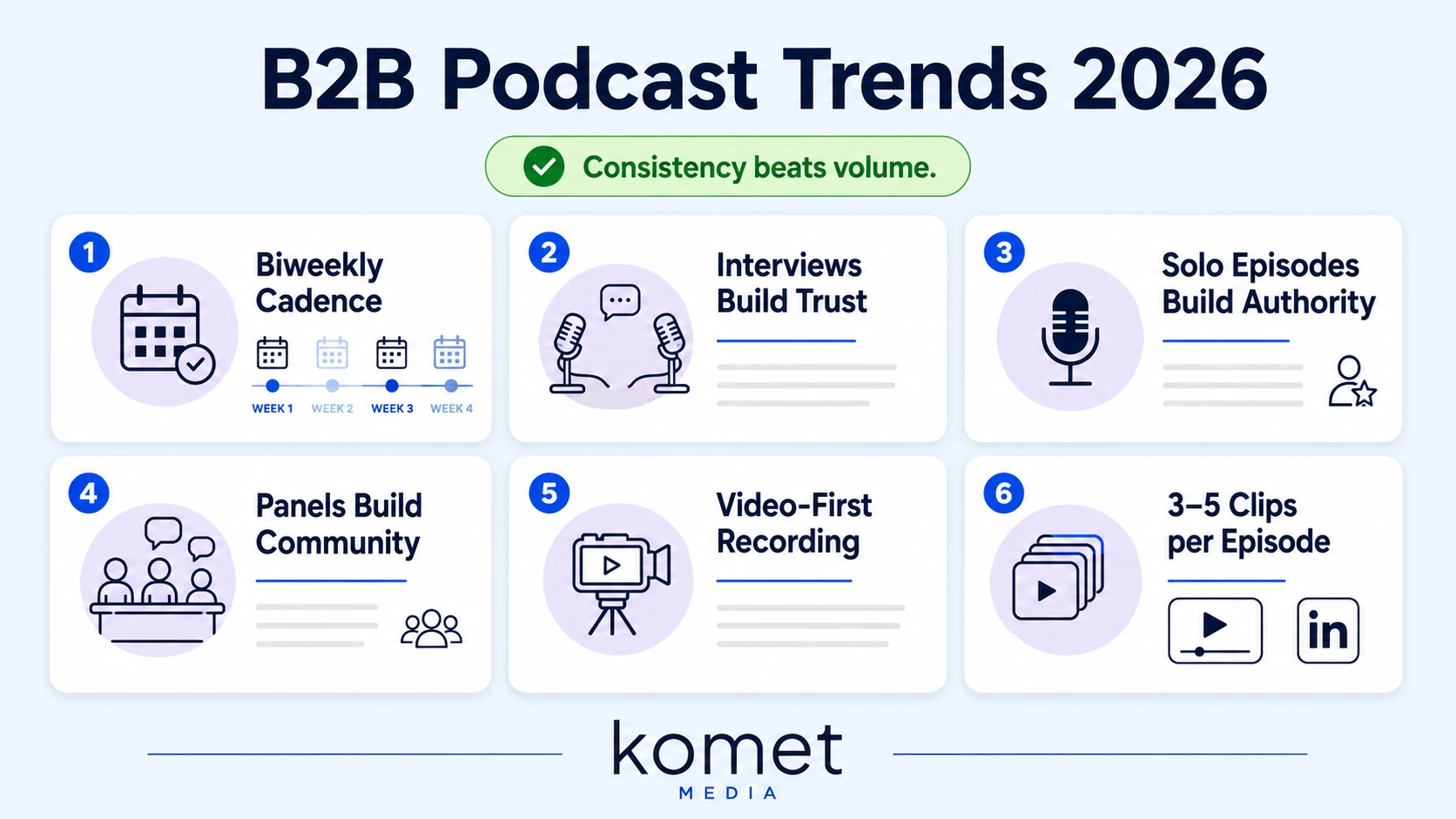
Format performance by objective: Format follows function. Need rapid trust building? One-on-one interviews. Establishing category leadership? Solo thought leadership episodes. Building community? Panel discussions with customers. A professional services firm tested three formats, discovering that panel discussions with client executives generated 3x more qualified leads than celebrity interviews.
Video-first is now table stakes: 61% of the top 150 podcasts post a video for every episode, and two-thirds of U.S. podcast listeners now prefer podcasts with video options. 85% of companies capture video when producing podcasts, and 65% of showrunners post short clips weekly. Short-form clips are the #1 audience growth driver in 2025 and beyond. Publishing 3–5 short clips per episode per week across LinkedIn and YouTube is typically enough to support discovery and reinforce messaging without overwhelming production.
Discovery trends: 45% of weekly podcast consumers who started a new podcast in the previous six months said they started their latest new show on YouTube. That is where discoverability lives now, not in podcast directories.
B2B adoption growth: B2B podcast production has increased by over 45% in the last two years , and B2B companies running a podcast see an average of 20 to 30% higher engagement on LinkedIn and other digital platforms compared to those that rely solely on written content. The fastest-moving trend in 2026 is content repurposing discipline. Teams that use short-form video editing to atomize podcast episodes into clips, carousels, and email sequences consistently outperform those treating each episode as a standalone publish.
Conclusion
The B2B podcast statistics for 2026 tell a consistent story: the audience is there, the decision-makers are listening, and the pipeline outcomes are real for teams that build with attribution in mind.
Key takeaways:
- Audience reach: 619.2 million global listeners projected in 2026, with 75% of B2B decision-makers actively tuning in.
- Engagement edge: 80%+ episode completion versus 12% for video; trust and brand recall metrics that no paid channel can replicate.
- Pipeline proof: 10% average guest-to-client conversion; SaaS companies attributing up to 47% of enterprise deals to podcast audiences.
- Format discipline: 20–35 minute episodes, biweekly cadence, video-first recording, and 3–5 short clips per episode are the benchmarks that compound over time.
If your podcast is already recorded but not yet fully utilized, talk to the Komet Media team about building a repurposing system that turns every episode into pipeline-ready content.
Frequently Asked Questions
Q1: How many B2B companies are using podcasts as a marketing channel in 2026?
Over half of B2B brands now allocate part of their marketing budget to podcast production or guest appearances. Adoption has grown sharply, with B2B podcast production increasing by over 45% in the last two years, driven by saturation in traditional paid channels.
Q2: What is a good download count for a B2B podcast?
Context matters more than raw numbers. The top 50% threshold is just 28+ downloads in the first 7 days. Top 25% requires 104+ and top 10% requires 428+. For B2B, 127 downloads from the right ICP outperforms 10,000 from the wrong audience.
Q3: How often should a B2B company publish podcast episodes?
Most B2B podcasts should publish at least twice per month. Consistency matters more than frequency, and a reliable biweekly release cadence will usually outperform an inconsistent weekly schedule.
Q4: What podcast format works best for B2B lead generation?
Guest-based interview formats drive the clearest pipeline outcomes. A professional services firm testing three formats found panel discussions with client executives generated 3x more qualified leads than celebrity interviews. Match format to your primary objective: interviews for trust, solo episodes for authority, panels for community.
Q5: What is the ideal B2B podcast episode length?
The sweet spot for most B2B companies is 20–35 minutes. Data shows 22-minute episodes achieve 85% completion rates among C-suite listeners, versus just 45% for hour-long shows. Shorter, denser episodes retain senior decision-makers far more effectively.
Q6: How do I measure B2B podcast ROI beyond downloads?
Track guest-to-opportunity conversion rates, CRM-attributed pipeline touches, and demo requests linked to specific episodes via UTM parameters. Track podcast influence using UTM-tagged episode links, a "How did you hear about us?" field, and a podcast touchpoint property in your CRM tied to opportunities and revenue. Downloads confirm reach; CRM data confirms revenue.