
🪄 AI Summary
Heading 1
Heading 2
Heading 3
Heading 4
Heading 5
Heading 6
Lorem ipsum dolor sit amet, consectetur adipiscing elit, sed do eiusmod tempor incididunt ut labore et dolore magna aliqua. Ut enim ad minim veniam, quis nostrud exercitation ullamco laboris nisi ut aliquip ex ea commodo consequat. Duis aute irure dolor in reprehenderit in voluptate velit esse cillum dolore eu fugiat nulla pariatur.
Block quote
Ordered list
- Item 1
- Item 2
- Item 3
Unordered list
- Item A
- Item B
- Item C
Bold text
Emphasis
Superscript
Subscript
Funded startups usually have money, a small team, and a short window to explain a product that buyers do not yet understand. A YouTube strategy for funded startups works when the channel is built like a product education system, not a brand gallery. This guide covers channel architecture, series ideas, how to align video with sales, a 90-day plan, and the metrics that show whether the channel is helping the business.
Quick answer
Build a channel around buyer questions, not company news. Organize videos into three or four series, publish a steady mix of long videos and Shorts, hand the best videos to sales, and review pipeline signals alongside views.
Why funded startups should consider YouTube
Funded teams have a particular problem, and it shapes any YouTube strategy for funded startups. They need trust quickly, but they have little brand recognition, and their products are often technical. YouTube gives buyers a place to learn at their own pace, and it supports search, which matters when buyers research solutions before they talk to sales.
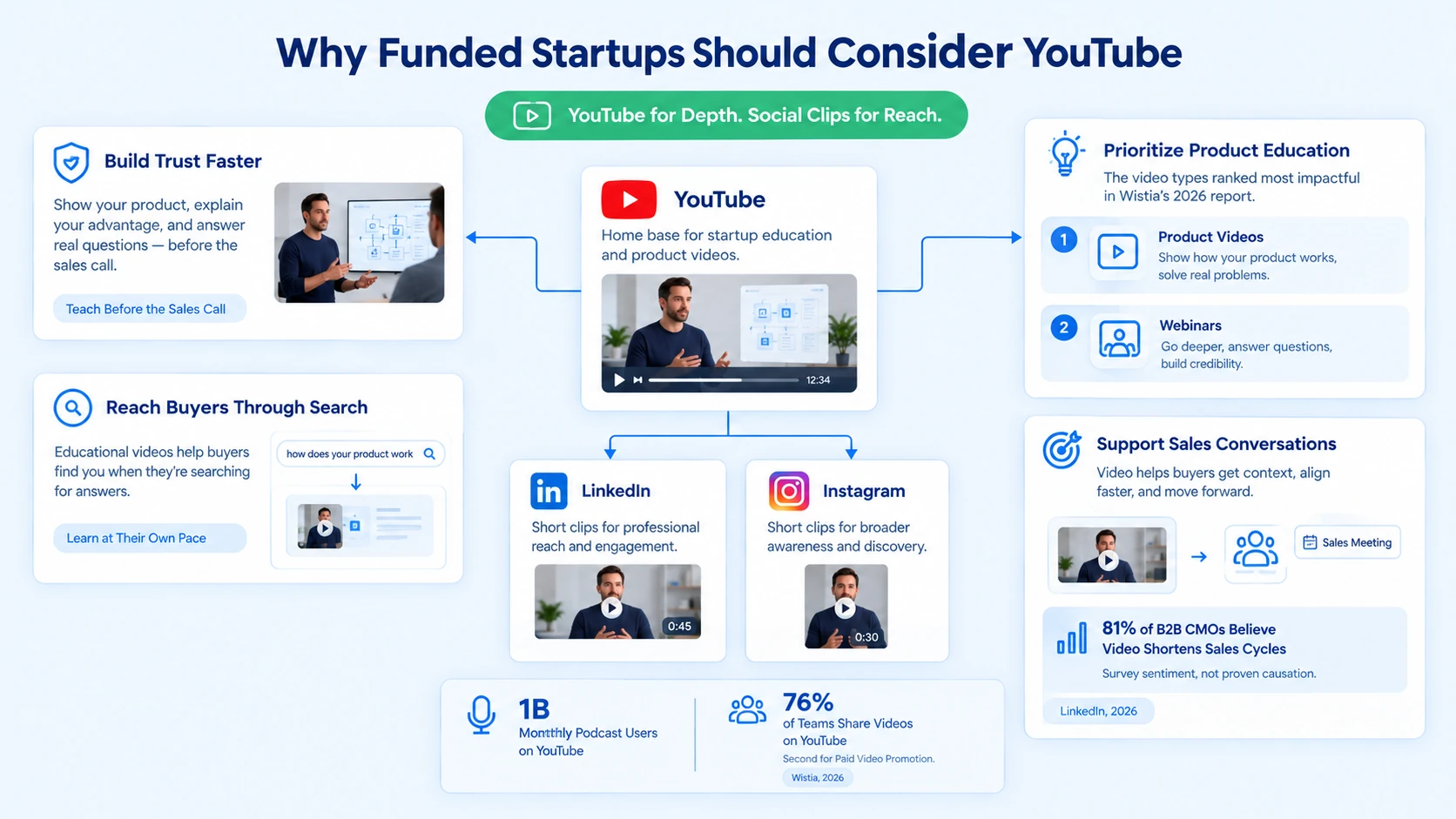
The data points that shaped my view:
- In Wistia's 2026 State of Video Report, which combines a survey of more than 900 professionals with platform data, 76% of teams said they share videos on YouTube, and it ranked second for paid video promotion. LinkedIn led on both measures. The report comes from a video platform vendor, so read it as directional.
- The same report lists product videos as the most impactful video type, with webinars in second place, so product education is where the demand sits.
- In LinkedIn's 2026 Global B2B Marketing Outlook, 81% of B2B CMOs believed video shortens sales cycles compared with other formats. It is a survey of 1,299 B2B marketers fielded in January and February 2026, and it is LinkedIn's own research, so I read it as sentiment rather than proof.
- YouTube says its podcast content reaches one billion monthly active users, which shows how much long-form conversation now lives on the platform.
My view: for a funded startup, YouTube is best used as the home base for educational and product video, with LinkedIn and Instagram carrying clips to the audience.
Decide the job of the channel
A startup channel can serve several jobs. Choose the first one deliberately.
For AI-Native companies, buyer education and category creation often come first, because the market is still learning what the product category means.
Build the channel like a library
A library has sections. Do the same with series.
Each series should have a repeatable title pattern and a consistent look. That makes the channel easier to browse and easier for a small team to produce.
Playlists by series and by buyer stage help viewers find the next video. The guide on YouTube strategy for B2B brands covers the structure in more detail.
Align the channel with sales
A startup channel fails when sales never uses it. Build the handoff into the plan.
- Start from sales calls. List the ten questions buyers ask most. Each becomes a video.
- Create a library for the team. Give sales a simple list of videos by objection and stage.
- Use videos in follow-ups. A short video link after a call can answer a question better than a long email.
- Add feedback. Ask sales which videos buyers mention, and which questions are still unanswered.
- Record the product demo once. A clean demo recording can feed long-form, Shorts, and sales material.
Our guide on mining sales calls and discovery calls for content shows how to turn this into a topic bank.
Formats for a small team
A small team needs a mix that is easy to produce.
On clips, YouTube Help says Shorts can be up to three minutes long. It also explains that since March 31, 2025, a Short counts a view whenever it starts or replays, with no minimum watch time, and the older metric appears as "engaged views" in Analytics. Use engaged views when you judge which clips work.
For a deeper view of long versus short, read our comparison of long-form YouTube versus short-form clips and our guide to YouTube Shorts strategy for B2B brands.
A 90-day YouTube strategy for funded startups
This is the YouTube strategy for funded startups I would use for a new channel with a small team.
Rules I follow during the 90 days:
- Do not rebuild the channel design every month.
- Record in batches to protect product and engineering time.
- Review sales usage every two weeks.
- Change one thing at a time, so you know what worked.
How the plan changes by funding stage
The right scope depends on team size and how well the market knows you. The table below is my working view, not a benchmark. Adjust it to your own runway and sales motion.
At any stage, a YouTube strategy for funded startups should stay smaller than the team's ability to review and distribute. A narrow plan that ships every week beats a broad plan that stalls in month two.
Who owns what
Unclear ownership kills more startup channels than weak ideas. A simple split works well.
Three habits keep the system moving:
- Hold a 30-minute review every two weeks with marketing, sales, and product.
- Set a clear approval window, such as two working days, so videos do not wait.
- Keep one shared brief that records audience, series purpose, tone, and claims rules.
For teams building this operating model, the guide on setting turnaround SLAs with a video editing partner is useful. Getting the ownership right is the part of a YouTube strategy for funded startups that most plans skip.
Packaging and search
Funded startups often have strong products and weak packaging. A few reminders:
- Write titles that state the buyer's problem or question.
- Use thumbnails with one clear idea and few words. See our tutorial on designing thumbnails that earn clicks.
- Add a clear description, with the key points and a next step.
- Organize playlists by series and buyer stage.
- Check technical specs before upload with our YouTube format and spec guide.
For search and discovery, see the YouTube SEO basics for B2B channels.
Distribution across channels
YouTube should not be the only place a video appears.
- Cut two to four clips from each long video for LinkedIn and Instagram.
- Add the video to sales sequences and the help center.
- Include it in product launch emails and investor updates.
- Share it with customer success for onboarding.
- Pin the best video on the company page.
Wistia reports that LinkedIn is the most commonly used B2B video channel, with 81% of teams sharing video there. That makes it a natural partner for YouTube, with the full video on YouTube and clips on LinkedIn.
What to measure
Wistia's report says top success metrics include view counts, conversion assists, and social engagement, and that fewer than half of marketers connect their video platform to a CRM or email tool. For a startup, connecting video to the CRM is worth doing early.
Attribution will be imperfect, so use several signals together. Read video KPIs B2B teams should track for a fuller framework.
A sample first month of content
To make the plan concrete, here is an illustrative first month for a hypothetical AI-Native startup that sells to operations teams. It is a planning example, not a client case.
Notice what is missing: no company anniversary video, no hiring montage, and no long brand film. Those can come later. In the first month, the channel's job is to answer real buyer questions.
Mistakes I see repeatedly
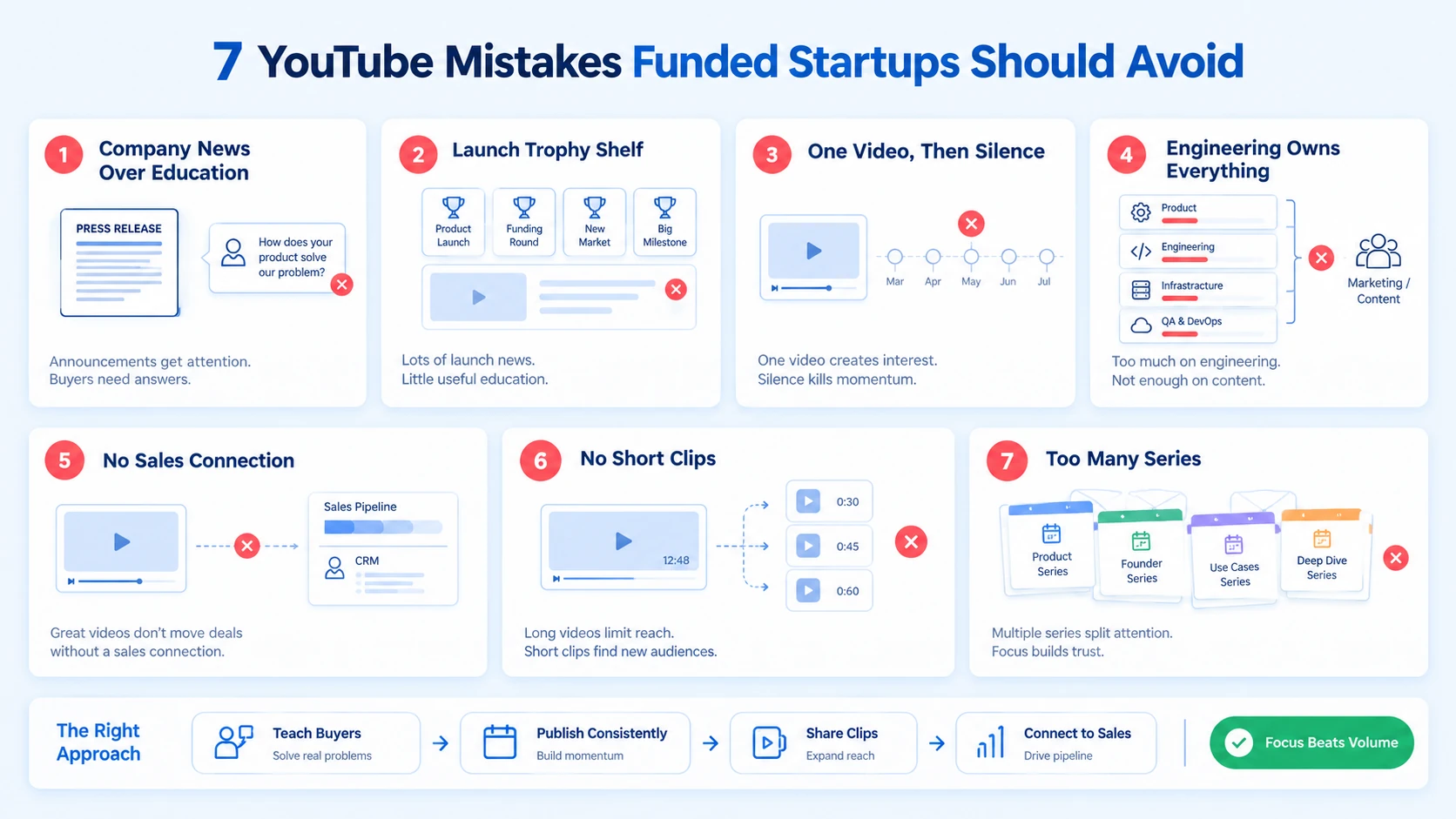
- Publishing company news instead of buyer education
- Using the channel as a trophy shelf for launches
- Producing one expensive video and then going quiet
- Letting engineering and product carry all production work
- Not connecting videos to sales and the CRM
- Ignoring clips, so long videos get limited discovery
- Starting too many series at once
How the work gets done
A small funded team can run this plan with a mix of internal ownership and outside help. Typically, one person owns strategy and sales alignment, while a production partner handles editing, packaging, clips, and distribution.
Komet Media supports funded B2B SaaS, AI, and tech startups & teams with content creation from scratch, video editing for startups, YouTube video editing, and short-form video editing. Teams in the Bay Area can also explore our video editing services in San Francisco. We can repurpose webinars, demos, and founder interviews you already have, or script and produce original video from scratch. Many startups use both.
Conclusion
A YouTube strategy for funded startups is a product education system. Start from buyer questions, organize series, give sales a library, and measure pipeline signals as well as views. A small team that does this well can build trust long before its brand is widely known.
FAQ
1. What is the best YouTube strategy for funded startups?
Start from buyer questions, build three or four series, publish on a steady rhythm, share the videos with sales, and review pipeline signals. Use Shorts and clips for discovery and long videos for depth.
2. How often should a startup publish on YouTube?
Pick a rhythm your team can sustain for at least 90 days. For many small teams, one long video and a few clips each week or every two weeks is realistic with outside editing support.
3. How much does it cost to run a startup YouTube channel?
Costs depend on volume, motion graphics, scripting, and recording support. At Komet Media, our typical retainers run from roughly $2,500 to $5,000, depending on scope, volume, production difficulty, and turnaround. An internal approach costs staff time instead.
4. How long until the channel produces results?
I would plan for 90 days before judging formats and topics. I do not have a verified benchmark for growth rates, so be cautious about promises of fixed outcomes.
5. What should the first videos cover?
Answer the questions buyers ask most in sales calls, then add a clear product walkthrough and one customer story. Videos that sales can use right away make the channel valuable from the start.
6. Should we use Shorts or only long videos?
Use both. Long videos carry depth, and Shorts support discovery. Because Shorts can run up to three minutes, you can use longer clips when the idea needs it.
7. Should we hire an agency or build in-house?
Keep strategy and sales alignment in-house, because your team knows the buyer. Use an agency or dedicated editor for editing, packaging, clips, and distribution if your team lacks capacity.
8. Does Komet Media work with funded startups on YouTube?
Yes. We work with funded B2B SaaS, AI, and tech startups & teams on content creation from scratch, YouTube editing, short-form clips, and distribution, using existing recordings or original video built from scratch. If you want to talk it through, you can book a call.