
🪄 AI Summary
Heading 1
Heading 2
Heading 3
Heading 4
Heading 5
Heading 6
Lorem ipsum dolor sit amet, consectetur adipiscing elit, sed do eiusmod tempor incididunt ut labore et dolore magna aliqua. Ut enim ad minim veniam, quis nostrud exercitation ullamco laboris nisi ut aliquip ex ea commodo consequat. Duis aute irure dolor in reprehenderit in voluptate velit esse cillum dolore eu fugiat nulla pariatur.
Block quote
Ordered list
- Item 1
- Item 2
- Item 3
Unordered list
- Item A
- Item B
- Item C
Bold text
Emphasis
Superscript
Subscript
Most founders I talk to treat YouTube like a vanity channel. Post a few videos, see no views, quit. That's not a YouTube problem, it's a strategy problem. The YouTube playbook for Founders & CEOs I'm sharing here is built specifically for B2B leaders who want buyers, investors, and future hires to find them before any sales conversation begins. This is how you use YouTube to become the obvious choice in your market.
TL;DR
- YouTube is the second-largest search engine on the planet, your buyers are already there researching you.
- Founder-led video builds more trust than any company content page ever will.
- One long-form video per week, clipped into Shorts and distributed to LinkedIn, compounds over time.
- You don't need to go viral. You need to be findable, credible, and consistent.
Why Founders and CEOs Can't Ignore YouTube in 2026
YouTube isn't a nice-to-have. It's where your buyers do their due diligence. According to Semrush data, YouTube attracts 79 billion annual visits, trailing only Google in global web traffic, positioning it as a primary destination for information seekers, including B2B buyers researching solutions.
That's not a consumer audience. That's your pipeline. Video research behavior is near-universal among B2B buyers, with 88% watching videos in the last quarter to evaluate products and services. Brands without a YouTube presence are invisible during these critical research moments.
Here's where it gets personal for founders specifically: executive thought leadership, where the founder is the named voice, consistently outperforms company-only content in trust and engagement. Your company page cannot do what your face on camera can do. The business case is also unambiguous.
A recent Columbia Law study found that executives with strong media presence and digital visibility raise 36% more funds and complete IPOs one-third faster than less visible peers. Visibility isn't branding fluff, it's a valuation strategy. Over 50.9% of decision-makers prefer YouTube as their primary research outlet, outpacing other social and video platforms.
The question isn't whether to be on YouTube. It's whether your competitors are going to own that space while you're still thinking about it. Most founders wait until they have something "big" to say. By that point, a competitor who started earlier has already earned the trust of your buyers.
The YouTube video editing and strategy services at Komet Media are built for exactly this scenario, turning what you already know into a channel that works while you sleep.
What Kind of YouTube Content Actually Works for B2B Founders
Not every video format earns trust with buyers. Here's what the data and my client work confirm actually moves the needle.
Format performance by goal:
Tutorial videos receive 53% higher average watch time than promotional videos across most platforms, which means the more you teach, the longer people stay, and the more the algorithm rewards you. What AI cannot produce is the founder's authentic experience, proprietary data, or a contrarian take backed by real deals closed. That is the only content worth publishing in 2025 and beyond.
Stop making company videos. Make founder videos. The specific formats that work for B2B:
- Contrarian industry takes: Challenge a common assumption in your market. Name why it's wrong and what you believe instead.
- Decision breakdowns: Walk through a real business decision you made, what you weighed, what you chose, why.
- Process exposés: Show how you actually solve the problem your company is built to fix.
- Investor and hiring lens: Speak directly to the type of team member or backer you want to attract.
According to a 2025 Edelman study, 73% of B2B buyers trust companies with strong thought leaders more than those without. The format that delivers that trust fastest? Long-form video, where depth is undeniable.
How to Build a YouTube Channel as a CEO Without Starting From Zero
If you're reading this thinking "I have no content library," you probably do, you just haven't seen it yet. Every founder I've worked with has a backlog of raw material sitting untouched.
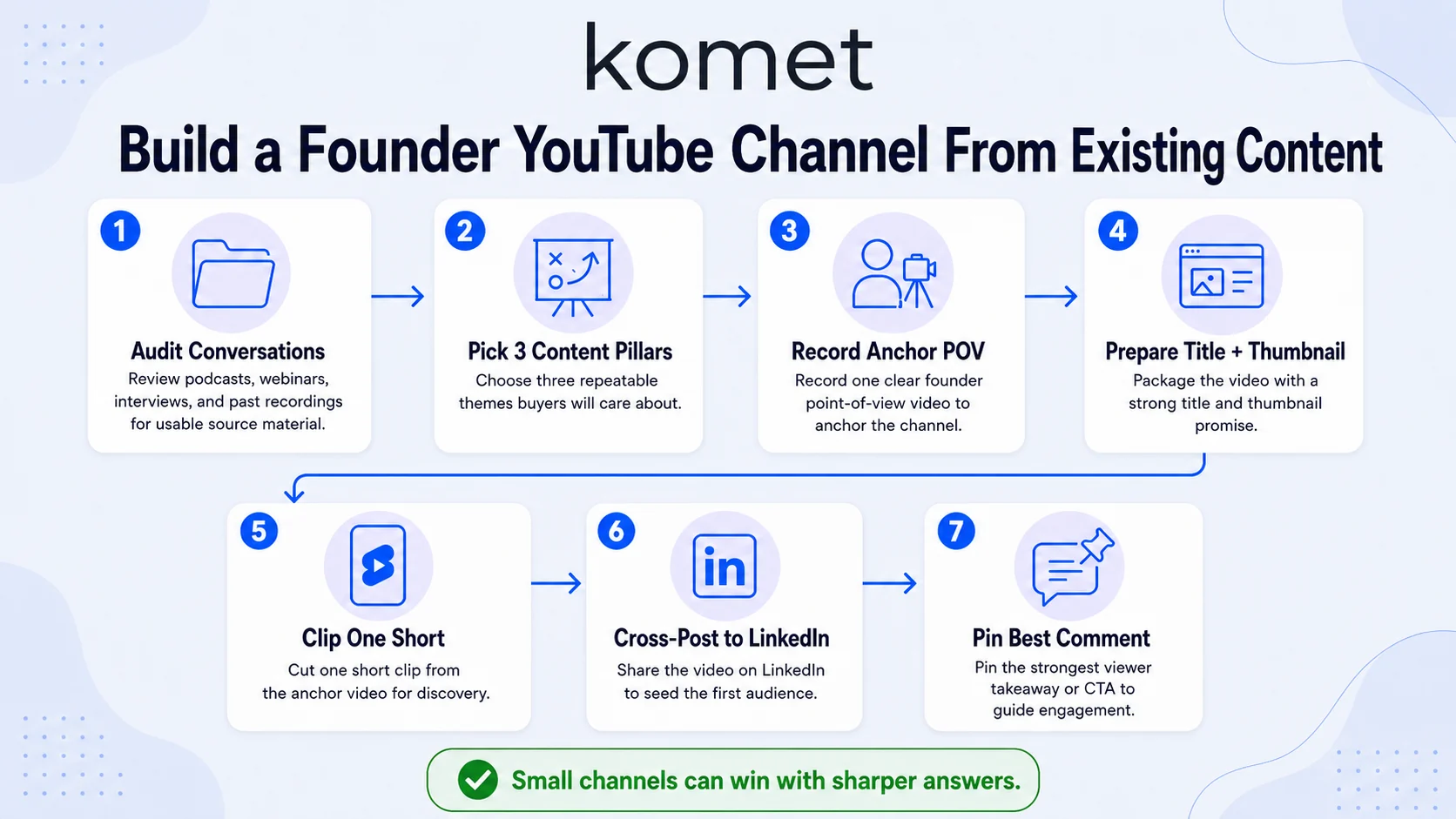
Here's the system I use to launch a founder YouTube channel in 30 days:
- Audit your existing conversations: Sales calls, investor decks, podcast appearances, webinar recordings, internal all-hands talks. These are your first 10 videos.
- Define three content pillars: The intersection of your expertise, your buyer's pain, and your market's most contested questions. Every video lives under one pillar.
- Record a POV video first: Your founding philosophy, why you built what you built and what you believe the market gets wrong. This is your channel anchor.
- Optimize the basics before upload: Title (searchable query + founder lens), thumbnail (face visible, high contrast), description (first 150 characters must include primary keyword and value promise), and chapters.
- Clip one Short per long-form video: The strongest 60–90 second moment from each video becomes a Short published 24–48 hours before the main video goes live.
- Cross-post to LinkedIn within 24 hours: Native upload on LinkedIn outperforms a YouTube link share every time.
- Pin the best comment on every video to seed the conversation direction you want.
A well-optimised video from a 500-subscriber channel can rank above a mediocre video from a 100,000-subscriber channel if it better answers the search query and keeps viewers engaged. Small channel, no excuse. If you already have podcast episodes or long webinar content, our podcast production and editing services connect directly into this video repurposing pipeline.
The YouTube Algorithm Optimization Playbook for Founders
Understanding the algorithm isn't optional if you want organic growth without paid distribution. Here's what's changed in 2026 and what it means for your strategy. YouTube's home feed UI overhaul reduced long-form video recommendations from six per row to approximately two, with up to 80% reduction in total long-form content slots. This is the most important algorithm shift in years. Long-form is still essential, but it now lives primarily in search, not browse.

What this means for your content structure:
- Shorts are your new top-of-funnel. They surface in browse feeds and drive subscribers back to your long-form library.
- Search-optimized long-form is your conversion engine. Buyers searching "how to [solve problem you solve]" find your 15-minute deep-dive and stay.
- Watch time is the single most important signal. Hook viewers within the first 1–3 seconds, YouTube's algorithm measures whether viewers watched to the end.
The specific signals that matter most:
- Click-through rate on thumbnail + title (aim for 4–8% for niche B2B content)
- Average view duration as a percentage of total length
- Comments that contain questions (signals depth of engagement)
- Subscribers gained per video (indicates new audience reach)
YouTube Search prioritizes relevance first, then satisfaction metrics like retention and engagement. Small channels can outrank large ones if their video better satisfies the search query. For titles, write for the search query your buyer types, not the idea you want to talk about. "Why Your SaaS Onboarding Is Losing Enterprise Deals" beats "Our Thoughts on Customer Success" every time. The algorithm doesn't reward the biggest channels. It rewards the videos that best answer the question someone just searched for.
How to Grow a YouTube Audience as a Founder Without Going Viral
Viral is a lottery. Compounding is a strategy. Here's how founder channels build real audiences without chasing trends. Consistency is what separates thought leaders from one-post wonders. The goal is not to produce a lot of content, it is to produce a steady cadence that keeps you visible over a 12–18 month horizon.
The growth system I recommend for time-constrained founders:
- One long-form video per week, recorded in batches of four on a single half-day session each month.
- Three to four Shorts per week, clipped from that long-form library.
- One LinkedIn native video post per week, repurposed from your best YouTube moment.
- One email or newsletter mentioned linking back to the week's YouTube video.
The most sustainable system for a time-poor CEO is a hub-and-spoke model: one anchor piece per month gets repurposed into five to seven shorter-form posts across the week.
Growth tactics that work for B2B founders specifically:
- Collaborations over cold outreach: Guest on a peer founder's YouTube channel. They promote it to their audience. You both grow.
- Answer the exact questions your sales team hears: Every objection a prospect raises is a video title. Film the answer.
- Use YouTube chapters religiously: Viewers who skip to chapter 3 still register watch time. Chapters also index individually in Google search.
- Pin a CTA comment: Direct viewers to your newsletter, a free resource, or a discovery call, not just "subscribe."
Companies leveraging video achieve 49% faster growth compared to non-video competitors. Compound that over 18 months with a consistent cadence and the gap between you and a non-video competitor becomes enormous.
The short-form video editing services at Komet Media exist precisely to remove the production bottleneck that kills founder consistency.
Content Repurposing Framework: One Video, Seven Assets
The most common mistake I see: founders treat each platform as a separate content job. That's exhausting and unnecessary. One long-form YouTube video should produce the following:
YouTube Shorts functions as both a discovery tool and a complement to long-form content. If your company already produces webinars, podcasts, or educational videos, Shorts provides a way to repurpose that material into snackable clips. The platform's search functionality and recommendation algorithm can surface your content months after publication, giving Shorts longer shelf life than Instagram or TikTok posts. This is the content repurposing framework that every serious B2B founder should operate from. You record once. The system is distributed everywhere.
At Komet Media, we build exactly this kind of multi-platform video system, starting with video marketing strategy through to short-form video editing and LinkedIn distribution. Founders who work with us stop spending time editing software and start spending it on their next insight.
Measuring YouTube ROI as a Founder: The Metrics That Matter
Most founders track vanity metrics, views and subscribers, and then declare YouTube doesn't work. The metrics that actually signal business impact are different.
Primary KPIs for founder-led YouTube channels:
65% of executives have navigated to a vendor's site, and 39% have called a vendor after watching a marketing video. That's a direct pipeline from video, not hypothetical brand lift. Companies with strong digital positioning, including credible earned mentions and thought leadership, generate 23% higher revenue and 34% stronger customer acquisition performance.
The signal I trust most for founder channels: inbound mentions. When a prospect on a discovery call says "I watched your video about X," that's attribution. When a new hire says "I found you through YouTube," that's proof. When an investor references something you said on camera, that's leverage.
Track these qualitative signals in a simple CRM note alongside your quantitative metrics. After 90 days, you will have a clear picture of which video topics drive real commercial conversations, and you double down on those. 42% of marketers name YouTube their top-ROI platform (HubSpot), making it one of the few organic channels where a founder's time investment produces compounding returns long after the recording session ends.
Conclusion
The YouTube playbook for Founders & CEOs isn't about becoming an influencer. It's about becoming the obvious, trusted choice before your buyer ever sends an inquiry. Here's what to act on:
- Start with what you already have: podcast recordings, webinars, sales calls, and investor presentations are your first ten videos.
- Batch-record once a month, clip weekly, distribute to LinkedIn and email consistently.
- Optimize every video for search intent, not performance metrics, let watch time and retention do the algorithm work.
- Measure what moves pipeline: inbound mentions, site visits from YouTube, and DMs from prospects who watched before they reached out.
The channel you build this year will still be working in 2028. The one you don't build won't exist. Start with Komet Media when you're ready to turn your expertise into a video system that runs.
Frequently Asked Questions
Q1: How often should a founder post on YouTube to see results?
Consistency matters more than frequency. One high-quality long-form video per week, combined with three to four Shorts clipped from it, is the most sustainable cadence for time-constrained founders. The algorithm rewards regular publishing over bursts. Results typically compound visibly after 90 days of consistent output.
Q2: Do I need professional production equipment to start a founder YouTube channel?
No. A decent smartphone, a ring light, and a quiet room produce content good enough to build authority. Production quality matters less than authenticity for Shorts, and the same principle applies to founder-led long-form content. Upgrade gear when the channel proves its value, not before.
Q3: What's the difference between YouTube for B2B founders and general YouTube strategy?
Consumer YouTube chases views and viral reach. Founder YouTube optimizes for trust and buyer intent. Your titles target specific buyer search queries. Your content covers industry problems, decisions, and expertise. Your CTA drives a business conversation, not a subscription. The audience is smaller, the commercial impact per viewer is far higher.
Q4: How do I repurpose existing content into YouTube videos without recording anything new?
Webinar recordings, podcast audio with a static graphic, recorded sales presentations, and panel discussions all work as initial YouTube uploads. Strip the audio for a podcast episode, clip the strongest 90 seconds for a Short, and you have three assets from one existing piece. This is the fastest way to launch without a production schedule.
Q5: How long before a founder YouTube channel starts generating leads?
Most founder channels see meaningful inbound attribution in the 60–90 day range, assuming consistent weekly uploads and proper SEO optimization on each video. The first signals are rarely views, they're DMs, email opt-ins, and prospects mentioning your video on calls. Track those qualitative signals before judging the channel by view count alone.
Q6: Should I separate my personal founder channel from my company channel?
Run your personal channel as the primary vehicle. Executive thought leadership, where the founder is the named voice, consistently outperforms company-only content in trust and engagement. Your company channel can host product demos and case studies. Your personal channel builds the relationship that makes buyers want to work with the company in the first place. The two channels reinforce each other without competing.