
🪄 AI Summary
Heading 1
Heading 2
Heading 3
Heading 4
Heading 5
Heading 6
Lorem ipsum dolor sit amet, consectetur adipiscing elit, sed do eiusmod tempor incididunt ut labore et dolore magna aliqua. Ut enim ad minim veniam, quis nostrud exercitation ullamco laboris nisi ut aliquip ex ea commodo consequat. Duis aute irure dolor in reprehenderit in voluptate velit esse cillum dolore eu fugiat nulla pariatur.
Block quote
Ordered list
- Item 1
- Item 2
- Item 3
Unordered list
- Item A
- Item B
- Item C
Bold text
Emphasis
Superscript
Subscript
Developers are allergic to marketing. They skip intros, ignore hype, and close any video that wastes their time. That does not mean they avoid video. It means they only watch video that teaches them something. Video marketing for developer tools works when it looks more like a great tutorial than an advertisement. This guide covers what devtools and API companies should produce, how to make technical video clear, and how to distribute and measure it so it supports adoption and revenue.
Quick Answer
Video marketing for developer tools and API companies works when videos teach real tasks, show working code, and respect developers' time. Prioritize tutorials, demos, and engineer-led explanations, then distribute them where developers already learn.
How Developers Actually Use Video
Developers learn constantly, and they use many formats to do it. In the Stack Overflow 2024 Developer Survey, technical documentation was the most used online resource for learning to code, at about 84% of respondents. How-to videos were used by about 54%, and video-based courses by about 50%.
Two things stand out from that data. First, documentation remains the foundation, so video should support your docs, not replace them. Second, roughly half of developers already use video to learn. The opportunity is not to convince developers to watch video. It is to make videos good enough that they choose yours.
The broader market is crowded. Wyzowl's 2026 survey of 266 marketers found that 91% of businesses use video as a marketing tool. That is cross-industry data, not devtools-specific, but it shows that video alone is no longer a differentiator. Usefulness is.
There is also a commercial layer. Developers often discover and try a tool, but purchases can involve engineering managers, security teams, platform leads, and finance. The 2025 Edelman and LinkedIn B2B Thought Leadership Impact Report, based on a survey of nearly 2,000 management-level professionals, found that more than 40% of B2B deals stall because of internal misalignment within buying groups. Devtools companies need video for the developer who adopts the tool and for the people who approve the spend.
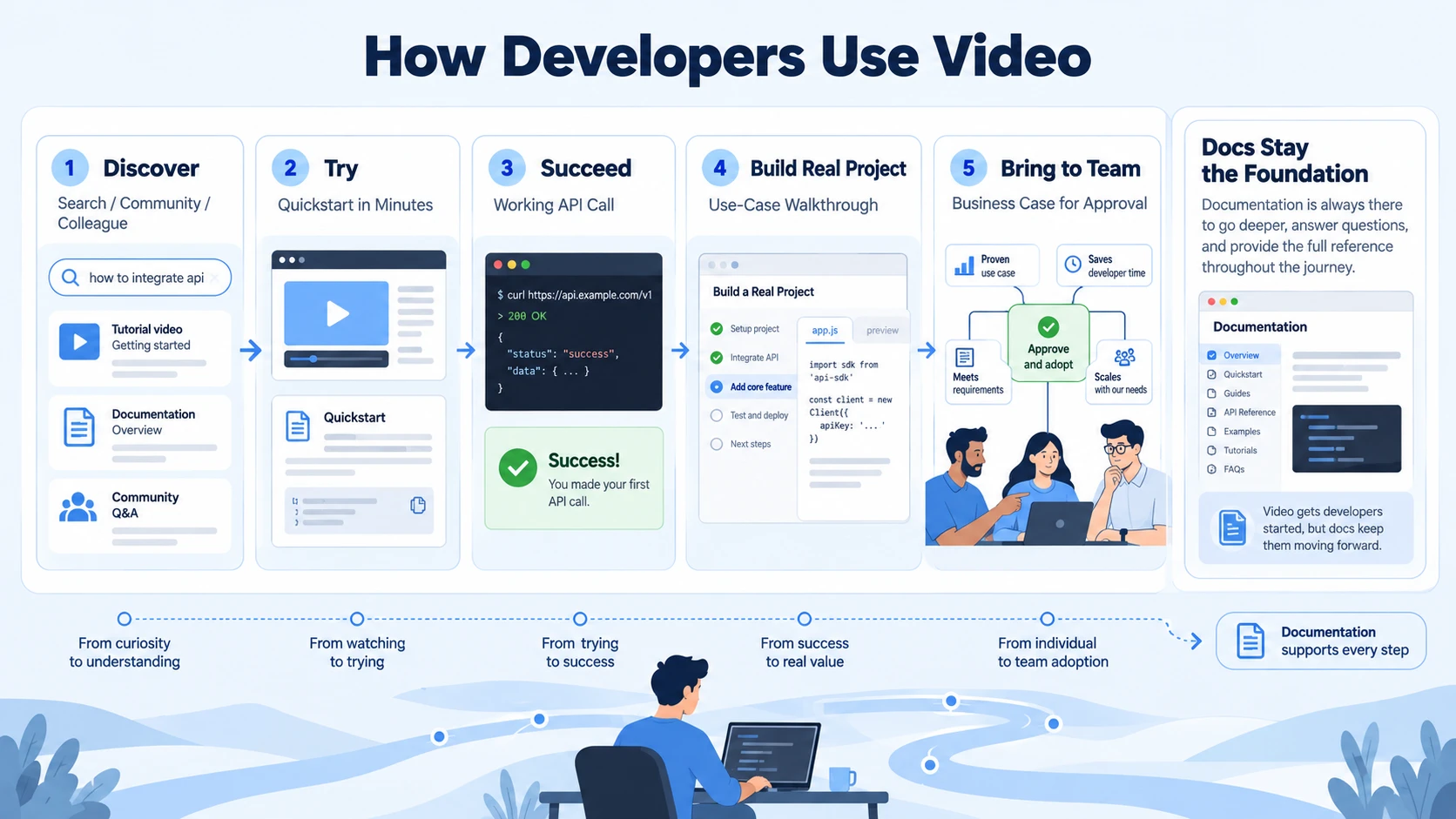
It helps to map video to the developer journey. A developer discovers a tool through a search, a community thread, or a colleague. They try it, often within minutes, and either succeed or give up. If they succeed, they build something real and later bring the tool to their team. Effective video marketing for devtools supports each step: discovery clips, quickstarts for the first try, walkthroughs for real projects, and business-case videos for the team decision.
The DevTools Video Mix: What to Produce
One mistake I see repeatedly is a devtools company making a polished brand video with stock footage of people typing. Developers ignore it. The videos that work show real code, real terminals, and real problems.
There are two ways to build this mix. Komet Media produces original tutorials and explainers completely from scratch, as well as repurposing existing material like conference talks, livestreams, webinars, and podcasts into shorter clips. Most devtools companies benefit from both approaches: original tutorials cover gaps in onboarding and key product workflows, while repurposing maintains a steady stream of content without extra recording overhead.
What makes a strong quickstart? In my experience, it does one job: get the developer to a working result as fast as possible. It states the prerequisites up front, shows every command, and ends with visible proof that the call worked. It does not explain the company history or tour every feature. If the quickstart runs longer than a few minutes, it is probably two videos. A developer who succeeds in five minutes is far more likely to keep going than one who sits through a twenty-minute overview.
For product walkthroughs specifically, our guide to product demo videos for SaaS covers structure and pacing.
Length should follow the job. Short tips and feature highlights can run under two minutes. Quickstarts usually land in the few-minute range. Architecture explainers and migration guides can run much longer, because developers who need them will watch the whole thing. The mistake is padding short topics or squeezing complex ones.
Making Technical Video Clear and Credible
Developer video has its own production rules. Getting them wrong signals that the company does not understand its audience.
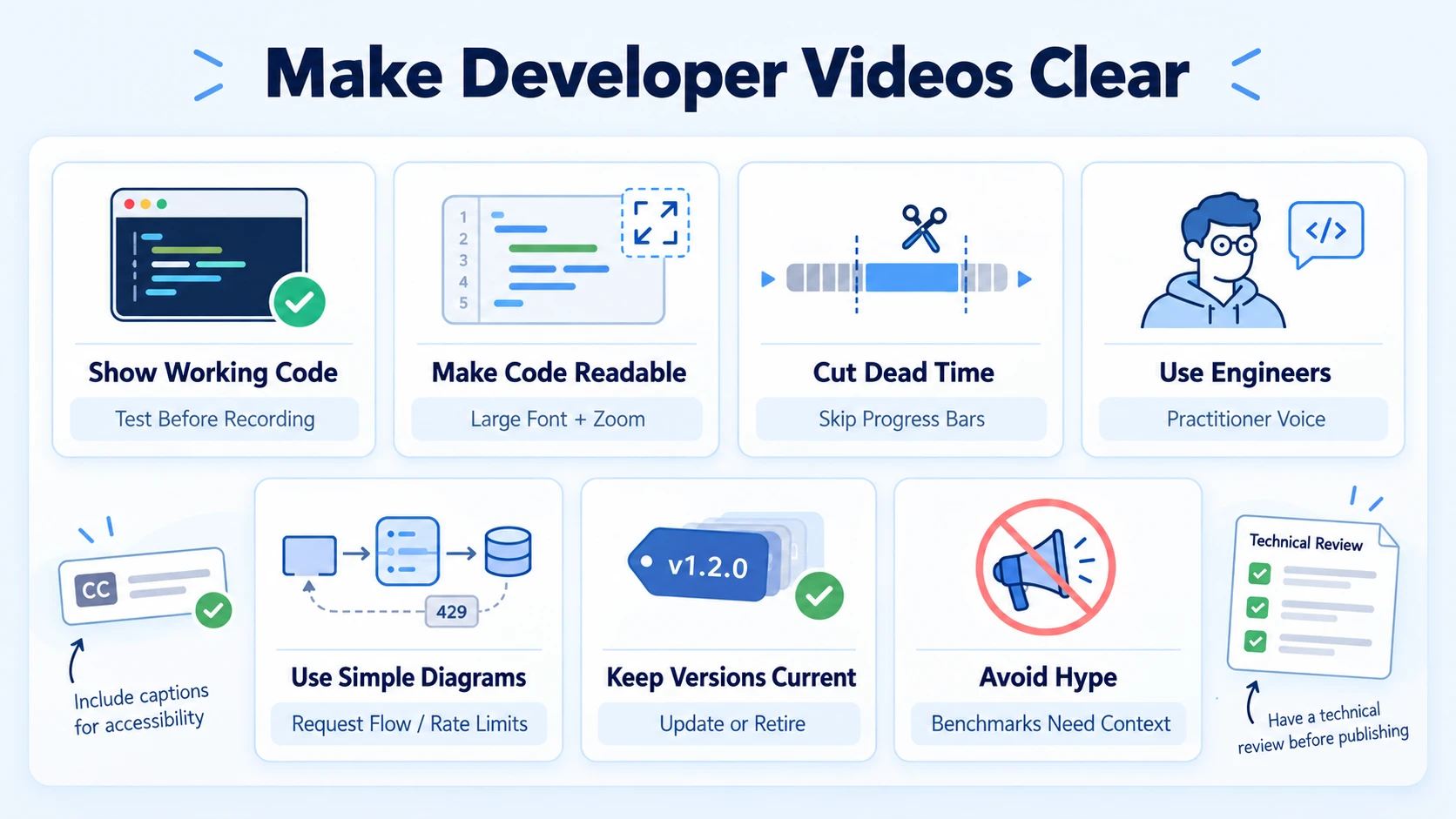
Show working code. Every tutorial should use code that actually runs. Test it before recording, and link to the repository or docs in the description. Nothing loses developer trust faster than a demo that only works on screen.
Make code readable. Use a large font, a high-contrast theme, and zoom into the relevant lines. Many developers watch on laptops or phones, and tiny text makes a video useless. For vertical short clips, crop tightly to the part of the code that matters.
Cut the dead time. Remove long waits for installs, builds, or page loads. Keep the steps, but do not make viewers watch a progress bar.
Use engineers on camera. Developers trust other developers. They also forgive a slightly nervous delivery far more readily than a scripted pitch. A staff engineer explaining a design decision often outperforms a polished presenter reading a script. Production quality helps, but it cannot replace a clear point of view.
Use motion graphics carefully. Simple animated diagrams can explain request flows, rate limits, or event-driven architecture better than talking alone. Our motion graphics work is often used for exactly this kind of explanation. Keep diagrams accurate and minimal.
Keep versions current. APIs and SDKs change. Label videos with the version they cover, and plan to update or retire tutorials when major versions ship. Pinning a comment with any corrections is a quick fix until a new version is recorded. An outdated quickstart creates support tickets.
Avoid hype. Phrases like "the fastest API ever" invite skepticism. Benchmarks should state what was measured, against what, and under which conditions.
Good video marketing for developers also respects accessibility. Accurate captions help developers who watch without sound or in a second language, and they make technical terms easier to follow. Check captions manually, since automatic transcription often mangles function names, libraries, and acronyms.
Building a Repeatable Video Marketing System
Devtools teams often start strong with video and then stall when engineers get busy. A simple system keeps production going without draining the engineering team.
A typical monthly rhythm might look like this:
This is an example rhythm, not a fixed package. Smaller teams may produce fewer videos on a longer cycle.
Where topics should come from:
- Support tickets. Repeated questions are your best tutorial topics.
- Docs analytics. Pages with high exits or long time on page often signal confusion that a video can fix.
- Sales and solutions engineers. The questions they answer on every call belong in video.
- Community discussions. Threads where developers struggle with a concept point to strong explainers.
Do not overlook existing recordings. Conference talks, livestreams, office hours, and community calls often contain excellent explanations buried inside long sessions. Cutting those into focused clips with clear titles can fill a large part of the calendar without new recording time.
The most common reasons developer video programs stall are predictable: engineers get pulled onto releases, nobody owns publishing, and tutorials go out of date without anyone noticing. Each of these is a process problem, not a creative one.
Protect engineering time. An engineer's job on a video should be to explain and review, not to edit. Batch recordings into one session per month, and let a production team handle editing, captions, graphics, and publishing.
Distribution: Where Developers Actually Find Video
A polished video with no distribution plan is still an underused asset. Developers discover content in specific places, and promotional tactics that work elsewhere often backfire here.
YouTube is the main home for developer tutorials. Developers search there for how-to answers, and good tutorials keep getting found for years. YouTube reported more than 1 billion monthly active viewers of podcast content as of January 2025. That figure is about podcasts across the whole platform, not developers, but it shows how normal long-form technical conversations have become there. Titles should match how developers search, such as "how to paginate API results in Python."
Your documentation is one of the most valuable places for video. Embed short tutorials directly in relevant docs pages, next to the written steps.
Developer communities such as forums, Discord or Slack groups, and open-source spaces reward teaching and punish promotion. Share videos that solve a specific problem, credit the engineer, and join the discussion.
X and LinkedIn both reach developers and technical leaders, with LinkedIn stronger for engineering managers and buyers. Short engineer-led clips work well on both. Our guide to short-form video for developer tools and API companies covers formats in more depth.
Onboarding and lifecycle email can deliver the right tutorial at the right time, such as a quickstart video right after signup or an advanced feature video after a user reaches a usage milestone.
Paid distribution can work for developers when it promotes genuinely useful tutorials rather than brand messages. Prove a video organically first, then put budget behind the pieces developers already save and share.
Sales enablement needs business-case and security videos. Engineering managers and procurement teams want clear answers on reliability, data handling, and cost.
How to Measure Developer Video
Do not judge developer videos only by views. A quickstart watched by a few thousand developers who then make their first API call is more valuable than a brand video with far more views.
Product analytics make devtools measurement richer than most categories. If you can connect video views to signup and activation events, you can see which tutorials help developers succeed. Attribution will still be imperfect, so combine product data with community feedback and sales notes.
Qualitative signals matter as well. Watch for developers linking your videos in community answers, engineers referencing a tutorial in support conversations, or prospects mentioning an architecture explainer on a sales call. These signals rarely appear in dashboards but show that video is earning trust.
Review monthly. Retire tutorials that no longer match the product, update the ones driving activation, and use comments to find the next topics. Over time, your video marketing should follow the developer journey: discover, try, succeed, expand.
Conclusion
Developer tools and API companies have an advantage in video: their audience wants to learn and already uses video to do it. The challenge is that developers have no patience for anything that feels like marketing.
The decision that matters is to run video marketing as an extension of your documentation and developer experience. Produce tutorials and explainers that solve real problems, keep them accurate and current, put them where developers search, and measure whether they help people succeed. That is how video earns trust with one of the most skeptical audiences in software.
FAQ
1) What does video marketing for developer tools include?
It usually includes quickstart tutorials, use-case walkthroughs, short feature tips, architecture explainers, engineer-led opinion clips, migration guides, and business-case videos for buyers. Tutorials and walkthroughs usually come first.
2) How much does it cost?
It depends on volume and complexity. Freelancers often charge per video or per hour, subscriptions charge a flat monthly fee for editing volume, and agencies price by scope. At Komet Media, engagements typically fall in the range of about $2,500 to $5,000, depending on video volume, motion graphics, original production needs, and distribution support.
3) How long does it take to produce a developer tutorial?
It depends on length and complexity. The slowest steps are usually preparing working code and technical review. Batching recordings and keeping a reusable recording setup speeds things up.
4) Should engineers or presenters appear on camera?
Engineers usually work better with developer audiences, because developers trust practitioners. Developer advocates are a strong middle ground, since they combine technical depth with comfort on camera. A production team can help engineers feel comfortable and handle everything except the explanation itself.
5) Should we hire a freelancer or an agency?
A freelancer with technical editing experience can work well for tutorials. An agency fits better when you need topic planning, original production, repurposing of talks and livestreams, motion graphics, and distribution handled as one system.
6) Can our internal team handle this?
Yes, if you have developer advocates or marketers with time and editing skills. The common risk is that engineering priorities pull people away, and video production stops for months.
7) How do we keep tutorials from going out of date?
Label each video with the product version it covers, track which videos reference features that change, and review the library after major releases. Retire or update outdated tutorials quickly.
8) How does Komet Media work with developer tools and API companies?
We help devtools teams plan, record, edit, and distribute video across both original creation and repurposing workflows. Whether producing original tutorials and explainers completely from scratch or repurposing existing talks, livestreams, webinars, and podcasts into engaging clips, Komet Media handles the entire process. Engineers explain, and we take care of the rest. If you want to talk through your plans, you can book a call with our team.