
🪄 AI Summary
Heading 1
Heading 2
Heading 3
Heading 4
Heading 5
Heading 6
Lorem ipsum dolor sit amet, consectetur adipiscing elit, sed do eiusmod tempor incididunt ut labore et dolore magna aliqua. Ut enim ad minim veniam, quis nostrud exercitation ullamco laboris nisi ut aliquip ex ea commodo consequat. Duis aute irure dolor in reprehenderit in voluptate velit esse cillum dolore eu fugiat nulla pariatur.
Block quote
Ordered list
- Item 1
- Item 2
- Item 3
Unordered list
- Item A
- Item B
- Item C
Bold text
Emphasis
Superscript
Subscript
I have reviewed enough SaaS ad accounts to recognize the pattern within the first three creatives. A slick animated explainer, a stock-footage montage, and a claim that the product is "AI-powered" without ever showing what it actually does. Video ads for B2B SaaS and AI/tech startups fail for a specific reason: technical buyers can tell within seconds whether an ad understands the problem or is guessing at it. The ad that shows the product solving something real usually wins, and the one built to sound impressive usually does not.
Quick Answer
Video ads for B2B SaaS and AI/tech startups work best when they show the actual product solving a specific, narrow problem for a named buyer, rather than a general brand message or a feature list.
Why Video Ads Work Differently for B2B SaaS and AI/Tech Startups
Technical buyers research differently than the average consumer, and that gap is widening. TrustRadius's 2026 B2B Buying Disconnect Report found that 63% of B2B technology buyers used AI to research software purchases in 2026, yet 94% of them still fact-check what AI tells them, and product demos, trials, and prior experience remain the resources that most influence a final decision. An ad that only makes a claim, without showing proof, is asking a skeptical buyer to trust exactly the kind of unverified statement they have learned to double-check.
Paid video is also getting more crowded, which raises the cost of a generic ad. IAB's 2026 Digital Video Ad Spend report found that US digital video ad spend is set to pass $80 billion in 2026, growing nearly 20 percent faster than the overall ad market. A SaaS or AI startup running a lean budget is competing against that volume, which makes specificity, not polish, the thing that actually earns attention.
A few patterns show up often in our work with SaaS and AI-native ad accounts:
- Video still delivers, when it is built around a real use case. In Wyzowl's 2026 State of Video Marketing report, 82% of marketers said video marketing had given them good ROI, and 85% said it helped generate leads. That baseline holds for SaaS, but it depends on the ad actually showing the product rather than talking around it.
- A founder or engineer explaining the product often beats a produced ad. LinkedIn's own data on Thought Leader Ads found that ads built around a real person's post outperformed standard company-page ads by 1.7 times on click-through rate in early testing, a pattern that shows up often in technical categories where buyers trust a practitioner more than a brand voice.
- The word "AI" alone does not do the work anymore. Every competitor claims it. The ad that shows a specific input, a specific output, and a specific time saved earns more trust than one that repeats the category label.
Video ads for B2B SaaS and AI/tech startups work when they replace a claim with a demonstration, since that is the fastest way to earn credibility with a buyer who has been trained to be skeptical of exactly this kind of ad.
Where SaaS and AI/Tech Startup Video Ads Usually Go Wrong
I would rather name the common failure points than repeat generic ad advice. Four show up constantly with technical products.
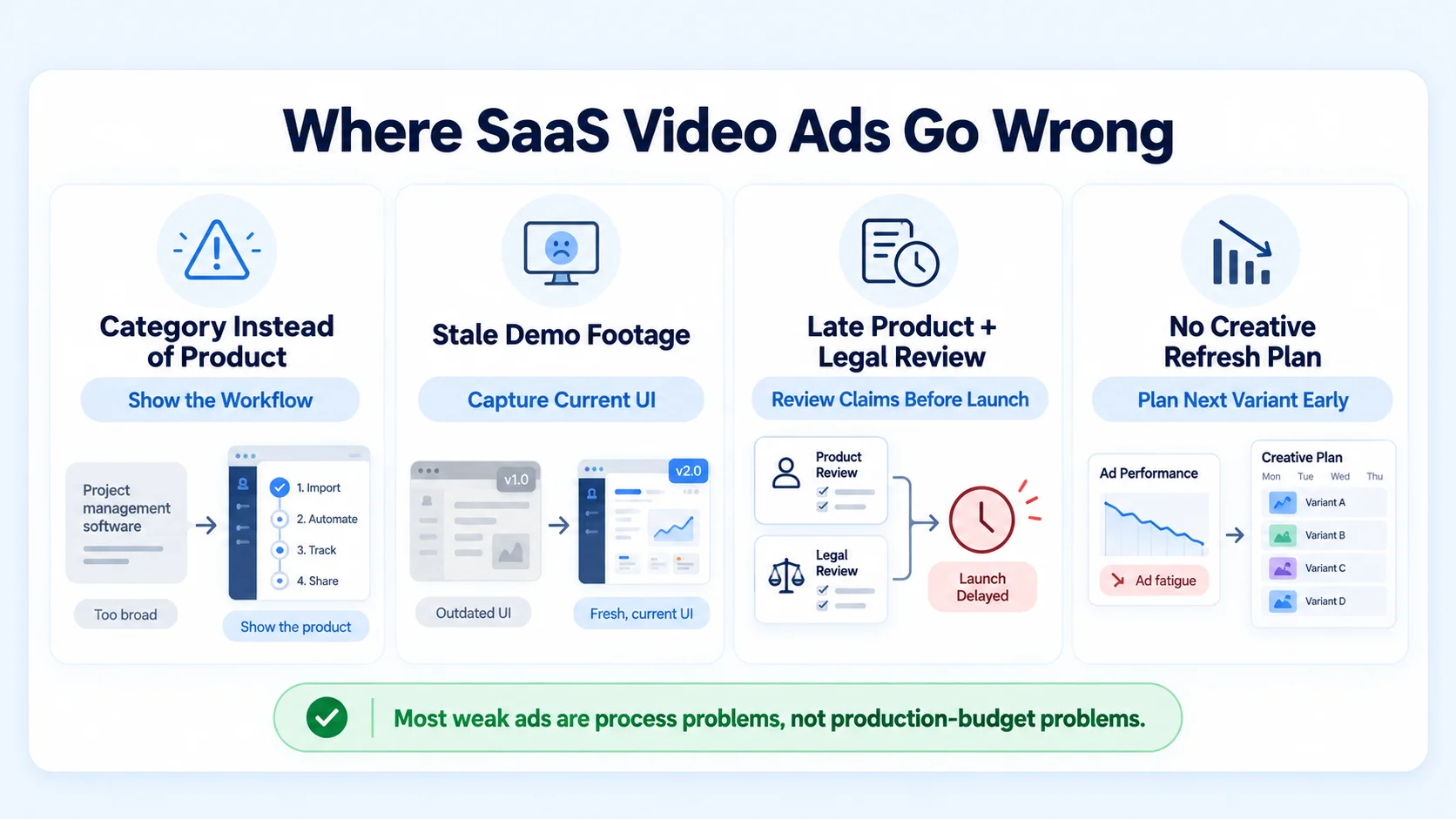
The ad explains the category instead of the product. A startup selling a specific workflow tool often opens with a broad statement about "the future of work" instead of showing the actual screen where the workflow happens. The buyer never sees proof that the product does what the ad claims.
The demo footage is stale by the time the ad launches. Product UI moves fast at an early-stage company. An ad built around a screen recording from two releases ago undercuts trust the moment a prospect clicks through and sees a different interface.
Legal and product review happens after the ad is already live. Startups making performance claims, comparing themselves to competitors, or referencing customer names often need a review step that many lean teams skip, which creates cleanup work later instead of a quick check before launch.
One ad runs until performance drops, with no plan for what replaces it. A single strong ad, however well it performs at launch, wears out with repeated exposure to the same audience. Teams without a refresh plan watch performance decline and assume the channel stopped working, rather than the creative.
None of these are creative problems in the technical sense. They are process problems that show up as underperforming ads, and each one is fixable with a tighter brief and a defined review step rather than a bigger production budget.
What a Video Ad for B2B SaaS and AI/Tech Startups Should Actually Include
A capable video advertising partner working with a technical product is not just producing something that looks polished. The work usually spans several distinct pieces.
Not every startup needs the full list on the first campaign. A pre-seed team testing paid for the first time might start with one clear demo-led ad and one founder-led variant, then expand once early signal shows which angle resonates. A funded startup running an always-on paid program usually needs the fuller set from the start, since ad fatigue and platform-specific delivery become real constraints once spend increases.
The deliverable list matters less than the decision behind it. An ad aimed at a cold, unaware audience needs to earn attention with a problem statement, while an ad retargeting someone who already started a trial can go straight to a specific feature or objection. Reviewing video ad examples that have worked for other SaaS brands is a useful way to see this funnel-stage thinking applied before briefing a new campaign, and looking at how product demo videos for SaaS get structured is a useful reference point, since a strong video ad and a strong demo video usually share the same instinct for proof over polish.
A Practical Workflow, From Message to Published Ad
Founders and marketing leads do not need to run production themselves, but knowing the shape of the workflow sets realistic expectations for turnaround and approvals.
- Name the specific buyer and the specific problem before writing anything. An ad meant for a technical evaluator needs a different opening than one meant for a business buyer approving the purchase, even for the same product.
- Capture current product footage, not a stand-in. Screen recordings should reflect the interface a prospect will actually see if they click through, recorded close to the ad's launch date.
- Write the script around proof, not adjectives. A specific input, a specific output, and a specific outcome carry more weight than words like seamless, powerful, or intelligent.
- Keep early cuts lightweight. A clean screen recording with a clear voiceover often outperforms a heavily animated version for early testing, since it is faster to produce and easier to iterate on.
- Build two or three variants around the same core proof point. Testing a different opening line or a different use case against the same underlying claim shows which framing earns attention before a full production budget goes to one version.
- Route claims through product and legal review early. Anything referencing benchmarks, competitors, or customer names should clear review during scripting, not the day before launch.
- Cut platform-specific versions from the same footage. A vertical cut for LinkedIn and a horizontal cut for YouTube can share the same source material with different pacing and framing.
- Set a refresh cadence tied to the product roadmap. A UI-based ad needs updating whenever the interface changes, not just when performance drops, which keeps the creative from becoming a liability.
Small teams can compress this. A solo founder testing a first campaign might skip formal variant testing, but skipping the product review step on comparison claims usually costs more in cleanup than it saves in time.
How to Judge Whether the Video Ad Is Working
Views and impressions are not the right first signal for a SaaS or AI startup ad, and treating them as one usually hides what is actually happening. I would weigh these instead:
- Cost per qualified lead or trial signup, not just cost per click, since a demo-led ad can draw curiosity clicks that never convert into a real buyer.
- Trial-to-activation rate for leads from the ad, since an ad that attracts the wrong audience will show cheap signups that never use the product.
- Click-through rate against the account's own baseline, comparing a new creative to past performance rather than to a generic industry number that may not reflect the product's category.
- Sales team feedback on lead quality, since a rep noting that leads from a specific ad ask sharper, more qualified questions is a stronger signal than the dashboard alone.
- Frequency and fatigue signals, watching for the point where click-through starts declining against the same audience so a refresh can happen before performance collapses.
Attribution here is rarely clean, especially for a startup running paid alongside organic founder content, a product-led signup flow, and outbound sales at the same time. The signals above, tracked together over a full flight rather than the first few days, tell you more than any single number in isolation.
A common pattern in our work is a team that kills an ad after a few days because cost per click looks high, without checking whether the trial signups it produced are activating at a higher rate than cheaper traffic from a broader, less targeted ad. A more expensive click that turns into an active user is worth more than a cheap click that never opens the product again.
In-House, Freelance, or a Production Partner
This decision comes up in nearly every conversation about video ads for B2B SaaS and AI/tech startups, and the right answer depends on how technical the product is and how much internal bandwidth exists to keep footage current.
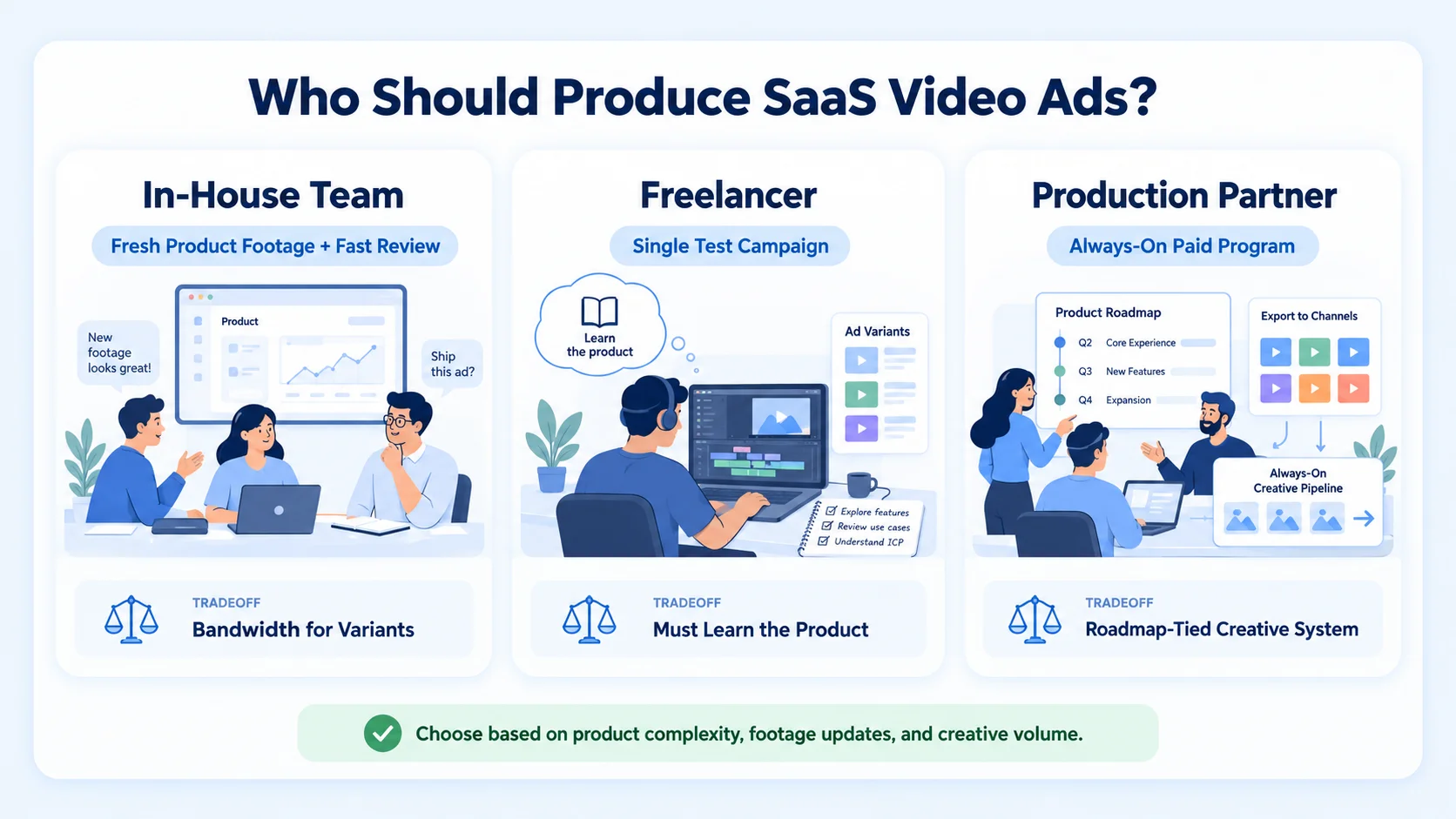
An in-house setup can work when a company already has someone who can capture fresh product footage regularly and a fast internal review process for claims. The tradeoff is bandwidth: in-house teams often struggle to produce enough creative variants to avoid fatigue while also keeping up with a fast-moving product.
A freelancer can work well for a single campaign or a team testing paid video for the first time, provided the freelancer is willing to learn the product closely enough to capture accurate footage rather than relying on generic stock visuals.
A production partner tends to fit best once a startup is running an always-on paid program and wants a steady supply of tested, current creative without pulling engineering or founder time into every shoot. A partner that treats video ads as connected to the product roadmap, not a one-off shoot disconnected from what ships next quarter, tends to close the gap between an ad that looked good at launch and one that still holds up three releases later.
Conclusion
The decision that matters most is not which platform gets the biggest share of budget or how polished the final cut looks. It is whether video ads for B2B SaaS and AI/tech startups are built around a specific problem, backed by current product proof, and tested with enough variants to avoid fatigue. Startups that get this right are not necessarily spending more than their competitors. They are spending it on ads a skeptical technical buyer actually believes. If you are weighing whether to build this in-house or bring in a partner, our team at Komet Media is glad to talk through what a working system would look like for your campaigns.
FAQ
1) What are video ads for B2B SaaS and AI/tech startups?
They are paid video creative built to show a technical product solving a specific buyer problem, usually through real product footage rather than stock visuals or a purely brand-focused message.
2) How much do video ads for B2B SaaS and AI/tech startups cost?
Pricing depends on the number of demo captures, creative variants, platform-specific cuts, and whether compliance review is included. At Komet Media, retainers for this kind of work typically fall between $2,500 and $5,000 per month, with the final number set by scope rather than a fixed package.
3) What does the production process typically look like?
Most workflows move from naming the buyer and problem, to capturing current product footage, to scripting around proof points, followed by platform-specific cuts and a review step for any claims before the ads go live.
4) How long does it take to produce a video ad for a SaaS or AI product?
Turnaround varies with how many variants are needed and how much product footage must be captured, but a common range is one to two weeks from scripting to a first set of platform-ready ads.
5) What deliverables should a startup expect from a video ad partner?
A set of platform-specific cuts using current product footage, captions and labeled UI elements on every version, two or three creative variants for testing, and a refresh plan tied to product releases.
6) Should a startup use a freelancer or an agency for video ads?
A freelancer can work well for a single test campaign, provided they are willing to learn the product rather than relying on generic visuals. An agency tends to fit better once the program runs across multiple platforms and needs creative that stays current with a fast-moving product.
7) Does this approach work for a very early-stage startup with limited product footage?
Yes, though the scope should match the stage. An early-stage team can start with one clean screen-recorded demo ad and a founder-led variant, then expand the creative set as the product and the paid budget both grow.
8) How does Komet Media approach video ads for B2B SaaS and AI/tech startups?
We build ads around current product proof and a specific buyer problem, capture footage close to launch so it reflects the real interface, and plan variant testing and refresh cycles from the start rather than treating the ad as a one-time asset.