
🪄 AI Summary
Heading 1
Heading 2
Heading 3
Heading 4
Heading 5
Heading 6
Lorem ipsum dolor sit amet, consectetur adipiscing elit, sed do eiusmod tempor incididunt ut labore et dolore magna aliqua. Ut enim ad minim veniam, quis nostrud exercitation ullamco laboris nisi ut aliquip ex ea commodo consequat. Duis aute irure dolor in reprehenderit in voluptate velit esse cillum dolore eu fugiat nulla pariatur.
Block quote
Ordered list
- Item 1
- Item 2
- Item 3
Unordered list
- Item A
- Item B
- Item C
Bold text
Emphasis
Superscript
Subscript
Every SaaS marketing team hits this decision point. You need video content that moves buyers, and someone asks: talking-head or animated? Both formats are legitimate. Both can convert. The mistake is treating it as a style choice rather than a strategic one. I've worked with enough B2B SaaS teams at Komet Media to know this decision comes down to funnel stage, buyer awareness, and what you're asking the video to do. Here's the full breakdown.
TL;DR
- Talking-head video builds trust and fuels thought leadership content, strongest at mid-funnel and for founder-led growth.
- Animated explainer video wins at top-of-funnel awareness and complex product storytelling where no human presence is needed.
- Neither format universally "converts better", the right call depends on funnel stage, buyer awareness, and content placement.
- Most high-performing SaaS teams run both formats as a system, not a single choice.
Talking-Head vs Animated Video: What Each Format Actually Is
Before choosing, you need a precise definition of what you're choosing between.
A talking-head video features a real person (founder, executive, subject matter expert, or sales rep) speaking directly to the camera. It's the format that powers LinkedIn thought leadership, webinar clips, founder-led sales sequences, Loom async messages, and product explainer walkthroughs where a human voice carries the credibility. Platforms like Vidyard and Wistia are built around this format's deployment in sales and marketing workflows.
An animated explainer video (or animated video more broadly) uses motion graphics, 2D character animation, whiteboard-style visuals, or hybrid screen recordings with animated overlays. No on-camera talent required. Tools like Synthesia introduce AI-generated avatars as a middle ground, but traditional animated explainers involve fully illustrated or motion-designed visuals synchronized with a voiceover.
The talking-head vs animated video debate matters because these formats trigger different cognitive and emotional responses in buyers. Talking-head signals: "A real person believes in this." Animation signals: "Here's how this works, clearly." That distinction is the entire framework for deciding which to use. Animated videos are used by 38% of B2B brands and show 22% higher engagement rates compared to traditional talking-head formats. But engagement and conversion are not the same metric, which is exactly why the format decision must be tied to what you want the viewer to do next.
Here's a fast reference for where each format lives:
Which Video Style Converts Better for SaaS Demos?
This is the most-asked question, and the answer is conditional. Animated outperforms live-action at top-of-funnel, but flips at mid-funnel. A JotForm A/B test found animated drove 20% higher click rate on cold audiences. The mechanism: animation reads as "we're explaining" to a cold audience. Live-action reads as "we're closing" to a warm one.
For SaaS demo requests specifically, the warmer the audience, the more a real face wins. A founder walking through a product on camera carries more weight than a polished animated explainer when a buyer is already problem-aware and evaluating vendors. That's because trust, not comprehension, is the conversion lever at that stage. 73% of B2B decision-makers now prefer to watch product demo videos over reading whitepapers.
The format they prefer for that demo viewing, however, shifts by stage:
- Awareness stage: Animated explainer or motion graphics to introduce the problem and category.
- Consideration stage: Talking-head or hybrid, founder perspective, customer story, or screen-led walkthrough.
- Decision stage: Screen recording with motion overlays showing the actual UI, paired with a human call-to-action.
Product demo videos lead to a 46% increase in purchase intent compared to non-video product pages, which see just a 29% intent rate. The format that gets you to that 46% isn't fixed, it's the one that matches what the buyer already knows going in.
For our clients at Komet Media's video marketing services, the highest-converting demo-related videos combine a 30-second animated hook with a talking-head close. That's not a compromise, that's a system.
Animated Explainer Video Pros and Cons for B2B SaaS
Animated explainers carry real advantages for software companies, particularly where the product is abstract, the workflow is complex, or the team doesn't yet have a strong on-camera presence.
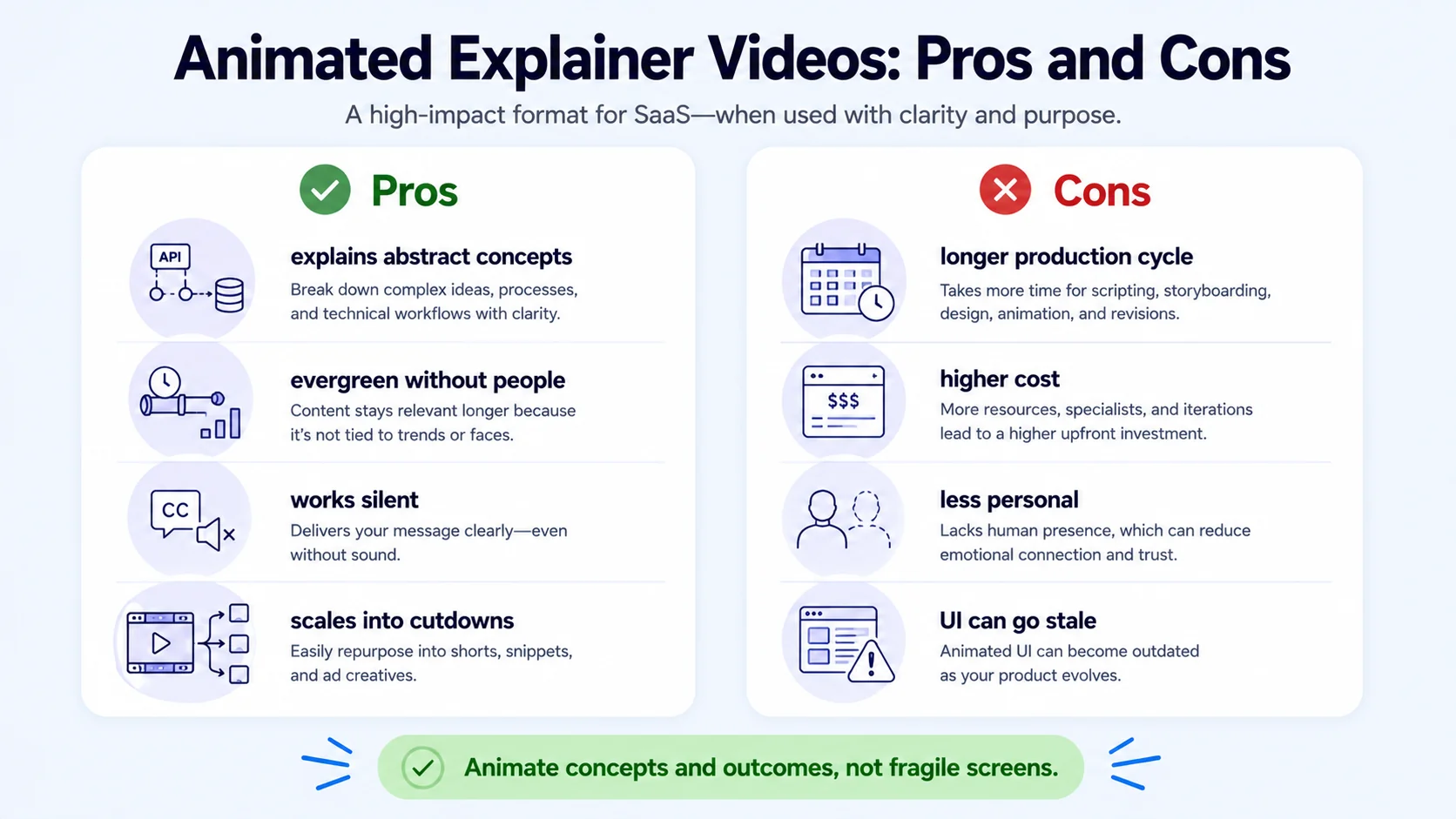
Pros:
- Visualizes abstract software concepts (API integrations, data flows, multi-step processes) that no screen recording can show cleanly.
- No dependency on a specific person. The video stays evergreen even when teams change.
- Many explainer videos use animation because it simplifies complex concepts. Animated explainer videos consistently rank among the highest-ROI marketing formats, particularly for SaaS and technical products where visual storytelling improves comprehension and retention.
- Scales into cut-downs for LinkedIn, YouTube pre-roll, and paid social from a single script. Motion graphics scale well when you need multiple cut-downs for Meta, LinkedIn, and YouTube pre-roll from one core script.
- Works silent. Silent mobile viewing is default. Captions and visual storytelling that work without audio are production requirements, not accessibility add-ons.
Cons:
- Production cycles run 4–8 weeks on average for custom animation, and costs for a quality 60–90 second animated explainer sit between $5,000 and $15,000.
- Animated content feels less personal at mid and bottom-of-funnel, where buyers need human trust signals, not brand polish.
- UI-based animations go stale fast. Every product update potentially requires a re-render.
- Overused motion graphics templates signal inauthenticity in a saturated SaaS market.
If your product interface updates every quarter, animated UI demonstrations are an expensive liability. Build motion graphics around concepts and outcomes, not specific screens. Animated explainer videos are dominant, used by 73% of marketers, for simplifying complex concepts. But dominance in adoption doesn't mean dominance in every use case.
Talking-Head Video Pros and Cons for Software Marketing
The case for talking-head video in B2B SaaS is fundamentally a case for founder-led growth and trust-based demand generation. It's the format that makes your people the brand, not just your product.
Pros:
- Founder narration wins for under-$50M ARR SaaS in 2026. Founder voice content was 41% more likely to generate very large business effects in 2025 B2B campaign benchmarks.
- Lowest production barrier. A founder with a decent camera, proper lighting, and a skilled editor using short-form video editing can produce pipeline-driving content within days.
- Repurposable at scale. One webinar or podcast recording becomes LinkedIn clips, sales enablement videos, email sequences, and YouTube content with a proper repurposing system.
- Use a spokesperson when trust and personality drive the sale, services, high-ticket offers, and founder-led brands.
- Authenticity is increasingly valuable. Buyers are trained to detect templated, faceless content.
Cons:
- Quality is heavily dependent on the individual on camera. A low-energy delivery tanks even a brilliant script.
- Doesn't visualize abstract technical concepts well without screen recording or b-roll overlays.
- Creates a dependency on a specific person, challenging for teams that scale or have leadership changes.
- Harder to localize or adapt for different markets without reshooting.
B2B marketers say video improves lead quality for 66% of their campaigns. Talking-head video is particularly effective for this because qualified buyers self-select when they see real expertise on camera. Someone who watches a founder work through a complex product problem for 90 seconds and stays engaged is a warmer lead than someone who clicked through a polished animated ad.
How to Choose Between Talking-Head and Animation for Your SaaS Landing Page
The landing page decision is where this choice has the highest direct impact on conversion rate optimization. Get it wrong and you're leaving a pipeline on the table.
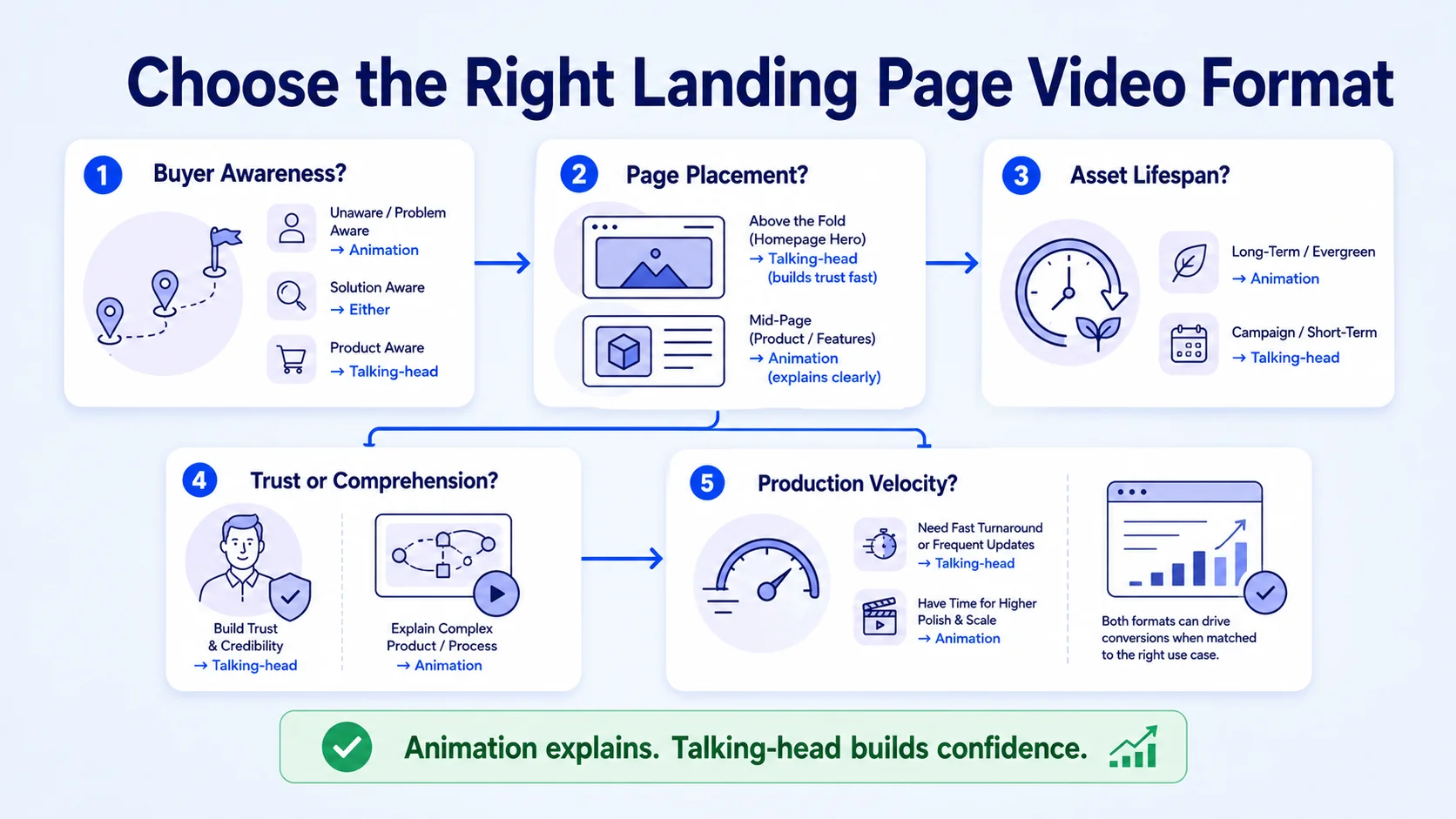
Ask these five questions before choosing:
- What is the buyer's awareness level? Problem-aware buyers convert better with talking-head or screen-led walkthroughs. Unaware buyers need animation to frame the problem first.
- What's the placement? Hero video above the fold? Animation wins for clarity and speed of comprehension. Mid-page product section? Talking-head or screen recording.
- How long will this asset live? Evergreen pages need animation that doesn't show UI. Campaign-specific pages can use faster talking-head production.
- Does trust or comprehension drive the conversion action? If the buyer needs to understand the product, animate it. If they need to trust the person selling it, put a face on it.
- What's your production velocity? Talking-head content ships faster and iterates cheaper. Animation takes longer but scales into more distribution formats.
The same SaaS might need a funny ad for prosumer signup and a whiteboard explainer for enterprise procurement, same product, different jobs. 38.6% of marketers say video is the single most impactful element on a landing page (HubSpot). That stat is format-agnostic. The video that performs is the one that matches buyer intent at that specific URL, not the one that looks the most expensive.
For SaaS landing pages specifically, the highest-performing configuration in 2026 is a 60–90 second animated explainer as the hero paired with a talking-head testimonial or founder clip lower on the page. Animation handles comprehension. Talking-head handles trust.
The Hybrid Strategy: Why Top SaaS Teams Use Both Formats as a System
The talking-head vs animated video debate assumes a binary. The best B2B SaaS video content strategies in 2026 reject that framing entirely. Most SaaS teams that win on video run two formats at once, not one perfect one.
The practical stack looks like this:
- Top of funnel (LinkedIn, YouTube, paid social): Motion graphics or animated explainer to capture cold attention and frame the problem.
- Mid-funnel (nurture sequences, retargeting, website): Talking-head clips from founders, executives, or customer success leads to build trust and educate.
- Bottom of funnel (demo pages, sales decks, proposals): Screen recordings layered with motion graphics showing the actual product solving a specific problem.
This is the content repurposing play that makes video scalable. A webinar or podcast episode becomes the raw source. Talking-head clips go to LinkedIn and sales sequences. Key concepts get animated for paid social. Product walkthroughs from the live session become bottom-of-funnel demo assets. Wyzowl's 2026 report finds that adding an explainer video to a landing page can boost conversions up to 80%, with 98% of people having watched an explainer to learn about a product.
The agencies that compete on a single format, subscription editing shops focused only on reels production, or animation-only studios, leave the strategic layer untouched. At Komet Media, we build video systems that use both formats in coordination, mapped to the buyer journey, so every asset has a defined job and a measurable outcome. The question isn't "which format is better?" It's "which format does this specific job at this stage of the buyer journey?"
Wistia's research on video engagement and platforms like HubSpot's video analytics consistently show that watch-through rate, not format, is the stronger predictor of downstream conversion. A 77% watch-through on a 60-second talking-head clip outperforms a 30% watch-through on a $15,000 animated explainer every time.
Conclusion
The talking-head vs animated video decision is a funnel strategy question, not a style preference.
- Animated explainer video wins at awareness, category education, and complex concept simplification, particularly for top-of-funnel paid social and homepage heroes.
- Talking-head video wins at mid-funnel trust, founder-led growth, sales enablement, and content repurposing velocity.
- The highest-performing B2B SaaS teams use both formats as a coordinated system mapped to the buyer journey.
- Format choice should follow buyer awareness level, content placement, and asset lifespan, not production budget or personal preference.
If you're a SaaS founder or marketing lead trying to figure out where to start, talk to the Komet Media team. We'll map the right format to the right stage, and build a system that actually moves the pipeline.
Frequently Asked Questions
Q1: Does animated video or talking-head video perform better for B2B SaaS lead generation?
Neither format universally outperforms the other. Animated outperforms live-action at top-of-funnel, but the dynamic flips at mid-funnel , where buyers need human trust signals. Match format to funnel stage, not to personal preference.
Q2: How much does an animated SaaS explainer video cost in 2026?
A professional SaaS explainer video in 2026 costs $5,000 to $15,000 for a 60–90 second production with custom animation, voiceover, and sound design. AI-assisted versions start lower but still require human review before publishing.
Q3: Can I repurpose a talking-head video into multiple formats?
Yes, and this is one of its strongest advantages. A single founder interview, webinar, or podcast recording can be cut into LinkedIn clips, sales sequence videos, email embeds, and YouTube content. Talking-head is the highest-velocity format for content repurposing.
Q4: Why do some SaaS companies prefer animated explainer videos over talking-head?
Unlike live-action shoots, which are a logistical headache of coordination, scheduling, and high costs, animation gives you total control over the narrative. You can illustrate abstract software architecture, visualize complex data integrations, or demonstrate a product's ROI with clarity that text or static images can't match.
Q5: What video format works best for enterprise software lead generation?
Enterprise buyers respond to credibility signals above all. Whiteboard-style explainers excel in consideration-stage content: website explainers, sales enablement, and investor or partner education. Pair this with executive talking-head content for trust and motion graphics for awareness campaigns.
Q6: Should a SaaS founder appear on camera or use animation for their product video?
Founder narration wins for under-$50M ARR SaaS in 2026. If you have a founder with genuine conviction and camera comfort, that on-camera presence will outperform a polished animated explainer in trust-building and pipeline influence at mid-funnel, every time.