
🪄 AI Summary
Heading 1
Heading 2
Heading 3
Heading 4
Heading 5
Heading 6
Lorem ipsum dolor sit amet, consectetur adipiscing elit, sed do eiusmod tempor incididunt ut labore et dolore magna aliqua. Ut enim ad minim veniam, quis nostrud exercitation ullamco laboris nisi ut aliquip ex ea commodo consequat. Duis aute irure dolor in reprehenderit in voluptate velit esse cillum dolore eu fugiat nulla pariatur.
Block quote
Ordered list
- Item 1
- Item 2
- Item 3
Unordered list
- Item A
- Item B
- Item C
Bold text
Emphasis
Superscript
Subscript
Most SaaS founders treat podcast editing as a technical checkbox. It isn't. Done right, podcast editing for B2B SaaS & AI/tech startups is a demand generation lever that turns founder conversations into buyer trust, pipeline touchpoints, and content assets that compound. Done wrong, one episode with bad audio tells your ICP you don't sweat the details. This guide covers everything your team needs to make smarter decisions, from workflow and tooling to pricing, outsourcing, and the specific mistakes that make SaaS brands look amateur.
TL;DR
- 75% of B2B decision-makers listen to podcasts, with 51% listening daily , making audio a direct line to your buyers.
- Professional podcast editing covers far more than noise removal. It includes structure, pacing, audiograms, show notes, transcription, and distribution.
- Podcast editing costs between $50 and $5,000 per episode in 2026 , with B2B agency retainers typically starting at $500/month.
- For most SaaS teams, the hybrid model (in-house recording, outsourced post-production) delivers the best return on founder time.
What Professional Podcast Editing Should Include for B2B SaaS & AI Startups
Most people confuse "editing" with audio cleanup. For B2B SaaS and AI startups, professional podcast editing for B2B SaaS & AI/tech startups is a full post-production system. Here's what a complete scope looks like:
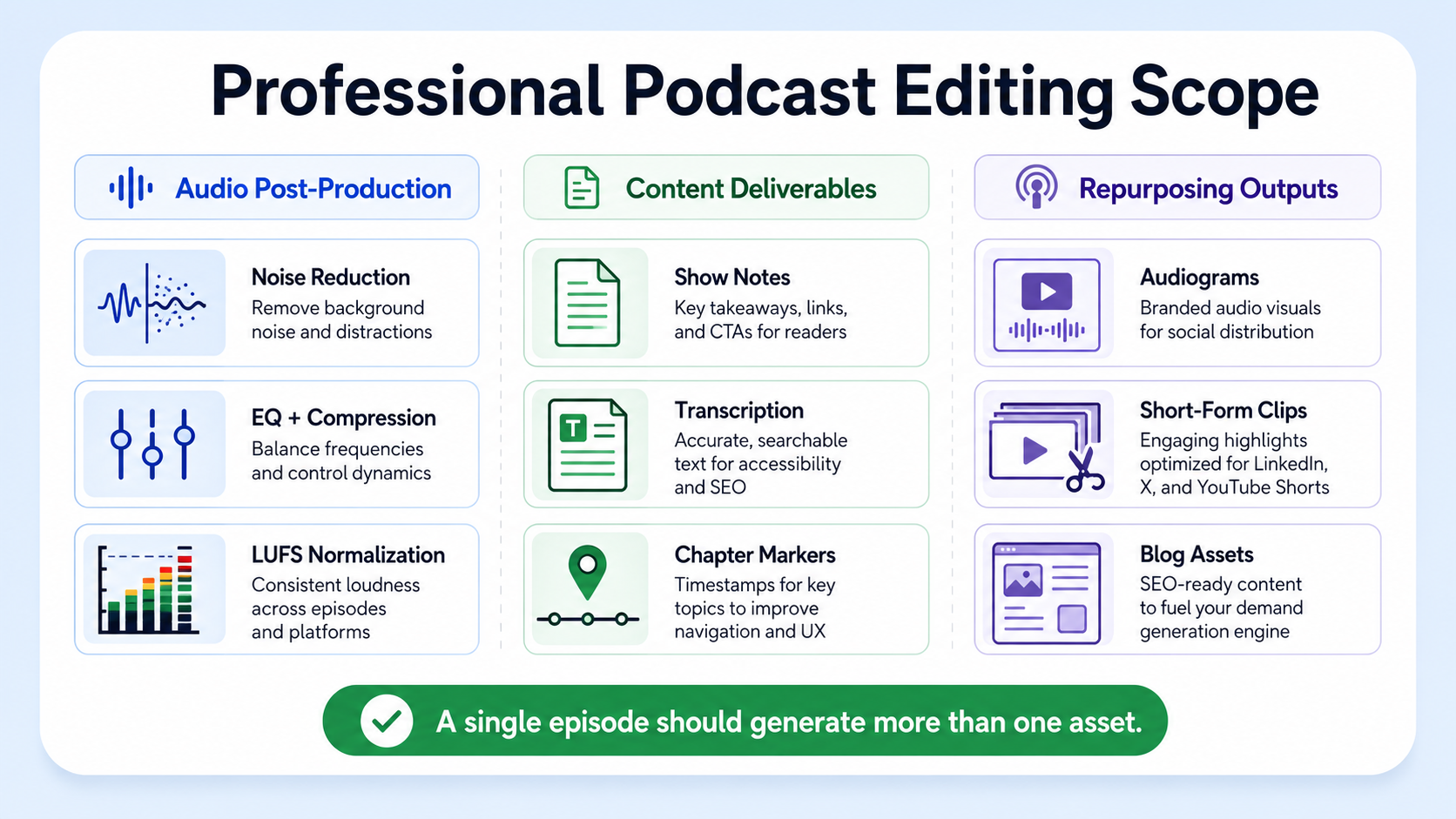
Audio post-production (non-negotiables):
- Noise reduction and room tone removal
- Dynamic range compression and EQ balancing
- Volume normalization to platform loudness standards (-16 LUFS for Spotify, -19 LUFS for Apple Podcasts Connect)
- Removal of filler words, false starts, dead air, and awkward crosstalk
- Intro/outro music integration with proper fade handling
- Mixing and mastering for final export
Content-layer deliverables (what separates basic from professional):
- Branded audiogram clips (15–60 seconds) for LinkedIn and short-form distribution
- Episode transcription for SEO, accessibility, and AI discoverability
- Structured show notes with timestamps, key takeaways, guest bios, and CTAs
- Chapter markers for Spotify and Apple Podcasts Connect
- RSS feed setup and management for podcast distribution
Repurposing outputs (where B2B ROI multiplies):
- Short-form video clips cut from video podcast recordings
- LinkedIn carousels derived from episode insights
- Blog posts and demand gen content from episode transcripts
In the world of B2B podcasting, your message is everything, and even the most brilliant insights can be lost to distracting background noise and uneven audio levels. A tight post-production scope protects the thought leadership investment your team made in the recording itself. At Komet Media, I build this entire asset layer into every podcast production engagement, because a single episode should generate more than one piece of content.
The Professional Podcast Editing Workflow for AI Startup Founders
A repeatable workflow is the difference between a podcast that publishes consistently and one that dies at episode seven. Here is the step-by-step process I use and recommend for SaaS and AI startup teams:
- Pre-session prep: Confirm guest, send a tech checklist (headphones on, mic close, quiet room, Riverside.fm or Zencastr link tested), and build a timed run-of-show.
- Record with backup: Professional workflows assume failure is possible. Even if you love your primary tool, record a secondary track when an episode matters.
- Ingest and label: Import all tracks into your DAW (Adobe Audition, Descript, or Reaper). Label tracks clearly: Host, Guest, Intro Music, Outro.
- Structural edit first: Cut for story and pacing before touching audio processing. Remove tangents, reorder segments if needed, trim dead air.
- Audio post-production: Apply noise reduction, dynamic range compression, EQ, and loudness normalization in that sequence.
- Review draft: Export and listen at 1.5x speed. This catches pacing issues your editor's ears miss at normal speed.
- Create content assets: Create show notes, transcript, cover assets, and a clip kit.
- Distribute: Upload to your podcast hosting platform, verify RSS feed playback, and schedule publication across Spotify for Podcasters and Apple Podcasts Connect.
- Publish and amplify: Release the episode, push short-form clips, and send the guest a promo kit with links and suggested copy.
The 2025 Independent Podcaster Survey of 558 creators found that DIY podcasters spend 4–8 hours per episode on average, with 27% spending 1–3 hours, 28% spending 4–5 hours, and 21% spending 9 or more hours. For a SaaS founder or head of marketing, those hours have a clear opportunity cost that outsourcing eliminates.
Basic vs. Professional Podcast Editing: The Real Difference for B2B Brands
Not all editing is equal. The tier gap matters enormously for a SaaS brand that is using its podcast to build buyer trust with CFOs, CTOs, and heads of engineering.
At the budget end ($50–$100 per episode), you're typically getting basic cleanup and an export file with no show notes, no strategy, and limited turnaround reliability. Mid-tier freelancers ($150–$350 per episode) have more consistent processes and often include show notes, but quality still varies enough that a portfolio review and a paid trial episode are non-negotiable before committing.
The more damaging gap is strategic, not technical. Listeners will abandon a podcast with poor audio in seconds, undermining your efforts to establish thought leadership and generate demand. A $50 edit on a webinar clip you're pushing to a CFO prospect is a brand liability. The right tier for most funded SaaS teams is mid-tier agency: you get full audio, clips, show notes, and podcast transcription without paying for services you don't yet need.
How Much Does Podcast Editing Cost for B2B Companies in 2026?
Pricing varies by scope, not just editor experience. Here is an honest breakdown of what B2B SaaS and AI startup teams should budget: Podcast editor rates in 2025–2026 run from $50 to $600 per episode for freelancers, depending on experience and scope. Managed agency services start at around $500 per month and scale to $6,000+ per month for specialist B2B services.
For video podcast editing (which most SaaS teams need for LinkedIn and YouTube), expect a meaningful premium on top of audio-only rates. At the branded podcast and B2B end of the market, companies commission podcast production as a content marketing and thought leadership tool and budget monthly retainers ranging from $2,000 to $20,000+. The smarter framing is opportunity cost. For a B2B executive earning $200,000 annually (roughly $100/hour), spending 6 hours per episode equals $600 in opportunity cost before considering whether that time would be better spent on revenue-generating activities.
What drives pricing up:
- Video editing added to audio (adds 30–60% to base rate)
- Audiogram and short-form clip production per episode
- Show notes written to SEO standards
- Same-week or 48-hour turnaround requirements
- Episode transcription and chapter markers
- Distribution management across multiple platforms
For most Series A SaaS or funded AI startups, a monthly retainer between $1,500 and $4,000 with a B2B-focused agency covers full post-production plus repurposed content assets. That is the tier where podcast editing transitions from a cost center into a demand generation asset.
Should B2B Tech Startups Outsource Podcast Editing or Handle It In-House?
This is the question most SaaS growth teams get wrong by defaulting to "we can figure it out internally." Here is the honest framework: For most B2B teams, the hybrid model (in-house host, outsourced production) works better than either extreme.
Outsource post-production when:
- Internal teams lack the time, systems, or expertise to produce episodes consistently.
- Your founder or exec is the host. Their job is the conversation, not the timeline.
- You need to repurpose episodes into short-form clips, show notes, and short-form video editing outputs at scale.
- You are publishing bi-weekly or more and consistency matters for algorithm trust on Spotify and Apple.
Keep in-house when:
- You have a dedicated content or media team with audio editing experience.
- Your podcast serves a very specialized audience with unique production needs that require highly customized creative direction.
- You are publishing fewer than two episodes per month and the retainer math does not work.
A single episode can need audio editing, video editing, motion graphics, copywriting, and design. One in-house hire is strong at two or three of those and adequate at the rest. An outsourced team brings specialists in each, which is why an outsourced episode often looks more finished than an in-house one at the same budget.
When your internal team doesn't have to manage the little technical tasks, they can focus on higher-value work. That's strategic leverage, and it often outweighs the upfront financial difference. The clearest signal it's time to outsource: your team is spending more time on Descript timelines than on pipeline conversations.
Podcast Editing Tips for Thought Leadership in SaaS: Common Mistakes to Avoid
In 2025, 91% of marketers planned to maintain or expand their podcast and audio content investments , which means your SaaS podcast is competing harder than ever for the same decision-maker ears. These are the editing and production mistakes that make B2B brands look unprofessional and undermine thought leadership:
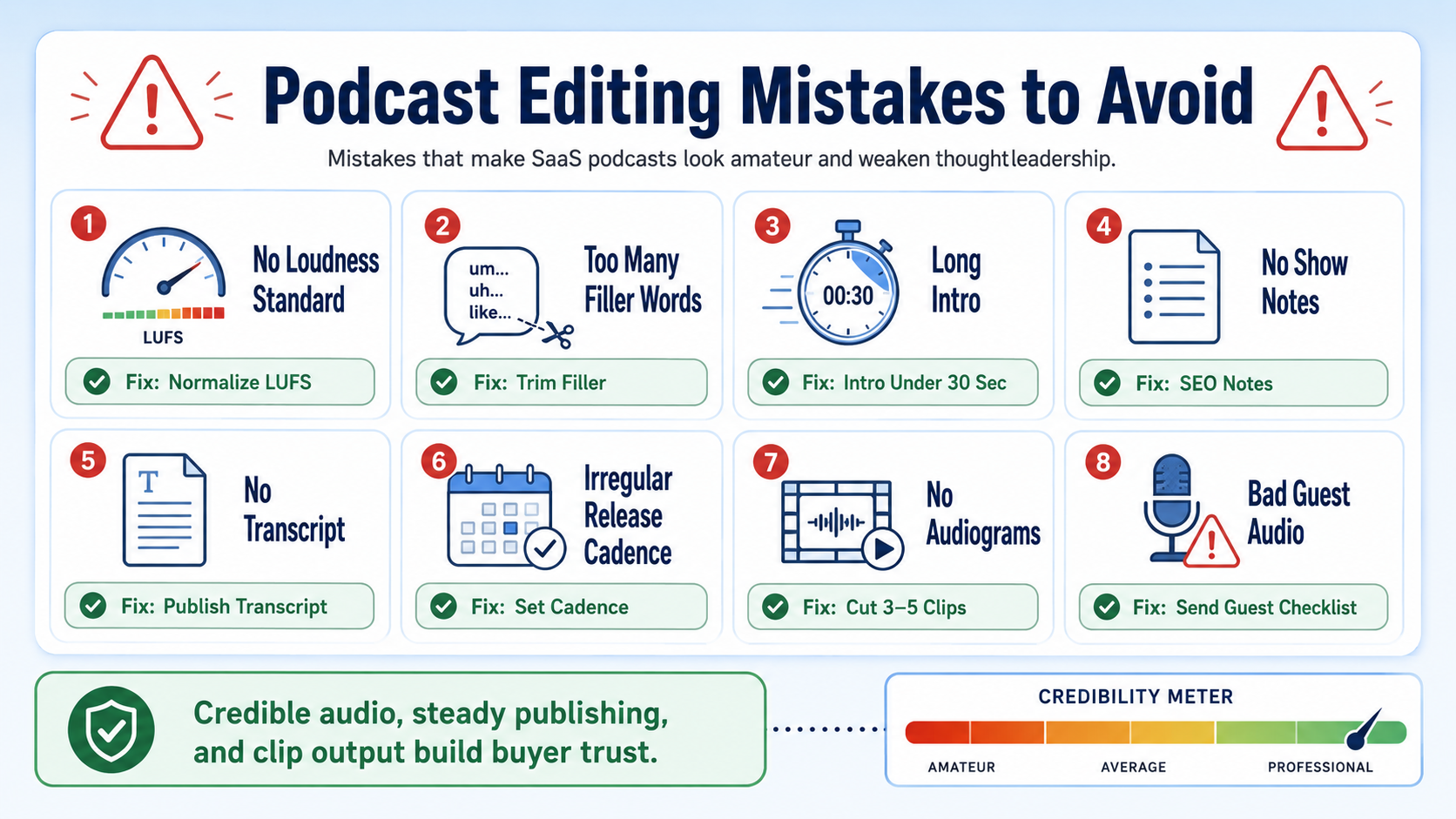
- Skipping loudness normalization: Listeners using earbuds at the gym will either blow out their ears or miss every word. Normalize to platform standards before publishing.
- Leaving in filler words at scale: One "um" is human. Forty-seven "ums" in a 45-minute episode tells buyers your team does not sweat quality. Descript's AI can strip most of them in minutes.
- No intro structure: Keep branded intros under 30 seconds in 2026; listeners skip long intros. Get to value fast.
- Publishing without show notes: Show notes are not a courtesy. They are an SEO asset, a sales enablement document, and the reason a buyer emails you after an episode.
- Skipping episode transcription: Transcripts feed AI discovery, improve accessibility, and give your content team raw material for blog posts and LinkedIn posts.
- Inconsistent release cadence: For B2B podcasts, irregular releases weaken authority faster than weak promotion ever will.
- No audiogram or clip output: A 60-minute episode that lives only on Spotify misses 80% of the distribution opportunity. Cut 3–5 short clips per episode for LinkedIn and short-form channels.
- Ignoring guest audio issues: Even the best platform cannot fix bad mic placement. Send guests a simple pre-recording checklist every time, without exception.
The B2B podcast that converts is not the one with the best guest list. It is the one that sounds credible, publishes consistently, and turns every episode into five more pieces of content that reach your ICP across every channel.
How to Find a Podcast Editor Who Understands B2B SaaS
Generic podcast editors edit audio. A B2B-literate editor understands buyer psychology, thought leadership positioning, and why a specific segment of your founder interview should become a LinkedIn audiogram instead of a YouTube clip. Here is how to vet the right partner:
Questions to ask any podcast editor or agency:
- Have you worked with B2B SaaS or AI/tech brands specifically?
- Can you show me ‘show notes’ you have written that include CTAs and product education?
- What is your standard turnaround, and what happens when a guest's audio is unusable?
- Do you produce repurposed clip assets, or is that a separate service?
- How do you handle RSS feed and podcast distribution setup?
- What is your revision policy and how do you handle feedback asynchronously?
Green flags:
- Portfolio includes B2B or SaaS clients with named brands
- They ask about your ICP and content goals before quoting
- They offer audiogram and podcast marketing outputs alongside editing
- Turnaround is 3–5 business days with a clear revision round policy
Red flags:
- Quote provided before seeing a sample episode or understanding scope
- No show notes or transcript service included or available
- Cannot explain the difference between dynamic range compression and noise reduction
- No client references in B2B content or SaaS verticals
At Komet Media, I work specifically with B2B SaaS and AI startup teams on end-to-end, from-scratch production. The services page outlines the full from-scratch production and content repurposing scope, because an expert who does not understand your pipeline goals cannot make the right creative decisions during development or post-production.
Conclusion
Podcast production for B2B SaaS & AI/tech startups is not a commodity task. It is a strategic decision that shapes buyer trust, content reach, and pipeline contribution through from-scratch development and professional post-production.
- Companies implementing pipeline-first podcast strategies see 3x higher ROI, with attribution rates jumping from 5% to 47% of influenced deals.
- Professional editing includes audio post-production, show notes, transcription, audiograms, and distribution, not just noise reduction.
- The hybrid model (in-house host, outsourced production) is the right default for most SaaS growth teams.
- Vet any editor or agency on B2B experience, repurposing outputs, and turnaround reliability before committing.
If your podcast is generating product trust and filling the pipeline, the editing is working. If it is not, the editing might be why.
Frequently Asked Questions
Q1: What loudness standard should a B2B SaaS podcast target for Spotify and Apple Podcasts?
Target -16 LUFS integrated for Spotify and -19 LUFS for Apple Podcasts. Both platforms apply their own normalization, but mastering these standards before upload ensures your episode does not sound quieter or louder than competing shows in the feed.
Q2: How long does professional podcast editing take per episode?
The whole process, from import to publish, can take anywhere from one to six hours, depending on episode length, format, and your toolset. A specialist B2B editor with a template-driven workflow typically delivers a 45-minute episode within 3–5 business days.
Q3: Is Descript good enough for a B2B SaaS podcast, or do I need Adobe Audition?
Descript handles AI-based filler word removal, transcript-driven editing, and fast turnaround extremely well, making it the right tool for most SaaS teams self-editing. Adobe Audition is the industry-standard DAW for professional sound engineers and is a top contender, especially for B2B teams already embedded in Adobe Creative Cloud. Use Descript for speed, Adobe Audition or Reaper for precision audio work.
Q4: Should a B2B podcast include video in 2026?
Yes, if your distribution strategy includes LinkedIn and YouTube. Video adds post-production cost but unlocks short-form clip creation, which is the primary channel where B2B SaaS buyers discover new content. A video recording with Riverside.fm is the minimum viable setup for this output.
Q5: How do I calculate ROI on podcast editing spend?
Track three metrics: pipeline influenced (deals that touched a podcast episode before or during the sales cycle), inbound demo requests sourced from podcast listeners, and content repurposing reach (impressions from clips, show note page visits, transcript-based organic traffic). The average guest-to-client conversion rate on B2B podcasts is 10%, with top performers converting 48% of strategically selected guests into pipeline opportunities.
Q6: How many episodes should a SaaS startup publish before outsourcing editing?
Start outsourcing from episode one if your podcast is tied to a business goal. A show that quits at episode three does not merely fail to return ROI. It returns negative ROI, because the production money is gone and the relationship flywheel never turns. Build the production system before you need it, not after you are already burnt out on timelines.