
🪄 AI Summary
Heading 1
Heading 2
Heading 3
Heading 4
Heading 5
Heading 6
Lorem ipsum dolor sit amet, consectetur adipiscing elit, sed do eiusmod tempor incididunt ut labore et dolore magna aliqua. Ut enim ad minim veniam, quis nostrud exercitation ullamco laboris nisi ut aliquip ex ea commodo consequat. Duis aute irure dolor in reprehenderit in voluptate velit esse cillum dolore eu fugiat nulla pariatur.
Block quote
Ordered list
- Item 1
- Item 2
- Item 3
Unordered list
- Item A
- Item B
- Item C
Bold text
Emphasis
Superscript
Subscript
Short-form video for B2B does not perform the same way a TikTok trend performs. In my experience, the videos that actually generate leads share a small set of ingredients: a sharp hook, a single clear idea, captions built for sound off, and a specific claim a buyer can act on. Skip any one of these and the clip gets scrolled past, no matter how polished the footage looks.
Quick Answer
Short-form video for B2B works when it opens with a clear hook, makes one point, uses captions, and ends with proof or a specific claim, usually inside 30 to 90 seconds.
Why Short-Form Video for B2B Behaves Differently Than Consumer Content
The mechanics of attention are the same on every platform, but the buyer watching is not the same as a consumer scrolling for entertainment. A B2B viewer is deciding, in the first few seconds, whether this video is worth their limited work-hours attention. Research from Google's video attention study shows that the first five seconds determine 80% of viewer retention, which means the hook is not a nice detail. It is most of the decision.
The format itself is winning ground in B2B specifically. Video is growing 1.6 times faster than any other content type on professional networks, and creators who consistently include video see three times faster follower growth than those who do not. Separately, short-form video generally receives 2.5 times more engagement than long-form video across social platforms, a pattern that holds across both consumer and professional content. That does not mean every short clip performs. It means the format rewards the ones that are built correctly.
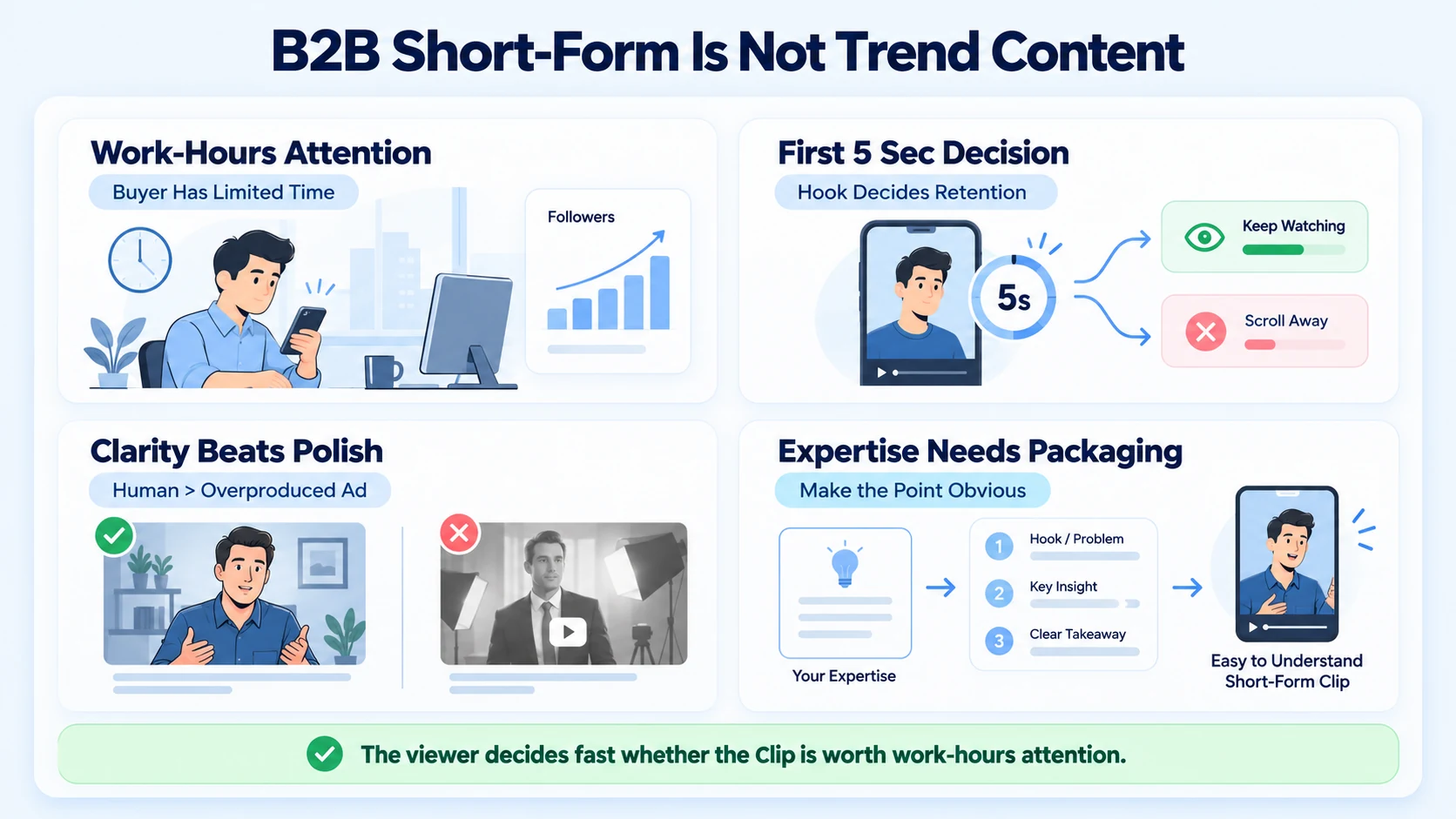
I have seen technical founders assume that expertise alone will carry a clip. It rarely does. A viewer who does not understand why they should keep watching in the first three seconds will not stick around to find out the point was good.
This is also why polish is not the deciding factor most B2B teams assume it is. In 2026, audiences keep rewarding videos that feel like a person made them for other people, rather than an overproduced brand ad. That does not mean production quality is irrelevant. It means the hook, the clarity of the idea, and the pacing matter more than how expensive the camera setup looks.
The Core Ingredients That Make Short-Form Video Work for B2B
Most high-performing B2B clips share the same handful of elements, whether the source is a podcast, a webinar, or a founder talking straight to camera.
None of these ingredients work in isolation. A strong hook with a weak, unclear middle still loses the viewer by the halfway point. Completion rate is usually the single number that captures whether every ingredient in the table above did its job together, not just individually, which is why it deserves more attention than raw view counts.
Common Mistakes That Stop It From Working
Most underperforming clips of short-form video for B2B fail for a predictable set of reasons, not because the underlying idea was weak.
I would rather post six honest, well-cut clips than fifteen overproduced ones. Short-form video for B2B rewards clarity over polish more often than most teams expect.
A Repeatable Production Workflow
Consistency, more than any single clip, is what makes short-form video for B2B compound over time. This is the process we use to keep quality high without burning out the person producing the content:
- Start from real material. Sales calls, podcast episodes, webinars, and founder interviews usually beat scripted studio recordings for authenticity.
- Find the strongest three to five seconds. This becomes the hook, regardless of where it happened in the original recording.
- Cut to one idea. Remove everything that does not support the single point the clip is making.
- Add captions and visual variety. Cuts, text overlays, or b-roll every few seconds keep the clip from going static.
- Close on something specific. A result, a claim, or a next step, not a fade to nothing.
- Batch the production. A realistic schedule for most teams is three to five strong videos a week, produced from one recording session, rather than a new shoot for every clip.
For a podcast, webinar, or founder interview already sitting in a team's recordings, this workflow usually produces several weeks of usable clips from a single source. The batching step matters more than it looks. Teams that try to produce one perfect clip at a time burn far more hours per finished video than teams that pull five or six clips from one well-chosen recording.
How to Measure Whether Short-Form Video Is Working for B2B
Views tell you almost nothing on their own. The signals worth tracking depend on what the clip was built to do.
I would rather look at hook rate and completion rate together than judge a clip by views alone. A high view count with a fast drop-off usually means the hook worked and the middle did not. Attribution from a single clip to a closed deal is rarely clean in B2B, so I look for these signals holding up across several videos over a few weeks rather than judging any one post in isolation.
What a Capable Production Partner Should Handle
Building short-form video that actually works for B2B is a production discipline, not a one-off editing task. Whether you have existing long-form recordings or are starting from scratch with no content library, a capable partner should handle the entire process from start to finish:
- Finding the strongest hook inside raw footage, not just trimming it to length
- Creating content from scratch through research, scripting, and recording guidance when no prior footage exists
- Cutting each clip around one idea instead of packing in everything usable
- Adding and correcting captions so the clip works on mute
- Matching pacing and visual variety to the platform, without overproducing the message
- Reporting back on hook rate and completion rate, not just total views
This is the core of what we do at Komet Media through our short-form video editing service. We work with B2B SaaS, AI, and tech startups & teams to build short-form video systems—whether that means repurposing existing recordings or creating content from zero—rather than defaulting to a single cut used everywhere. For teams weighing this format against longer content, our comparison of short-form versus long-form video for B2B covers that trade-off in more detail.
Conclusion
Short-form video for B2B comes down to a short list: a hook that earns the first few seconds, one clear idea, captions built for sound off, visual pacing that holds attention, and an ending that gives the viewer something specific. None of these require a large production budget. They require a workflow that applies them consistently, clip after clip, rather than treating each one as a fresh creative exercise.
FAQ
What is a short-form video for B2B, specifically?
It is video, typically under two minutes and often between 30 and 90 seconds, built for platforms like LinkedIn, Instagram Reels, and YouTube Shorts, aimed at business buyers rather than general consumers. It can be created from scratch through new research and scripting, or drawn from existing recordings like podcasts, webinars, or interviews.
How much does it cost to produce short-form video that works for B2B?
Cost depends on volume, source material, and how much new recording is needed. Retainer-based production, covering editing, captions, and platform formatting, typically runs in the range of approximately $2,500 to $5,000 a month, though scope changes the final number.
What is the process for building short-form video that performs well?
The process starts either by researching and scripting new concepts from scratch or by identifying the strongest hooks inside raw source footage. From there, it cuts to one clear idea, adds captions and visual variety, and closes with something specific. Batching production from a single recording session keeps the workflow sustainable.
How long does it take to see results from short-form video?
Engagement signals like hook rate and completion rate are usually visible within the first one to two weeks of consistent posting. Commercial signals, like inbound messages or profile visits, typically take four to six weeks of steady publishing to show a clear pattern.
What deliverables come with a short-form video program?
A typical program includes a set number of edited clips per week, captions and platform-specific formatting, and periodic reporting on hook rate, completion rate, and engagement. Some programs also include a monthly longer-form piece alongside the short clips.
Should a freelancer or an agency produce short-form video for a B2B brand?
A freelancer can work well for a single platform with a light, predictable volume. An agency tends to hold up better once a brand needs consistent output across multiple platforms with tested hooks and formats.
Does an in-house team or an external partner make more sense for this?
Small in-house teams often struggle to sustain the volume needed to test hooks and formats properly. An external partner running a higher weekly volume across several clients tends to have a clearer read on what actually works.
Does Komet Media build short-form video specifically for B2B brands?
Yes. We build short-form video for B2B SaaS, AI, and tech startups & teams around the ingredients covered here—handling the end-to-end process from scratch or repurposing existing recordings around strong hooks, one clear idea, captions, and a specific close. Book a call to talk through what a program could look like for your content.