
🪄 AI Summary
Heading 1
Heading 2
Heading 3
Heading 4
Heading 5
Heading 6
Lorem ipsum dolor sit amet, consectetur adipiscing elit, sed do eiusmod tempor incididunt ut labore et dolore magna aliqua. Ut enim ad minim veniam, quis nostrud exercitation ullamco laboris nisi ut aliquip ex ea commodo consequat. Duis aute irure dolor in reprehenderit in voluptate velit esse cillum dolore eu fugiat nulla pariatur.
Block quote
Ordered list
- Item 1
- Item 2
- Item 3
Unordered list
- Item A
- Item B
- Item C
Bold text
Emphasis
Superscript
Subscript
I work with founders and marketing teams who are building real video pipelines, not just posting once a month and hoping for the best. The question I hear constantly is: should we hire someone full-time or use an editing agency? It's the right question. The wrong answer costs you six months and a messy offboarding. This article breaks down the in-house editor vs editing agency decision across cost, scalability, brand consistency, and content operations, so you can make a call based on your actual situation.
TL;DR
- An in-house editor gives you depth and speed on quick turns; an editing agency gives you scale, specialization, and zero fixed overhead.
- A full-time in-house editor costs $40,000–$80,000/year in salary alone, before benefits, equipment, software, and management overhead.
- Agencies make more sense when you're producing 8+ assets per month and need consistent quality across formats.
- For most B2B SaaS and funded tech teams, the right move is a strategic agency partnership, not a hire.
What Are the Real Pros and Cons of Hiring an In-House Editor?
An in-house editor sounds like the obvious "serious" move. You control the timeline. You build institutional brand knowledge. You get someone in your Slack. That's real value, but most teams romanticize it until they run the full numbers.
The actual advantages:
- Instant availability: Need a 30-minute fix before a sales call? Your in-house editor can do it. An agency can't always match that.
- Deep brand immersion: After 6–12 months, a good in-house editor knows your product, your tone, your founder's cadence, better than any external vendor.
- Real-time collaboration is possible: you can sit next to them, review cuts together, and iterate in real time, which is valuable for highly creative or experimental content.
- Cultural integration: They attend team meetings, absorb product updates, and can proactively flag content opportunities.
The costs most teams ignore: Salary is typically only 60–70% of the true cost of an employee. Stack in benefits, onboarding, hardware, software licenses, and management time, and the number climbs fast. A mid-level editor's salary ($50,000–$85,000), plus software licenses ($3,000–$5,000/year), plus hardware ($3,000–$10,000 upfront), plus benefits, training, and management time adds up quickly.
The structural limitations:
- When they're sick, on vacation, or quit, you have zero editing capacity. One person can't be an expert editor AND colorist AND motion graphics artist AND sound designer. And if you need to double output for a launch, you can't double an employee for one month.
- Creative fatigue is real. After a year on the same brand, in-house editors often stop bringing fresh perspectives to the content calendar.
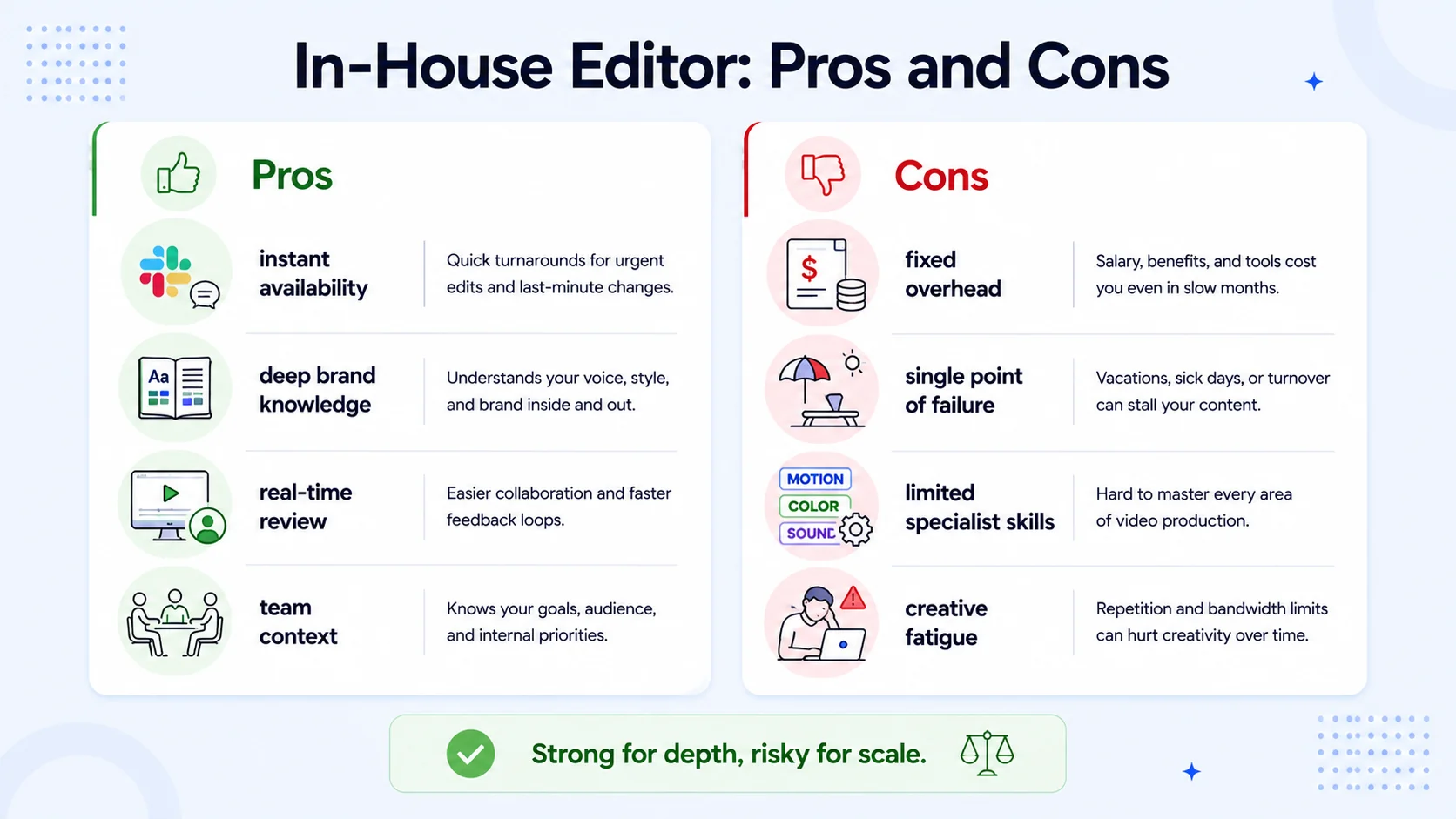
For B2B SaaS teams running founder-led content, webinar clips, demo breakdowns, and pipeline-facing short videos, a single generalist hire typically can't cover the full publishing pipeline without becoming a bottleneck.
In-House Editor vs Editing Agency: Cost Comparison 2026
Let's get specific. This is where most teams make the decision purely on sticker price and miss the full picture.
In-house editors cost $51,000–$93,000 per year in salary alone. On top of that, expect equipment costs (workstation, monitors, storage) and software licenses (Adobe Creative Cloud runs roughly $660/year per seat).
On the agency side: in 2026, agencies charge roughly $100 to $250 per hour, with project-based work from $300 to $1,500 for straightforward edits and $4,000 to $20,000+ for heavier production. For B2B SaaS teams producing 6–15 short-form assets per month, an agency retainer almost always comes in below the fully loaded cost of a single in-house hire. For most businesses producing 4–20 videos per month, an agency is more cost-effective and gives you access to multiple specialists, editor, colorist, motion designer, and project manager, instead of one generalist. That math only breaks down if you're producing daily content at very high volume, in which case a hybrid model makes sense.
What Does an Editing Agency Offer That an In-House Editor Can't?
This is the question that actually separates strategic buyers from teams who just default to hiring.
1. Specialization depth: An editing agency brings a full production team. Agency rates include more than just the editor, you're paying for a project manager, quality assurance, and usually access to a full post-production team including colorist, sound designer, and motion artist. A single hire can't replicate that stack.
2. Scalability on demand: Agencies can absorb volume spikes, product launches, conference weeks, sales sprints, without you restructuring headcount. An in-house editor hits a ceiling at 10–15 deliverables per month before quality or turnaround time degrades.
3. Operational infrastructure: Good agencies run on editorial briefs, revision cycles with defined rounds, and publishing pipelines that remove guesswork. That structure is what keeps quality assurance consistent across dozens of assets.
4. Subject matter expertise in B2B video: For SaaS teams specifically, generalist editors are a real problem. The hidden internal cost of managing an editor who doesn't understand B2B software mechanics is significant. When you hire a generalist editor at $75 an hour, the invoice looks cheap, but the internal labor required to manage them destroys your marketing ROI.
5. Continuity and redundancy: Agencies don't call in sick. They don't quit two weeks before your product launch. They have backup editors baked into their model.
At Komet Media, we build video systems for B2B teams, not just editing services. That means turning product demos, founder recordings, webinars, and podcasts into pipeline-facing short video assets with consistent brand voice, not one-off deliverables that fall apart between sprints.
Is It Cheaper to Outsource Editing or Hire Someone Full-Time?
The short answer: outsourcing is almost always cheaper until you're producing 20+ videos per month with consistent daily volume. The calculation that trips up most teams is treating the in-house editor's salary as the total cost. It's not.
Salary is typically only 60–70% of the true cost of an employee, which means a $70,000 salary hire realistically costs $100,000+ per year once you account for benefits, equipment, onboarding, and management time. Against that, a structured video editing services retainer with a focused B2B agency covers the same output, often with faster turnaround time and better quality assurance, at a fraction of the fixed overhead. At lower production volumes, outsourcing is typically cheaper than a full-time salary plus overhead.
The tipping point where in-house starts making sense:
- You're publishing 20+ short-form assets per week, consistently.
- You need real-time, same-day edits baked into your daily operations.
- You have the HR infrastructure to hire, manage, and retain creative talent.
For most B2B SaaS teams at Series A and beyond, producing webinar clips, podcast content, demo breakdowns, and founder-led video, that volume threshold doesn't apply. They're not in daily publishing mode; they're in strategic content mode. That's exactly where an agency partnership, not a hire, drives the pipeline.
When Should a B2B Team Switch From Freelance to an Editing Agency?
Freelancers from platforms like Upwork or Fiverr make sense early, low commitment, low cost, useful for one-off projects. But there are clear signals that you've outgrown the freelance marketplace model.
Switch to a structured editing agency when:
- You're running a real content calendar with weekly publishing commitments and freelancer availability is unpredictable.
- Brand voice consistency has broken down across different pieces, each video feels like it came from a different company.
- Revision cycles are eating into your team's production time because your freelancer doesn't understand your product or audience.
- You've had a freelancer go dark, miss a launch deadline, or ghost mid-project.
- You're investing in content repurposing, turning long-form assets like webinars and podcasts into short-form video, and need a reliable, repeatable workflow.
- Your sales team is asking for more video-based enablement assets and your current setup can't keep up.
When your content calendar depends on one person's availability, you have a single point of failure. That's a structural problem, not a people problem. The freelance marketplace works for experimentation; it breaks down as a production system.
The other signal: turnaround time. 24–48 hour turnaround is the norm for agencies with dedicated teams, a standard that most individual freelancers can't reliably hold across multiple active projects.
How to Decide: Building an In-House Editorial Team vs Outsourcing
If you've made it this far, you're either confirming what you already suspected or stress-testing your current setup. Here's a decision framework, not a sales pitch.
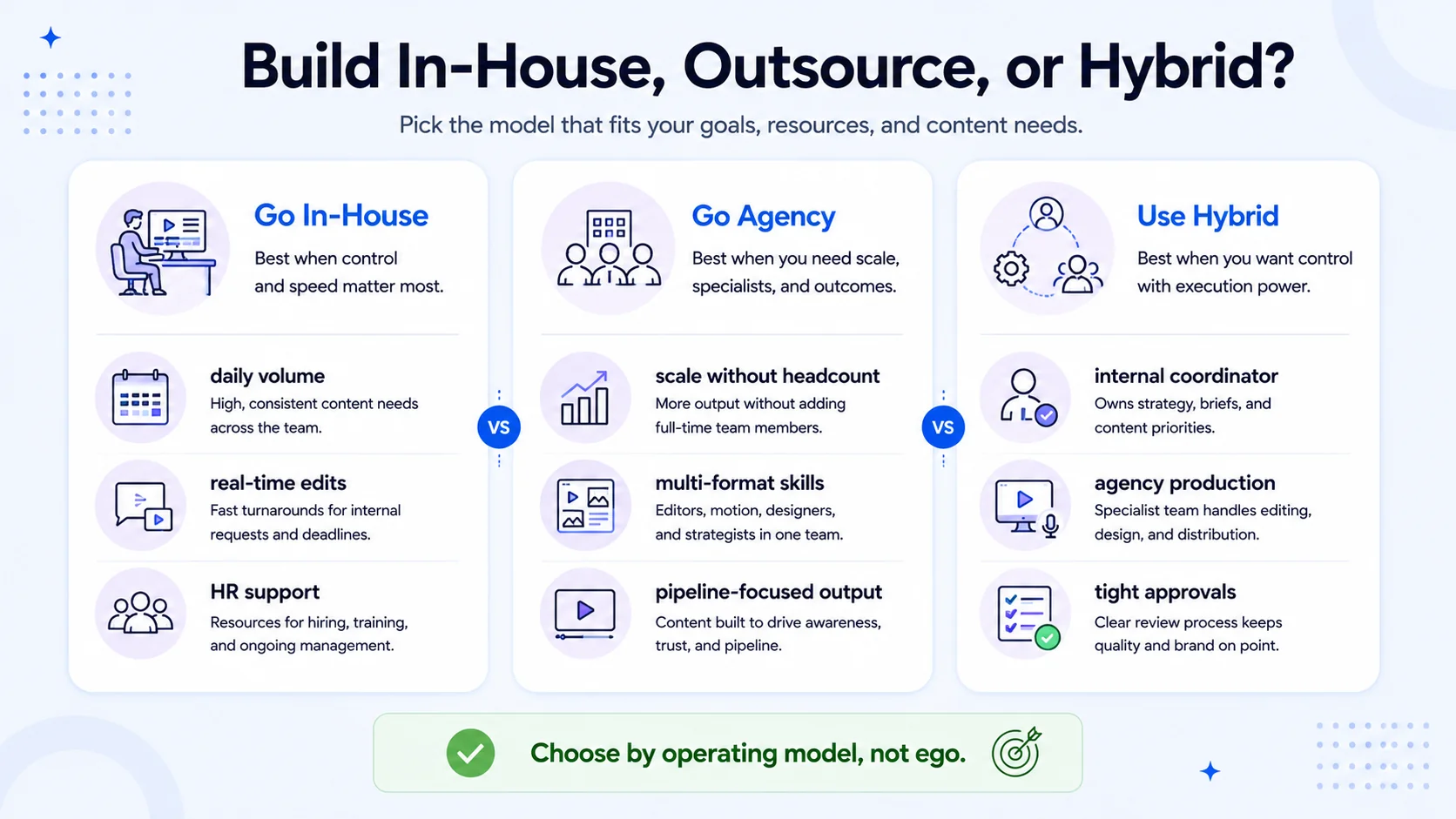
Go in-house if:
- You're producing daily video at consistent, high volume.
- Deep, real-time brand integration matters more than scale.
- You have the budget, management bandwidth, and HR systems for a creative hire.
Go agency if:
- You need a scalable content operation without the fixed overhead of headcount.
- Your video needs span multiple formats, short-form clips, YouTube video editing, motion graphics, podcast audiograms, that require specialist skills.
- Your focus is content strategy and pipeline outcomes, not production management.
Consider a hybrid if:
- Hybrid models often work best, with common setups including an agency for core content plus a freelancer for social clips, or an in-house editor for daily quick-turns plus an agency for premium content and specialization.
The in-house editor vs editing agency decision isn't permanent. Many teams start agencies, build their content library and systems, then layer in a dedicated in-house coordinator once their operation is mature enough to justify it. The worst outcome is hiring too early, before your content strategy is clear, and ending up with an expensive seat that doesn't produce pipeline.
Conclusion
- The in-house editor vs editing agency question is really a question about where your operation sits: experimentation stage, scaling stage, or daily production mode.
- In-house editors make sense at high volume with real-time needs; agencies win on cost, scale, and specialization for most B2B SaaS teams.
- Agencies cost more per video but deliver infrastructure you don't have to build yourself.
- If you're a funded SaaS team turning product demos, webinars, and founder content into pipeline-driving video, a structured agency partnership, not a hire, is the faster, leaner path.
Want to see what a B2B video system looks like in practice? Explore Komet Media's services or get in touch.
Frequently Asked Questions
Q1: What is the average cost of hiring a full-time video editor in 2026?
In-house editors cost $51,000–$93,000 per year in salary alone, plus equipment costs and software licenses like Adobe Creative Cloud at roughly $660/year per seat. Factor in benefits and the true cost climbs well past $100,000 annually for most U.S.-based hires.
Q2: How much does a video editing agency charge per month?
Typical agency retainers range from $1,500–$10,000/month for 4–20 videos. For B2B SaaS teams, Creative-as-a-Service flat monthly models often start around $3,000 and include project management and quality assurance.
Q3: Is in-house editing or outsourcing better for brand voice consistency?
Both can maintain a strong brand voice, but in different ways. An in-house editor builds deep institutional knowledge over time. A structured agency maintains consistency through editorial briefs, revision cycles, and dedicated account teams who specialize in your content format and audience.
Q4: When is an editing agency better than hiring an in-house editor?
If you're producing 8+ videos per month and don't want to micromanage every cut, agencies make the math work. Agencies are particularly valuable when you need multi-format output, specialist skills, and turnaround time guarantees your content calendar depends on.
Q5: What are the hidden costs of hiring an in-house video editor?
Beyond salary, expect hardware ($3,000–$10,000 upfront), software subscriptions, benefits, onboarding time, and ongoing management overhead. Salary is typically only 60–70% of the true cost of an employee, a figure most hiring managers underestimate when building the business case.
Q6: Can a B2B SaaS company use both an in-house editor and an editing agency?
Yes, and it often makes strategic sense. Use an agency for scalable output across formats like short-form clips, podcast audiograms, and demo videos, while an in-house coordinator manages briefs, approvals, and brand standards. This hybrid model keeps quality assurance tight without overloading one person.