
🪄 AI Summary
Heading 1
Heading 2
Heading 3
Heading 4
Heading 5
Heading 6
Lorem ipsum dolor sit amet, consectetur adipiscing elit, sed do eiusmod tempor incididunt ut labore et dolore magna aliqua. Ut enim ad minim veniam, quis nostrud exercitation ullamco laboris nisi ut aliquip ex ea commodo consequat. Duis aute irure dolor in reprehenderit in voluptate velit esse cillum dolore eu fugiat nulla pariatur.
Block quote
Ordered list
- Item 1
- Item 2
- Item 3
Unordered list
- Item A
- Item B
- Item C
Bold text
Emphasis
Superscript
Subscript
Most B2B buyers have already made up their mind before they talk to your sales team. They've watched demos, read case studies, and looked for proof that someone like them got results. Customer testimonial videos for B2B are the single fastest way to give them that proof. This guide covers everything: why they work, how to produce them, how long they should be, what questions to ask, and exactly how to deploy them across your funnel to drive pipeline and close deals faster.
TL;DR
- Approximately 92% of B2B buyers read reviews and watch testimonials before buying.
- Videos featuring customer testimonials have a 44% higher conversion rate at the decision stage than videos without.
- Keep testimonials between 60 and 90 seconds. Match the customer's industry to your prospect's.
- Deploy across sales sequences, landing pages, LinkedIn, and post-demo follow-ups, not just your website.
What Are Customer Testimonial Videos for B2B, and Why Do They Work?
A B2B testimonial video is a short, structured video in which a real customer explains the problem they had, why they chose your product or service, and the specific outcome they achieved. It is not a quote card. It is not a polished brand ad. It is a peer speaking directly to a skeptical buyer. The reason they work comes down to decision-maker psychology. 53% of B2B buyers prefer video case studies over written testimonials, and the B2B buying process is rarely simple, prospects often need to convince a team, justify a budget, compare vendors, and reduce risk before making a decision. A good testimonial gives them the evidence they need to move forward internally.
Executives, often pressed for time, show a strong preference for video content, with 59% opting to watch rather than read about a topic. That's not a minor preference shift. It means your written case study is getting skimmed while your competitor's video is being watched in full. The credibility gap between text and video is significant, too.
Video format adds extra credibility on top of the testimonial itself. Seeing an actual customer speak removes doubt about whether a quote is real or fabricated. The authenticity and transparency of video helps overcome skepticism. For SaaS and funded tech teams specifically, the purchase cycle involves multiple stakeholders: a champion, a budget holder, an IT lead, maybe legal. Enterprise B2B buyers respond most strongly to detailed case studies with quantifiable ROI metrics, followed by video testimonials from recognizable brands in their industry. This means a single well-produced testimonial from a relevant customer can do real work across your entire buying committee.
73% of B2B businesses using video report positive ROI, and that number rises when testimonials are built around specific, verifiable customer outcomes rather than vague praise. The bottom line: customer testimonial videos for B2B are not a "nice-to-have" brand play. They are a pipeline tool. At Komet Media, we treat them as sales assets first and marketing content second. That framing changes everything about how you produce, distribute, and measure them.
How to Create Effective B2B Customer Testimonial Videos
Production does not need to be expensive. It needs to be credible. Follow these steps:
- Identify the right customer: Choose someone whose company profile matches your ICP. Same industry, similar team size, analogous pain point. Testimonial videos featuring clients in the same industry improved lead quality by 42% for B2B.
- Brief them before the shoot: Share the three core themes you want to cover: the problem before, the decision to buy, and the result after. Never script them word-for-word, scripted testimonials read as fake.
- Use the Challenge-Action-Result (CAR) framework: Open with the pain, explain what changed, close with a specific metric or outcome. This structure mirrors how B2B buyers evaluate risk.
- Record in a clean, professional setting: Natural light or a simple three-point lighting setup. A real office background beats a virtual backdrop every time for credibility.
- Capture B-roll: Screen recordings, product screenshots, team footage, or workspace shots give your editor material to break up the talking-head sections and add visual context.
- Edit for clarity, not length: Cut anything that doesn't move the story forward. Add captions, always.
- Produce multiple cuts: A 60–90 second version for your website and sales sequences, a 30-second cut for LinkedIn and paid ads, and a 15-second soundbite for retargeting.
For teams without an existing content library, Komet Media's video production and editing services handle everything from raw interview footage to final short-form cuts built for each channel. For teams that already have webinar recordings, podcast episodes, or recorded customer calls, we turn that existing footage into ready-to-deploy testimonial assets through our short-form video editing service.
Best Practices for B2B Testimonial Videos That Actually Convert
Most testimonial videos fail because they are too vague. "We love working with this company" does not close a deal. Here is what separates high-converting testimonials from forgettable ones:
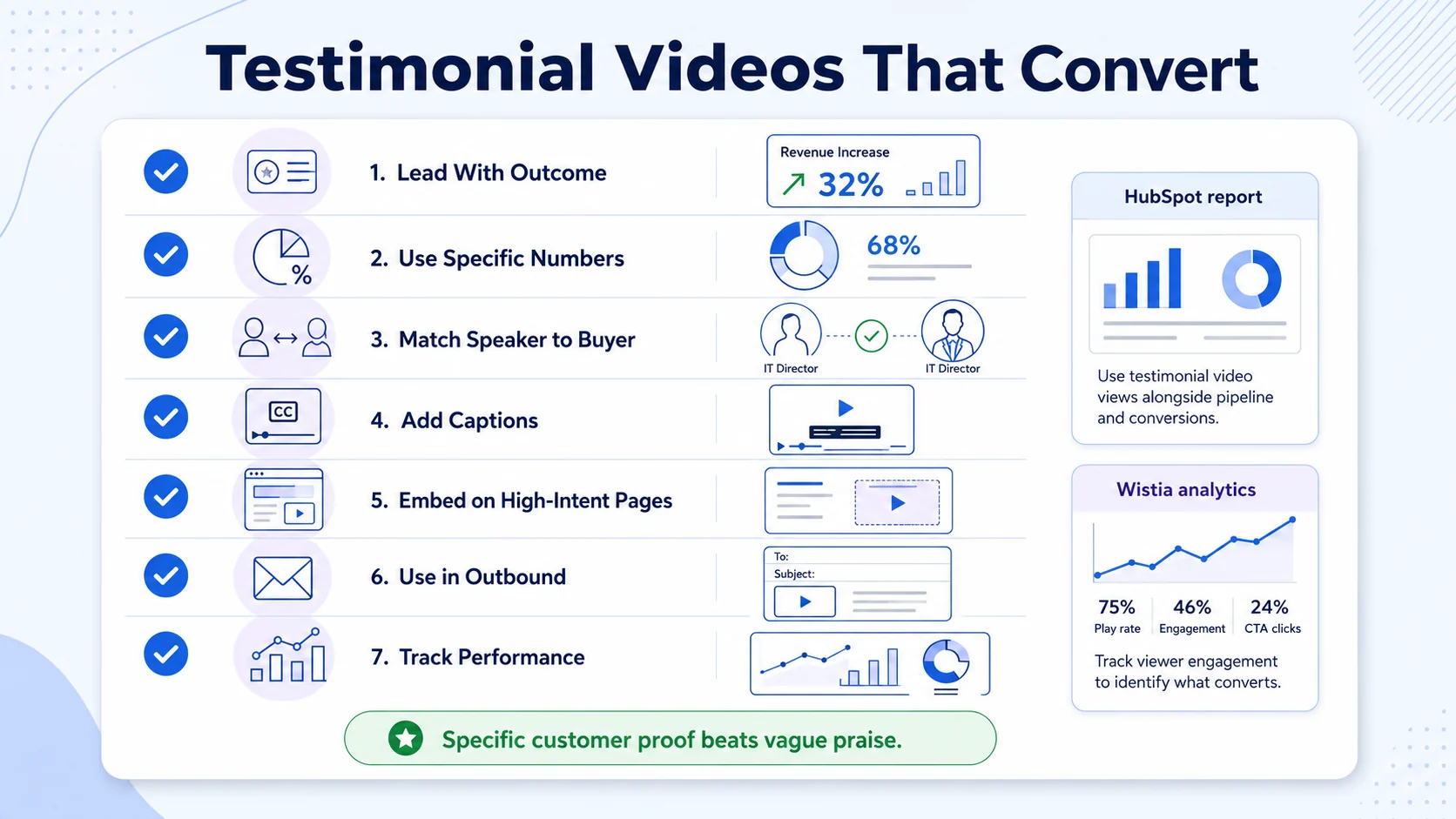
- Lead with the outcome, not the credentials. Testimonials beginning with customer credentials or company names see 34% higher early abandonment rates. Start with the problem or the result instead.
- Use specific numbers wherever possible. "We reduced onboarding time by 40%" beats "the onboarding got much better." Numbers give skeptical buyers something concrete to hold onto.
- Match the speaker's role to your buyer's role. A VP of Sales testimonial converts better with VP of Sales prospects. A founder-led testimonial resonates with other founders. Segment your library accordingly.
- Keep captions on by default. Most LinkedIn videos are watched without sound. Without captions, your message disappears.
- Embed on high-intent pages. Landing pages with embedded videos can improve conversion rates by up to 80%. Pricing pages, demo request pages, and solution-specific landing pages are the highest-leverage placements.
- Use industry-matched testimonials in outbound. 67% of B2B buyers say authentic, real-customer content builds the most credibility. Sending a prospect a testimonial from a direct industry peer in a sales sequence is one of the highest-ROI moves in sales enablement.
- Distribute on LinkedIn proactively. 62% of B2B marketers say LinkedIn is their most effective platform for video distribution. A testimonial posted natively on LinkedIn, not just buried on your website, extends reach to buyers who have never heard of you.
- Don't post and pray. Track performance. Use tools like HubSpot or Wistia to see which testimonials drive the most time-on-page, form fills, and downstream pipeline. Kill the ones that aren't working. Double down on the ones that are.
How Long Should a B2B Customer Testimonial Video Be?
Length is one of the most misunderstood decisions in testimonial video production. The answer: it depends on the channel, but shorter almost always wins.
Testimonial videos between 45 and 60 seconds had a 74% average completion rate, compared to just 49% for videos over 2 minutes. Completion rate matters because an incomplete watch rarely converts. The optimal testimonial length for maximum completion sits between 45–75 seconds, with 82% of viewers watching these testimonials to completion.
For B2B specifically, there is slightly more tolerance for depth. B2B viewers averaged 2 minutes 21 seconds watch time compared to 1 minute 46 seconds for B2C audiences, which means a 90-second video with a tight story will hold a motivated B2B buyer.
Rule of thumb: produce your full interview in 3–4 minutes. Then cut down. Never try to pad a 45-second story into 2 minutes. One underrated tactic: always produce a 15-second soundbite alongside every full testimonial. That clip becomes your retargeting ad, your email GIF, your LinkedIn comment asset. Looping short-form testimonials under 30 seconds increased ad recall by 52%, that single asset pays for the entire production.
How to Get Customers to Agree to Be in a Testimonial Video (and What to Ask)
The biggest bottleneck in testimonial production is not budget or production quality. It's getting customers to say yes. Here's the approach that works:
How to get the yes:
- Ask during peak satisfaction, right after a milestone, a renewal, or when they share positive feedback unprompted.
- Frame it as a mutual win: "We'd love to feature your team's results. It's great exposure for your brand too."
- Keep the ask small: "It's 20 minutes of your time. We handle everything else."
- Offer a review before publishing so they have full control over what goes out.
- Send a written case study alongside the video request, if they've already approved the case study, the video is a natural extension.
What questions to ask in the interview:
- What was the situation that made you start looking for a solution?
- What made you choose us over the alternatives?
- What was the first result you noticed after getting started?
- What specific outcome or metric has changed since you started using us?
- What would you tell a colleague in your industry who's evaluating us right now?
These questions follow the CAR framework and pull out the specific, buyer-relevant details that make testimonials convert. Avoid open-ended prompts like "tell me about your experience", they produce vague answers that require heavy editing.
For teams running webinars or podcasts, existing recordings often contain usable testimonial-quality soundbites from guests and customers. Repurposing those clips is significantly faster than scheduling fresh shoots, and the content is already authentic because it was captured in a natural conversation context.
How to Use Testimonial Videos Across Your B2B Sales and Marketing Funnel
Producing the video is only half the job. Where and how you deploy it determines whether it generates a pipeline. Here's the full-funnel playbook:
Top of funnel (awareness):
- Post natively on LinkedIn. Tag the customer and their company for shared reach.
- Run short cuts as LinkedIn video ads to ICP audiences.
- Embed on your homepage above the fold.
Middle of funnel (consideration):
- Add to solution-specific landing pages and case study pages. B2B testimonial videos embedded in case studies increased time on page by 68 seconds, which signals deeper engagement to search algorithms and sales teams alike.
- Included in email nurture sequences. B2B companies using testimonial videos in email saw 7.1% click-through rates, well above standard B2B email benchmarks.
Bottom of funnel (decision):
- Send as a personalized video in post-demo follow-ups. Match the testimonial's industry to the prospect's.
- Embed on your pricing page. Social proof at the point of conversion decision is where it matters most.
- Equip your sales team to share relevant clips directly in Slack, email, or HubSpot.
Account-based marketing (ABM):
- Identify which testimonial customers are in the same industry or tech stack as a target account.
- Use that video in direct outreach to that account's buying committee.
- Adding real customer testimonials to paid ads can increase click-through rates by 34%.
This is the full video marketing system that turns a single testimonial shoot into 6–10 assets deployed across every stage of the buyer journey. At Komet Media, we build this system for B2B SaaS teams so the content keeps working long after the original production date.
Common Mistakes B2B Companies Make With Customer Testimonial Videos
Understanding what breaks testimonial video strategy is just as important as knowing what builds it.
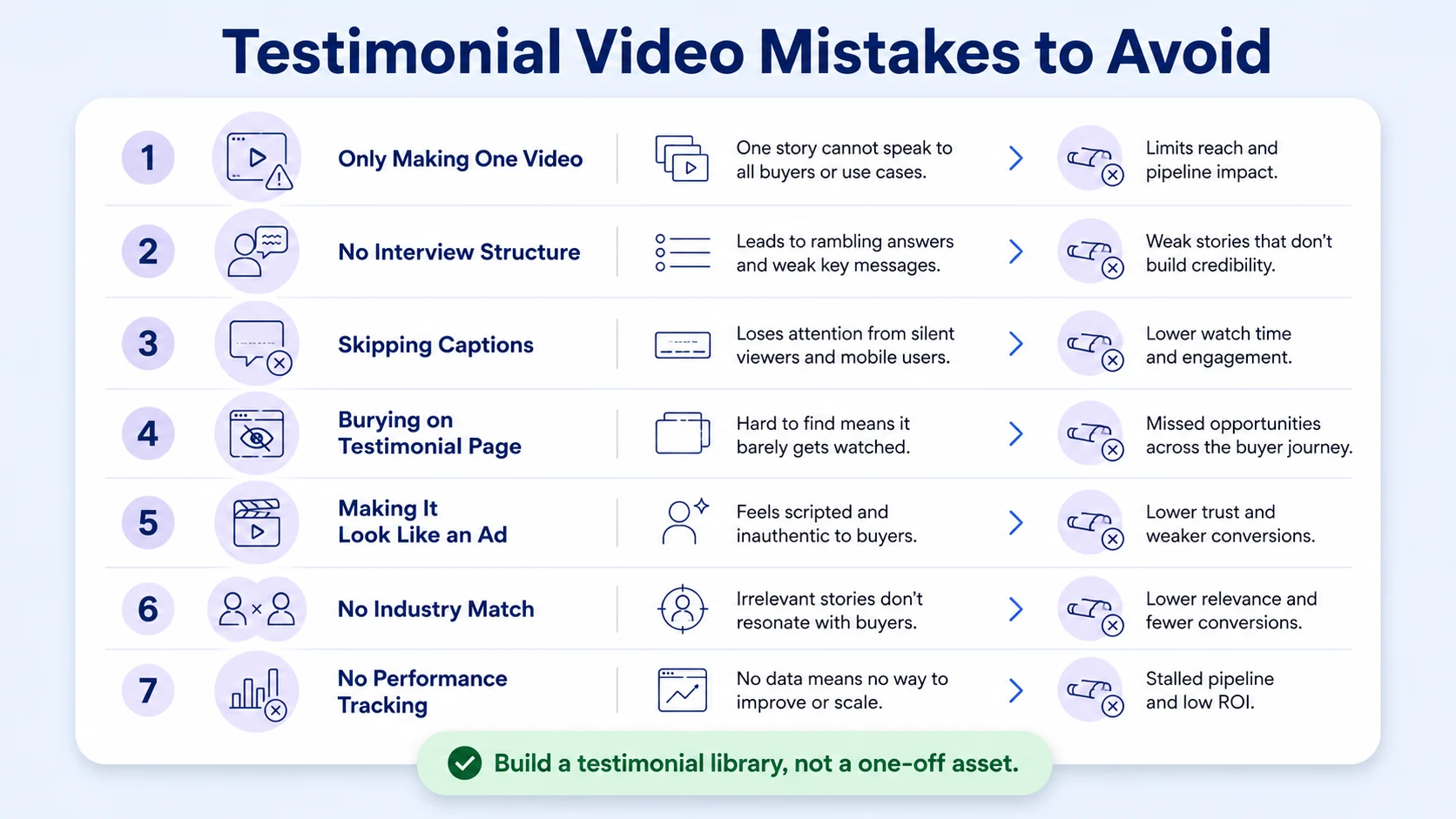
- Producing one video and calling it done. One testimonial covers one industry, one use case, one persona. You need a library organized by vertical, role, and outcome to support a full sales motion.
- Letting customers ramble without structure. Without pre-interview briefing, you get five minutes of unfocused content that takes 10 hours to edit into something usable. Brief every speaker before the shoot.
- Skipping captions. This is a non-negotiable in 2026. Silent autoplay is the default on every major platform.
- Burying testimonials on a testimonials page. A dedicated "customer stories" page that lives three clicks deep gets almost no traffic. Testimonials are embedded in context, on product pages, pricing pages, and in email sequences.
- Making it look like an ad. Authentic customer videos build stronger trust and engagement than polished brand-produced content. Over-produced testimonials with teleprompters and scripted lines backfire. Real environments and natural speech outperform studio gloss every time.
- Ignoring industry matching. A cybersecurity company does not convert a fintech prospect with a retail testimonial. Match the speaker's context to the viewer's context. Every time.
- Failing to track performance. Use analytics tools like YouTube Studio, HubSpot, or Wistia to track user behavior and conversion paths. If you don't know which testimonials are generating pipeline, you can't improve the program.
The teams that build consistent customer testimonial videos for B2B into their content system, not as one-off projects but as a repeatable production workflow, are the ones that see sustained pipeline impact.
Conclusion
Customer testimonial videos for B2B are the most direct form of purchase-intent social proof available to SaaS and tech teams. The data, the buyer psychology, and the funnel mechanics all point in the same direction.
Key takeaways:
- Keep videos between 45–90 seconds for maximum completion and always produce a 15-second cut.
- Use the Challenge-Action-Result framework and industry-matched speakers.
- Deploy across the full funnel: LinkedIn, email sequences, landing pages, and post-demo follow-ups.
- Track performance via HubSpot or Wistia and build a library, not a single video.
If your team has existing webinars, podcast recordings, or customer calls, there is already raw testimonial material ready to repurpose. Get in touch with Komet Media and we'll turn it into a conversion-ready asset system.
Frequently Asked Questions
Q1: What is a customer testimonial video for B2B?
A B2B testimonial video is a short structured video featuring a real customer explaining the problem they faced, why they chose your solution, and the specific result they achieved. It is a peer-to-peer proof asset used to support buying decisions at the consideration and decision stages of the funnel.
Q2: How many testimonial videos does a B2B company actually need?
More than most teams think. You need at least one testimonial per core industry vertical you sell into, one per primary buyer persona (e.g., founder, VP of Marketing, Head of Sales), and one per key use case. A working library of 8–12 videos covers most ICP combinations.
Q3: Can we repurpose existing customer calls or webinar recordings as testimonials?
Yes, and this is one of the fastest ways to build a testimonial library. Recorded discovery calls, QBRs, customer podcasts, and webinar Q&A segments often contain highly authentic, conversion-quality soundbites. A short-form video editing workflow can extract and format these clips for every channel.
Q4: What's the best platform to post B2B testimonial videos in 2026?
62% of B2B marketers say LinkedIn is their most effective platform for video distribution.
Post natively on LinkedIn first. Also embed on your website's highest-intent pages and deploy via email. YouTube functions as a secondary SEO and search discovery channel.
Q5: Should testimonial videos be professionally produced or raw and authentic?
Both can work, but authenticity consistently outperforms polish. A well-lit interview in a real office with clear audio will outperform a studio-produced, scripted testimonial almost every time. Invest in audio quality above everything else, bad audio kills credibility faster than any visual issue.
Q6: How do I measure whether my B2B testimonial videos are actually driving the pipeline?
Track engagement in Wistia or HubSpot by embedding videos on key pages and monitoring watch time, drop-off rate, and downstream form fills. In sales sequences, monitor reply rates and meeting booked rates on emails that include a testimonial versus those that don't. Closed-won deal surveys should ask buyers which content influenced their decision.